
Facebook Marketplace Vs. eBay: Which Wins For Sellers? (2026)
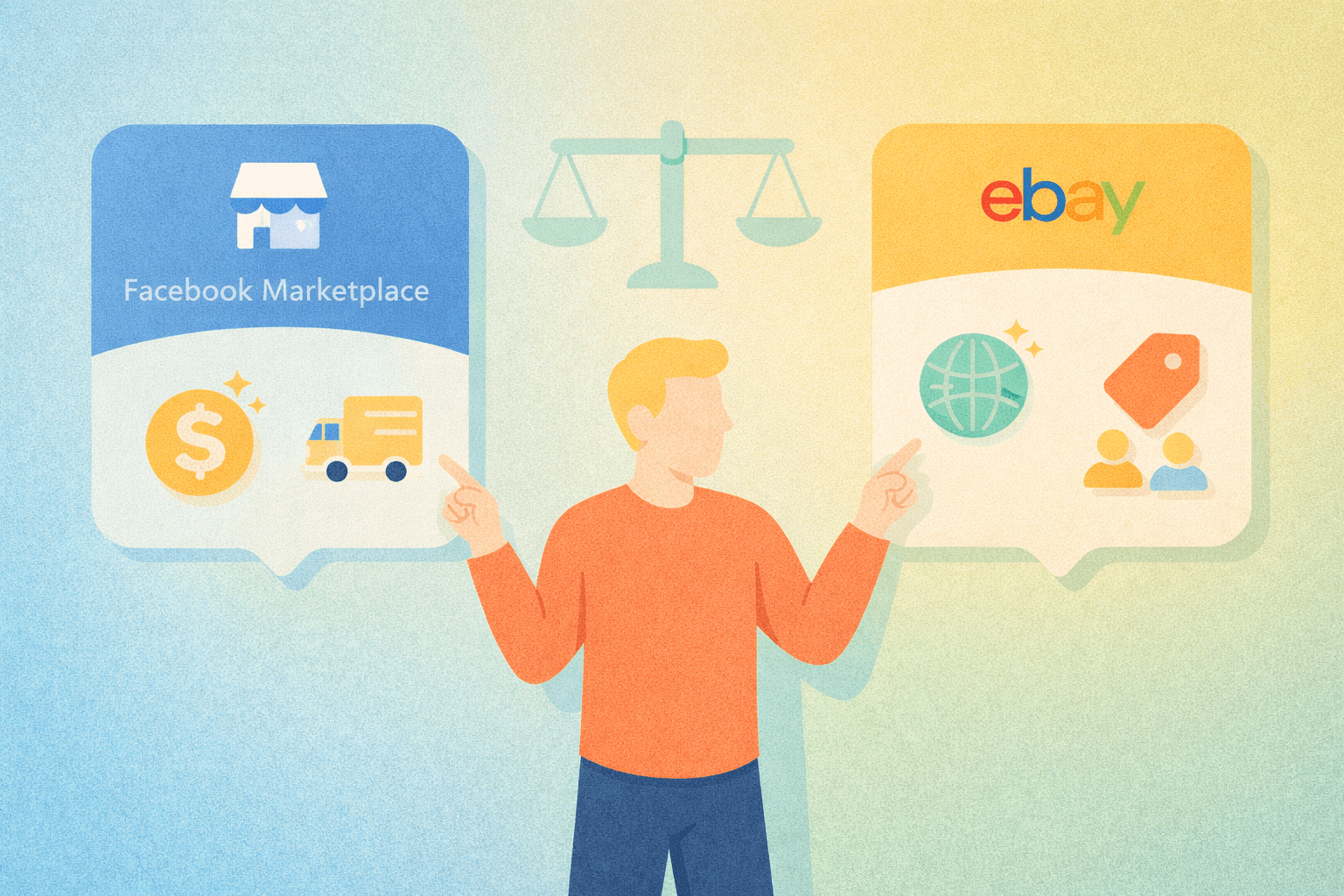
I've sold hundreds of items across Facebook Marketplace and eBay over the past 3 years. My breakdown of Facebook Marketplace vs. eBay covers fees, buyer behavior, shipping costs, and payout times.
Facebook Marketplace vs. eBay: The quick answer
Facebook Marketplace is widely used for local sales, especially for bulky items like furniture, where buyers and sellers meet in person. eBay has nationwide and international reach, appealing to sellers with a variety of items. It also offers seller tools and sales-protection policies.
Facebook Marketplace vs. eBay: At a glance
| Platform | Facebook Marketplace | eBay |
|---|---|---|
| Best for | Local sales needing fast pickup | Buyers from all locations seeking niche goods |
| Fees | No local fees, 10% if sold via the platform | 13–15% + listing fee + $0.30–$0.40 transaction fee |
| Strengths | Instant payouts for local sales, simple listings, easy messaging | Worldwide reach, auctions, strong seller tools |
| Weaknesses | No international shipping, low buyer intent, slow payouts | Higher fees, strict return rules |
| Ideal sellers | Bulky item sellers in local areas | Collectible or high-volume product sellers |
What is Facebook Marketplace?
Facebook Marketplace is a peer-to-peer selling platform built into Facebook that connects you to other Facebook users. You list items directly from your Facebook account. Buyers browse listings by location, category, and price.
Although Marketplace is popular for local sales, it also offers nationwide shipping in many regions. International use depends on Facebook’s availability and local policies.
What is eBay?
eBay launched in 1995 and gives you access to more than 130 million buyers around the world. It works well for resellers and small shops specializing in collectibles, electronics, and vintage items.
The platform offers seller-friendly features and tools. You can post items with fixed prices or auctions and use built-in eBay seller analysis tools like Product Research. Tools like Promoted Listings help you improve item visibility.
Facebook Marketplace vs. eBay: Audience reach and buyer intent
| Platform | Best for | Buyer intent | Audience size |
|---|---|---|---|
| Facebook Marketplace | Bulky items needing local pickup | Mostly casual shoppers with low intent | Large local reach, social-driven browsing |
| eBay | Niche items, collectibles, brand goods | High-intent buyers researching carefully | Global reach across 190+ markets |
Facebook Marketplace: Audience reach and buyer intent
Facebook Marketplace reaches over 3 billion Facebook users, but is actively used by about 1 billion people each month, letting folks in your area browse for local deals. Many buyers browse casually for bargains and quick local pickups.
Because the platform allows communication via Facebook Messenger, buyers and sellers can easily arrange meetups, drop-offs, or pickups. Marketplace supports offering bulkier items that might be expensive or difficult to ship. Many buyers are folks looking for appliances, couches, and outdoor equipment.
You can also sell items directly to buyers outside your area, as long as they are within the continental U.S. Facebook processes these transactions on its platform. Plus, you can use Facebook Ads to expand your marketing efforts.
eBay: Audience reach and buyer intent
eBay draws a wide mix of shoppers across nearly every category, from collectors to deal-focused buyers. These folks are searching for rare pieces, used items, and lower-cost name brands. The platform’s search filters help buyers find niche products and specialty items with great precision.
Folks looking to purchase on eBay come from all over the world, as the platform serves over 190 markets.
Buyers on eBay have clear purchase intent and expect full item details, strong photos, and, when warranted, solid proof of authenticity. These buyers compare listings closely and pay attention to seller feedback before they commit.
In many item categories, negotiation is common, thanks to auction listings and the Make Offer option. However, you can still list items with a “buy now” feature.
Want to know how to sell to more buyers on eBay? Our article guides you through 20 seller tactics.
My verdict
eBay wins for audience reach and buyer intent. The platform’s buyers arrive from all over the globe with clear intent, research listings carefully, and compare seller feedback before committing. However, Facebook Marketplace works well if you’re trying to sell bulky, difficult-to-ship goods to buyers in your area.
Facebook Marketplace vs. eBay: Seller fees and payouts
| Platform | Ideal sellers | Payout speed | Fee structure |
|---|---|---|---|
| Facebook Marketplace | Local sellers wanting instant payments | Up to 20 days | No local fees, 10% on items sold through the platform |
| eBay | High-volume sellers need consistency | 1 to 3 days after the buyer’s payment clears eBay’s system | 13–15% fees with caps, possible listing fee, $0.30–$0.40 transaction fee |
Facebook Marketplace: Seller fees and payouts
Facebook Marketplace charges zero fees for local pickup transactions, letting you keep every dollar. You can get paid instantly with cash, Venmo, or Zelle.
Facebook charges a 10% fee (or a $0.80 minimum) on shipped orders processed through Marketplace Checkout, which is deducted from your payout. The payout process starts 15 days after you mark the item as shipped, or 5 days after the system confirms the buyer has received it.
After the payout process starts, you may have to wait up to 5 days for the money to hit your account. This means you could wait up to 20 days from the moment you mark the item as shipped for the funds to appear.
eBay: Seller fees and payouts
eBay gives non-retail sellers up to 250 free listings each month. After that, you pay a listing charge of $0.35 per item. Final value fees on eBay vary by category and typically range from 13–15% of the final sale price, including shipping and taxes.
For many items, eBay caps its fees after you reach a specific amount. For instance, eBay caps the 13.6% on sales of “Most category” items (clothing, household goods, etc.) at $7,500. For every dollar you sell above $7,500 in that category, eBay takes only 2.35%.
You also pay a small processing charge of around $0.30–$0.40 per transaction.
Once the buyer’s payment clears, eBay usually sends your payout to your bank within 1 to 3 business days.
My verdict
Facebook Marketplace is the winner. It works best for fast local sales with no fees and instant payouts for local pickups. You avoid listing charges and pay only a small fee if you choose to ship, but there's a downside: A potentially long wait time for a payout. eBay costs more, but its fee caps, predictable structure, and quick payouts make it the stronger choice for many sellers.
Facebook Marketplace vs. eBay: Shipping and return policies
| Platform | Shipping options | Return rules | Coverage limits |
|---|---|---|---|
| Facebook Marketplace | USPS or UPS prepaid labels only | Buyer claims allowed under Purchase Protection | U.S.-only shipping with strict timelines |
| eBay | USPS, UPS, FedEx; international shipping | Returns are allowed for about 30 days (typically) | Global reach with seller-set shipping rates |
Facebook Marketplace: Shipping and return policies
Facebook Marketplace’s policy requires sellers to ship items within 7 calendar days from the sale. You must mark items as “shipped” and add tracking, or the system automatically cancels the order.
Marketplace lets eligible sellers use prepaid USPS or UPS shipping labels, with shipping costs typically paid by the buyer unless you choose to cover them. Creating or confirming a prepaid label automatically marks the order as shipped and adds the tracking number to the order.
The platform doesn’t have international shipping. It only offers shipping in the continental United States.
Purchase Protection and your stated return policy cover shipped orders placed through Facebook’s onsite checkout. For most delivery issues, buyers typically have 45 days to open a claim (and longer for unauthorized charges).
Sellers must respond to buyer refund requests within 2 business days. If a resolution is not reached and Meta issues a refund decision, sellers have 10 calendar days to appeal that decision before the refunded amount is sent to the buyer.
eBay: Shipping and return policies
eBay lets sellers ship through USPS, UPS, or FedEx and set their own rates or offer free shipping. eBay also provides discounted labels with tracking and optional insurance.
The platform supports international shipping through its eBay International Shipping program. eBay handles customs, delivery, and added protections for both parties.
Under the eBay Money Back Guarantee, sellers generally must accept returns requested within about 30 days if items aren’t received or don’t match the listing. eBay expects buyers to return items in the same condition that they were received. If items come back used or damaged, sellers may be allowed to deduct some value from the refund.
Return shipping depends on the reason for return and the seller’s stated policy.
My verdict
eBay wins for shipping and return policies thanks to greater carrier flexibility, discounted labels, and international shipping support. Even though eBay's Money Back Guarantee heavily favors buyers, sellers get 30-day return windows and can set their own shipping rates.
What real users are saying
I searched sites like Trustpilot, Reddit, and the Better Business Bureau to find honest user feedback comparing Facebook Marketplace vs. eBay. Here’s what folks are saying:
Facebook Marketplace pros
- Works well in big cities: A big-city dweller reported that Facebook Marketplace works reliably for them. They’ve made in-person and shipped deals ranging from $10 to $1500 without major issues. (October 23rd, 2025)
- Making a steady income on Marketplace: A user shared that they earn a few hundred dollars a week selling women’s clothing on Facebook Marketplace. They avoid issues by checking buyer ratings and setting clear boundaries to reduce no-shows. (October 23rd, 2025)
- Good mix of shipping and in-person sales: One user explained that selling on Facebook Marketplace has mostly been positive after a few years. While flakes and lowball offers pop up, they simply block offenders, avoid delivery, and meet buyers at safe locations. (October 17th, 2025)
Facebook Marketplace cons
- Crickets on Marketplace: Someone shared that they got more responses about a motorcycle listing on another platform, while Facebook Marketplace produced none. (June 10th, 2025)
- Data protection not ideal: A user warned that Facebook’s data sharing can lead to spam, scams, or even doxxing. They advised using software that masks their personal data. (October 17th, 2025)
- Unreliable buyers: One user vented that most of their Facebook Marketplace experiences involve lowball offers, ghosting, or unreasonable demands. The user said these interactions highlight why sales there are often frustrating. (October 24th, 2025)
eBay pros
- Easier than Facebook Marketplace: One user noted that eBay delivers better results than Facebook Marketplace, mainly because it avoids lowball offers and awkward interactions. (June 9th, 2025)
- Seller Hub boosts user experience: An eBay seller shared that Seller Hub makes the interface easier to move through. (October 12th, 2024)
- Steady track record for solid finds: A longtime eBay buyer shared that the platform has provided dependable, well-made products for over a decade. (July 12th, 2025)
eBay cons
- Weak customer support: A user explained that eBay’s support often falls short, leaving cases open and offering no follow-up after saying they would handle the issue. (August 7th, 2025)
- Slow payouts and pricey shipping labels: A seller said eBay holds their funds for too long, even though the payment comes in right away. They also felt that eBay’s shipping labels are too expensive. (November 7th, 2025.
- Frustrating fees and authentication: A user complained that eBay takes too much of their earnings and said the platform often mishandles shoe authentications. (November 25th, 2025)
When to use Facebook Marketplace or eBay
Both Facebook Marketplace and eBay serve sellers targeting different buying groups. Follow these directions when choosing which platform to use:
Use Facebook Marketplace if …
- You sell bigger items: Furniture makers, woodworkers, and surfboard builders, this one’s for you. Facebook Marketplace is excellent for selling large, bulky items that require local pickup. Buyers expect in-person exchanges, which reduces shipping headaches and keeps your workflow simple.
- You want to reach nearby buyers quickly: Facebook Marketplace’s algorithm makes new listings discoverable to local shoppers. Plus, you can use Facebook ads to boost your listings and reach even more buyers.
- You want to avoid selling and shipping fees: Choose Facebook Marketplace when you want to keep more profit on local deals. Most in‑person transactions have no platform selling fees, and you only pay a 10% fee (with a small minimum) on eligible shipped orders processed through Marketplace Checkout.
Use eBay if …
- You offer a variety of items: eBay caters to sellers who move specialty items such as retro tech, vintage finds, collectible pieces, or even vehicles. The platform gives these categories steady buyer interest and strong turnover potential.
- You want a chance to increase prices with bids: eBay’s auction setup lets buyer demand drive the final price through active bidding. This approach applies to rare goods, collectible items, and anything with an unpredictable market value.
- You want to sell to buyers outside your area: The platform’s global audience helps you move products that might take weeks to sell locally. You can ship items (almost) anywhere, expanding your demand pool and increasing the likelihood of stronger final sale prices.
Facebook Marketplace vs. eBay: My final verdict
Facebook Marketplace works best if you sell large items that are tough to ship. You reach nearby buyers who can make quick pickups, which helps you move furniture, home goods, and everyday products without shipping.
eBay is a traditional online marketplace: It’s best for selling collectibles, rare products, or anything that attracts niche buyers. The global audience and auction tools help you find the right buyers. You just need to factor in eBay’s numerous seller fees.
Your choice depends on what you list. If you’re aiming for global reach and sell unique items that ship easily, go with eBay. Facebook Marketplace fits sellers who want simple, fast, local transactions. My advice is to list items on both platforms and see what sticks.
Increase your eBay profits with Nifty
Now that you’ve compared Facebook Marketplace vs. eBay, it’s time to put your selling strategy into action. If you want a crosslisting tool that helps you win on multiple marketplaces, choose Nifty. You can list and manage your items from eBay, Etsy, Poshmark, and other platforms all in one place.
Here’s why over 10,000 resellers choose Nifty:
- AI listing: Snap a pic and let Nifty’s AI build a high-performing listing with SEO-ready titles, clean descriptions, trending hashtags, and every dropdown filled out for you. It’s cloud-based, mobile-friendly, and simple to use.
- Crosslist now: With a couple of clicks, post your items across Poshmark, eBay, Mercari, Depop, and Etsy. No copy-paste. No multi-tab Chrome extensions. Everything runs in the background. (More marketplaces coming soon!)
- Automatic delisting? Handled: When you make a sale, Nifty’s sales detection auto-delists that item from every marketplace. You avoid double-selling issues and awkward “it’s already gone” messages.
- Bulk tools = no busywork: Share and relist daily without lifting a finger. Update or discount dozens of items at once. You can even schedule drafts to go live while you sleep.
- Analytics and profits are real: Track sales, fees, top performers, and slow movers in one clean dashboard so you can see what works and what wastes space.
Nifty pays for itself in a few weeks, so what are you waiting for? Try a 7-day free trial today.
FAQs
1. What items sell better on Facebook Marketplace vs. eBay?
Difficult to ship items sell better on Facebook Marketplace, whereas vintage, retail, and niche items sell best on eBay. Facebook Marketplace excels at moving furniture, appliances, exercise equipment, and bulky household items. eBay performs better for collectibles, electronics, sneakers, rare finds, and anything that ships easily to distant buyers.
2. Which platform has lower fees, Facebook Marketplace or eBay?
Facebook Marketplace has lower fees than eBay. It charges zero fees for local pickup transactions and only 10% for shipped items sold through Marketplace Checkout. eBay charges 13–15% final value fees, plus $0.35 per listing after 250 free listings, and $0.30–$0.40 in transaction fees.
3. Should I list on both eBay and Facebook Marketplace?
Yes, you should list on both eBay and Facebook Marketplace to maximize reach and sales opportunities. Each platform attracts different buyers: Facebook works for local, bulky items with instant payouts, while eBay reaches global collectors and niche shoppers. Using both marketplaces diversifies your income stream and reduces reliance on a single platform.


.png)
.png)
.png)