Is OfferUp legit? Seller safety, scams, and fees (2026)
OfferUp is legit. The app lets you sell items locally with face-to-face purchases. But scammers can trick you with fake payments, suspicious messages, and dishonest offers.
I reviewed OfferUp’s safety rules, fees, and seller feedback from Reddit, Trustpilot, and Facebook. By the end, you’ll know 5 common scams, how to avoid them, and what to do if something goes wrong.
Is OfferUp legit?
Yes, OfferUp is a legit marketplace. It ended nationwide shipping in October 2025, so every sale now happens face-to-face, and the risk sits in who you meet and how they pay.
Is OfferUp safe for sellers?
Yes, OfferUp is generally safe for sellers. Since OfferUp now supports local pickup only, sellers must arrange safe meetups and check payments themselves. OfferUp recommends using approved meeting spots that you can find on the OfferUp app. If you can’t make it to one of those approved meeting spots, use a busy, well-lit public area.
OfferUp doesn't recommend meeting at your home, and it suggests meeting during regular business hours, in daylight wherever possible. For a couch or dresser that's too big to move, OfferUp suggests meeting the buyer at a Community MeetUp Spot first, then sharing the pickup location only if you feel comfortable.
Who should sell on OfferUp?
Sellers offering large, bulky items that don’t ship well should sell on OfferUp. Here are some of the typical seller types:
- Local furniture sellers: Bulky items like couches, dressers, and tables work well for local pickup. Buyers handle transportation, while sellers arrange collection times.
- Electronics sellers: Used phones, consoles, and laptops attract buyers who want to inspect devices before paying. But you need to show that everything works.
- Casual sellers: Clearing out closets and garages gives occasional sellers a way to earn extra cash and free up space.
- High-volume resellers: Regular inventory sales require careful planning around buyer messages, listing limits, and pickup schedules. Flippers can arrange several transactions on the same day.
5 common OfferUp scams sellers should watch for
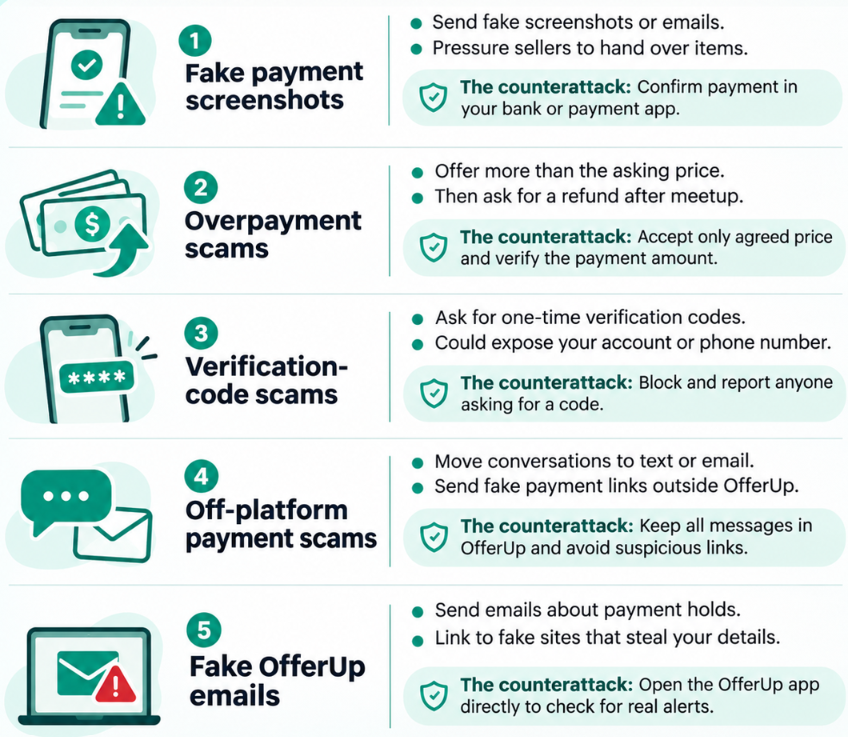
OfferUp sellers face scams such as fake payment screenshots and overpayment scams. Here’s a look at the popular scams:
1. Fake payment screenshots
Scammers send fake screenshots or emails showing payments that never arrived. They may use bank logos and pressure sellers to hand over items quickly. Always check your bank or payment app before handing over an item.
The counterattack: Never trust a buyer's screenshot alone, even if it looks like a real Cash App receipt. OfferUp recommends sellers only accept cash. App payments like PayPal, Zelle, or Venmo are safer than checks or gift cards but still carry risks. If you do take an app payment, confirm that it’s in your account before handing over the item.
2. Overpayment scams
An overpayment scam happens when a buyer sends more than your asking price, often by check or a payment app before you meet, then asks you to send back the difference. The original payment is fake or gets reversed, so you lose the money you sent back, and sometimes the item too. For example, a buyer "pays" $500 for a $350 couch and asks you to return the extra $150.
The counterattack: Accept only the agreed price and refuse requests to send extra money back. If the buyer pays by transfer, always confirm the amount they pay by checking your app. For large cash payments, count the money carefully; if you can, invest in a cash-counting machine.
3. Verification-code scams
Scammers may ask for one-time verification codes to confirm a listing or prove you're real. Sharing a code can let a scammer take over your account or link a Google Voice number to your phone number. OfferUp doesn't send verification codes to verify listings, so treat any buyer who asks for one as a scammer.
The counterattack: Block and report anyone asking for a code to “prove you're human.”
4. Off-platform payment scams
Scammers may move conversations to text or email before sending fake payment links. OfferUp recommends keeping all messages in its app and warns that asking to move the chat off OfferUp is a common scam tactic.
The counterattack: Keep all messages inside OfferUp and refuse mailed checks or suspicious payment links.
5. Fake OfferUp emails
Scammers send emails that look like OfferUp messages about payment holds or account problems. These emails may link to fake websites that steal passwords or bank details. Open OfferUp directly to check your account. For example, an email demanding a $50 business upgrade fee before releasing payment is a warning sign of fraud.
The counterattack: Open the OfferUp app directly to check for real account alerts. Never enter passwords or payment details through links in unexpected emails.
Is OfferUp safe for buyers?
Yes, OfferUp is safe for buyers. Buyers can lower their risk on OfferUp by checking the seller’s profile, meeting at an official Community MeetUp Spot, and inspecting the item before paying. Never send a deposit or down payment before the meetup. OfferUp notes that paying before you meet puts you at risk for fraud, so pay in person after you've inspected the item.
Buyers can look at ratings and account history to judge a seller. You can also use TruYou, OfferUp's identity verification program that adds a badge to approved profiles.
You still need to be careful. The TruYou badge only shows that someone completed OfferUp's verification process, but it doesn't guarantee honest behavior.
Let’s say you’re buying a used iPhone. During hand-off, test its features and check if it is locked to one phone carrier. Before paying, ask the seller to erase the phone and start setting it up again. Make sure it doesn’t ask for the previous owner's Apple Account details.
What should you do if you get scammed on OfferUp?
If you get scammed on OfferUp, immediately stop communicating with the scammer and save all the evidence. Follow these steps:
Step 1: Stop communicating with the scammer
Stop replying as soon as you spot the scam. Scammers will only make it worse: They’ll promise refunds, ask for more money, or make threats to keep you talking. Don’t send them anything else.
Save all chat info before you block and report the account. If a scammer broke into your OfferUp account, change your password right away.
Step 2: Save messages and transaction evidence
Take screenshots of chats, usernames, listing links, payment confirmations, and bank records. Do this quickly since messages and listings could disappear. This proof helps everyone who looks into your case. Write up a quick 100-200 word summary of what happened to paint a clear picture for the OfferUp team.
For instance, say you gave a scammer a verification code. Keep the message that asked for it, plus every alert your bank or account sent afterward.
Step 3: Report the account to OfferUp and your bank or payment provider
Open the scammer's profile and submit a report explaining what happened. Include relevant details and save screenshots as evidence. OfferUp reviews reports and may take action against accounts that violate its rules.
When a scammer takes your money, contact your bank or payment app immediately to ask about recovery options. Tell them exactly what happened.
Ask them to dispute the charge, stop a pending payment, or recover the money you sent. Federal rules may protect some electronic transfers you didn’t approve. But money you chose to send to a scammer is harder to get back.
If you suspect a buyer handed you counterfeit cash, report the incident to local police and OfferUp.
Step 4: Report identity theft or financial fraud if necessary
Report the scam at ReportFraud.ftc.gov or to the FBI’s Internet Crime Complaint Center at IC3.gov.
If someone stole your identity, go to IdentityTheft.gov for a recovery plan. Call your carrier immediately if a scammer took over your phone number; a local police report helps too. Keep copies of every report and reference number for later.
OfferUp seller fees: What you need to know
OfferUp lets sellers list items for free, but limits them to 200 listings per month. A few categories have their own smaller allowances that don't count toward the 200, such as 15 for appliances and 25 for furniture.
When you run out, you can buy extra listings, priced by category, or wait until your free listings reset on the first of the month.
Sellers can also pay to promote listings. Promote Plus costs $19.99 per month or $99.99 per year. It promotes one item at a time. You can also switch which item gets promoted.
Pros and cons of selling on OfferUp
I checked out real user reviews of OfferUp on sites like Facebook, Reddit, and Trustpilot:
OfferUp pros
- Large items sold quickly through local listings: One seller reported continued success using OfferUp for larger items. (OfferUp seller, Facebook, February 16th, 2026)
- Quick listings and reliable buyers impressed seller: A YouTuber praised OfferUp's easy listing process and fast sales of smaller items within two days. Verified buyers and designated meeting locations made local transactions feel safer and more dependable. (GigaBits, YouTube, November 9th, 2025)
- Scammers rather than OfferUp caused problems: One reviewer defended OfferUp, attributing negative experiences to dishonest users rather than the platform itself. Checking profiles and assessing suspicious behavior helped buyers and sellers avoid potential scams. (Alwyn J., Trustpilot, March 10th, 2025)
OfferUp cons
- Lowball offers drove sellers away: After getting too many lowball offers, one seller stopped using OfferUp. (Alice M., Facebook, October 30th, 2026)
- Removed shipping and excessive ads hurt usability: A seller complained about OfferUp's discontinued shipping, poor search, and excessive advertisements. (OfferUp seller, Reddit, September 25th, 2026)
- Overpriced listings and inactive sellers ruined shopping: One buyer struggled with retail-level prices, unanswered messages, and listings abandoned for years. (OfferUp buyer, Reddit, July 7th, 2026)
Final verdict: Should I sell on OfferUp?
You should sell on OfferUp if your items work well for face-to-face pickup. The platform is legit, and it takes no cut of in-person sales. Some extra features cost money, but they’re optional.
But you’ll still face scams such as fake payment confirmations, and you’ll always need to meet in safe places.
Lower those risks with a few simple habits. Only meet in public places recommended by OfferUp. If none are available, choose a busy, well-lit location. Keep all your messages inside the OfferUp app, and check every payment yourself.
Sell more with Nifty
OfferUp is legit, but it’s a local-only marketplace, so every sale depends on who shows up and how they pay. If you want to list on other marketplaces, try Nifty. It’s a crosslisting and automation tool that lets you manage your items for eBay, Etsy, Poshmark, and other platforms all in one place.
Here’s why Nifty’s so helpful:
- Customized AI listings: Upload photos and let Nifty generate search-optimized titles, descriptions, and item details, so the furniture or electronics you’d sell locally are ready for buyers nationwide. Review the draft, then use custom instructions to shape its writing style.
- Crosslist now: List eligible items across eBay, Etsy, Poshmark, Whatnot, Mercari, and Depop from one platform, without having to re-enter details on each marketplace. Marketplace access and features depend on your connected accounts and plan.
- Bulk crosslisting: Select multiple existing listings in Nifty, choose your target marketplaces, pricing, and shipping, then save the AI-generated results as drafts or publish them.
- Marketplace-specific Pricing Rules: Set a primary marketplace and rules for how prices should change on other marketplaces, so you don't have to calculate every crosslisted price from scratch.
- Built-in auto-delisting: Enable auto-delisting, and Nifty can remove an eligible sold item from your other connected marketplaces, helping reduce the risk of selling the same item twice.
- Bulk tools = less busywork: Relist selected items in batches, schedule ready-to-publish drafts, and use supported automations to handle recurring selling tasks.
- Analytics and profits, made clear: Track sales, fees, and profit across your connected marketplaces, plus your top-selling categories. On Crosslisting and Bundle plans, set seller goals and check your progress from Nifty’s home screen.
Start with a 7-day free trial and see how Nifty can help you reach buyers beyond your zip code. And if you’re selling on Depop, eBay, Etsy, or Whatnot in the UK and Australia, Nifty is now available.
Note: Nifty doesn’t connect with OfferUp, so you’ll still post and manage OfferUp listings in the OfferUp app.
FAQs
1. Is OfferUp safer than Facebook Marketplace?
OfferUp can be safer than Facebook Marketplace for local deals because it offers TruYou identity verification and official Community MeetUp Spots. Facebook has its own trust signal, though: real-name profiles that show a buyer's account history and mutual connections. But both platforms still attract scammers, so meeting in public and confirming payments yourself lowers your risk of losing money on either app.
2. How do you know if someone is legit on OfferUp?
You can tell if someone is legit on OfferUp by checking their ratings, reviews, account age, and TruYou verification badge. A badge doesn’t guarantee honesty, so keep messages in the app. Confirm payments in your bank or payment app to avoid costly fake-screenshot scams.
3. Does OfferUp offer purchase protection?
No, OfferUp doesn’t provide purchase protection. All purchases now take place locally. Buyers and sellers arrange payment directly with cash or app transfers. Cash and Zelle transactions aren't covered by OfferUp's former protection program, and local sales are generally final.
4. Can someone scam you on OfferUp with your phone number?
Yes, someone can scam you on OfferUp with your phone number if you share a one-time verification code. The scammer can use it to take over your account or set up a Google Voice number linked to your phone. Never share a code with a buyer, and block and report anyone who asks for one. Blocking anyone who asks for your phone number can help prevent account takeovers.