
Reseller profit margin: Hit your goals and reduce costs | 2026

Calculate your reseller profit margin by subtracting business and inventory costs as well as seller fees from your final sale price. Although finding this number sounds easy, many beginner resellers struggle because they don’t price competitively or take marketplace fees into account.
Here’s my take on how to calculate your reseller profit margin, the costs that reduce it, what a healthy margin looks like, and how it varies across different marketplaces.
What is reseller profit margin? How do you calculate it?
Reseller profit margin is the percentage of revenue a reseller keeps after subtracting the cost of goods, marketplace fees, and taxes from the item’s resale price. To calculate margin, you use the formula: Net margin = (Revenue – COGS – Expenses) ÷ Revenue
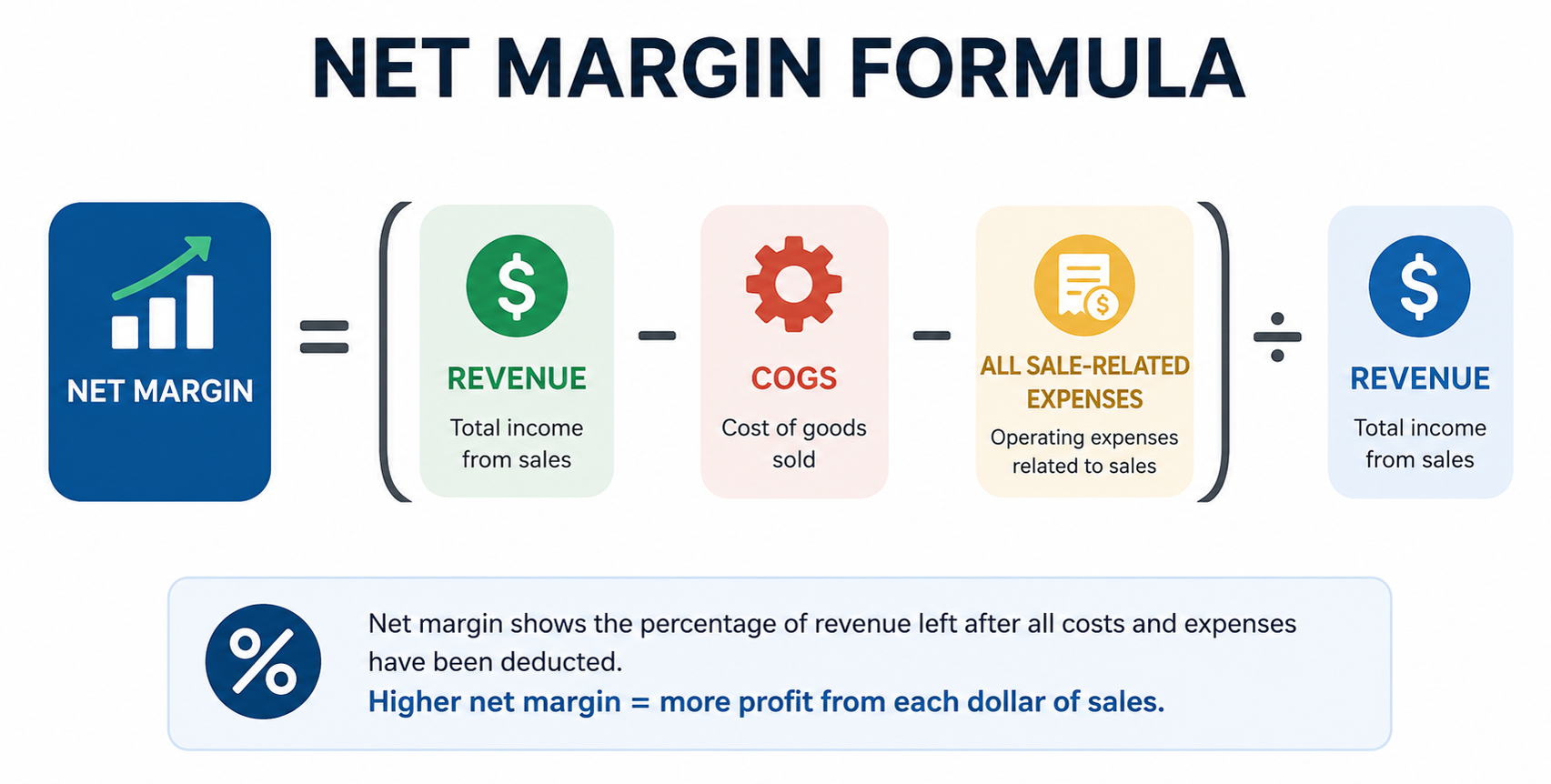
Let's say you buy an Essentials Hoodie for $35 and sell it on Poshmark for $80 (including buyer-paid shipping). Your revenue is $80, but your profit isn't $80 because you still need to subtract the cost of the hoodie, packaging, and Poshmark's selling fee.
You’ll need to take the following into account:
The cost of goods sold (COGS) includes the purchase price and the price of packaging material: $35 + $5 = $40
Poshmark’s 20% fee (taken from final sale price): $16
Total costs: $56
Profit: $24
Profit margin: 30%
Keep in mind that profit margin is always expressed as a percentage (%) and never a dollar amount ($).
What reduces reseller profit margins?
Expenses that reduce reseller profit margins range from paying high prices for items to high marketplace and payment processing fees. Here’s a look at what reduces your reseller profit margins:
- Inventory costs: Sometimes, you pay too much for an item that has little resale value. Worse yet, unsold stock takes up space, and sometimes, you sell it at a loss. Avoid this by researching similar items and how long they stay listed.
- Marketplace commission and payment processing fees: Platforms usually take a cut, which ranges from as little as ~3% to over 20%. Always take fees into account before listing, and set your prices according to how much recent items sold for. Add ~20% to account for bartering.
- Shipping costs: If you offer free shipping, build that cost into your sale price. Estimate shipping costs to different regions ahead of time so you don't accidentally cut into your profit margin.
- Packaging supplies: Buy them in bulk, then spread that cost across the items you sell. For example, if you spend $100 on shipping supplies and use them to ship 20 items, budget an expense as a COGS of $5 per item in your reseller bookkeeping.
- Returns and refunds: Returns almost always reduce your profits. The best way to prevent them is by using clear photos and honestly describing any flaws in your listing. Use a quality photo-editing tool to improve lighting and clarity, but never edit out damage or defects.
- Business expenses: Multi-channel listing software subscriptions, storage costs, and other business expenses like licenses are part of running a resale business. Like with packaging supplies, average these costs across the items you sell as one of your COGS so each sale reflects its share of your operating expenses.
- Confusing profit with profit margin: Profit measures dollars earned from a sale, while profit margin measures profitability as a percentage. Mixing them leads to poor pricing decisions. Track both metrics separately by calculating profit in dollars first, then converting it into a profit margin percentage before evaluating each sale.
What is a good reseller profit margin?
A good reseller profit margin is usually 10–50%, depending on your business model and level of experience. New sellers often start in the 10–20% range while learning to source and price effectively. This is a normal part of the learning curve, not a sign of failure.
However, margins under 10% become difficult once fees, shipping, returns, and bad buys hit and start eating into sustainability.
- Typical beginner margins: New resellers often earn profit margins of 10–20% after paying for inventory, selling fees, and shipping. Poor purchases can quickly wipe out your profits, so focus on making steady, repeatable sales instead of chasing risky flips.
- Part-time reseller margins: Part-time resellers need margins that make their time worthwhile. 20–40% is a solid goal if you’re working ~20 hours per week by sourcing, creating listings, packing orders, and helping customers.
- Full-time reseller margins: Full-time resellers usually have more expenses, such as software, supplies, storage space, or employees. But they also know how and where to source cheap products to get margins of 30–50%+.
Note: These are general benchmarks. Low-fee or high-markup categories, like Etsy handmade goods or Facebook Marketplace local pickups, can exceed 50%, as shown below.
Reseller profit margin by marketplace
Reseller profit margins vary greatly, mainly determined by the marketplace you choose to sell on. Each marketplace attracts a different target audience, and is best for listing different products. Here’s a look at each one:
| Marketplace | Best inventory type | Buyer profile | Typical fees | Typical net margin |
|---|---|---|---|---|
| eBay | Collectibles, electronics, automotive, everything | Price-conscious; looking to negotiate | ~13–15% | 15–35% achievable |
| Etsy | Handmade, vintage, personalized goods | Quality-focused; gift shoppers | 6.5% + $0.20 listing fee; processing fees 3% + $0.25 in the U.S.; Offsite Ads 12–15% | 30–60% achievable |
| Mercari | Used household goods, apparel | Bargain hunters seeking convenience | 10% flat rate | 15–30% achievable |
| Poshmark | Fashion, shoes, accessories, luxury | Brand-focused fashion shoppers | $2.95 on sales under $15; 20% on $15+ | 20–40% achievable |
| Depop | Vintage clothing, streetwear, Y2K | Trend-driven younger fashion buyers | 3.3% + $0.45 payment processing | 25–50% achievable |
| Facebook Marketplace | Furniture, local pickup, bulky items | Local buyers avoiding shipping | 0% in person; 10% on platform | 30–60% achievable |
| Whatnot | Collectibles, trading cards, live auctions | Community-driven impulse buyers | 4–8% + 2.9% + $0.30 | 20–40% achievable |
How to increase your reseller profit margin
Increase your reseller profit margins by crosslisting to other platforms, bundling, and tracking your inventory. Here’s how:
- Crosslist inventory: One of the best ways to increase your chances of a higher profit margin is to crosslist on multiple marketplaces. If you’re an established seller, you may also be able to transfer more sales to platforms with lower selling fees, helping you keep more of each sale.
- Bundle products: Single-item listings compete directly on price against identical inventory. Bundling complementary products, such as a hoodie and a hat, attracts buyers looking for a complete purchase while increasing the value of each sale. This strategy can also help you sell inventory faster.
- Track every expense: Margin estimates without real expense data are shots in the dark. Logging fees, shipping, and returns against each sale exposes which listings actually profit. Use a quality software tool that lets you enter your expenses for each item, and automatically calculates profit after it sells on a connected marketplace.
Nifty can help track and grow your reseller profit margins
A healthy reseller profit margin depends on speed, fees, and visibility into where your money actually goes. We built Nifty to protect all three. Track COGS, see how much marketplace fees cut into your profits, and manage all your listings from 6 connected marketplaces on one command center.
Here's why Nifty's so helpful:
- Customized AI listing: Snap a pic and let Nifty's AI build a complete listing, with SEO-optimized titles and descriptions, and trending hashtags already filled out for you. You can even customize how AI writes your listings to follow your unique style.
- Crosslist now: With a couple of clicks, post your items across Whatnot, Poshmark, eBay, Mercari, Depop, and Etsy. No copy-paste clutter and no multi-tab hopscotch. (More marketplaces coming soon!)
- Automatic delisting? Handled: When you make a sale, Nifty's sales detection auto-delists that item from every marketplace. Say goodbye to double-selling disasters and "sorry, it's already gone" apology messages.
- Bulk tools = no busywork: Share and relist daily in just a few clicks. You can even schedule drafts to go live while you sleep and set automatic discounts that run deeper over time.
- Analytics and profits are real: Track sales, fees, top performers, and slow movers in one clean dashboard, so you can actually see what's working and what's just dead space. You can also set and track seller goals directly from your home screen.
Nifty pays for itself in just a few weeks. Start with a 7-day free trial and see how Nifty can help you spot the fees eating your margin and finally price with real numbers instead of guesswork.
FAQs
1. What is a good reseller profit margin?
A good reseller profit margin is typically 10–50%, depending on experience and business model. To hit this range, you need to track your costs, price your items competitively so they sell, and know how much marketplace fees will cut into your bottom line.
2. Is a 50% profit margin good for reselling?
Yes, a 50% profit margin is strong for reselling. It’s usually achieved by full-time sellers or those on lower-fee marketplaces like Depop or Facebook Marketplace. However, you’ll need to source your inventory at very low prices and flip items on marketplaces quickly.
3. What's the difference between markup and profit margin?
Markup compares profit to your cost of goods, while profit margin compares profit to your final sale price. Understanding both avoids pricing mistakes and reduces overselling risk because you know how much you’ll pay in fees and costs before you list.
4. How do I calculate profit after marketplace fees?
Calculate profit after marketplace fees by subtracting your cost of goods, marketplace commission, and shipping or packaging costs from your sale price. Tracking this per item cuts manual updates and avoids stockouts caused by mispriced, unprofitable listings.



.jpg)
.jpg)