
Top 7 Sellbrite alternatives: Expert tested + reviewed | 2026
.png)
I’ve heard many sellers complain that Sellbrite updates inventory too slowly and has limited automation. So I tested 20 Sellbrite alternatives and discovered the 7 best that reliably handle multichannel selling.
Nifty is best for AI-powered crosslisting and reseller automation, Linnworks is best for managing high-SKU multichannel inventory across multiple warehouses, and Extensiv is best for advanced order routing across multiple third-party logistics providers.
7 best Sellbrite alternatives: At a glance
| Tool | Best for | Ideal users | Starting price |
|---|---|---|---|
| 1. Nifty | AI-powered crosslisting and reseller automation | Small to large resale inventories | $25/month |
| 2. Linnworks | High-SKU multichannel warehouse inventory management | Large brands with thousands of SKUs | Custom pricing |
| 3. Extensiv | Advanced order routing and logistics automation | Mid-market brands, 500+ daily orders | Custom pricing |
| 4. Shopify Marketplace Connect | Shopify-controlled marketplace expansion workflows | Shopify sellers with growing catalogs | Free app; Shopify from $29/month |
| 5. Zoho Inventory | Inventory-first purchasing and warehouse control | Retailers managing physical stock | Free; paid from $39/month |
| 6. Ordoro | Shipping-centric multichannel order management | Dropshippers with high shipping volume | Free; $299/month for dropshipping |
| 7. Rithum | Enterprise marketplace syndication and dropship control | Global brands selling via partners | Custom pricing |
1. Nifty: Best Sellbrite alternative for reducing manual work
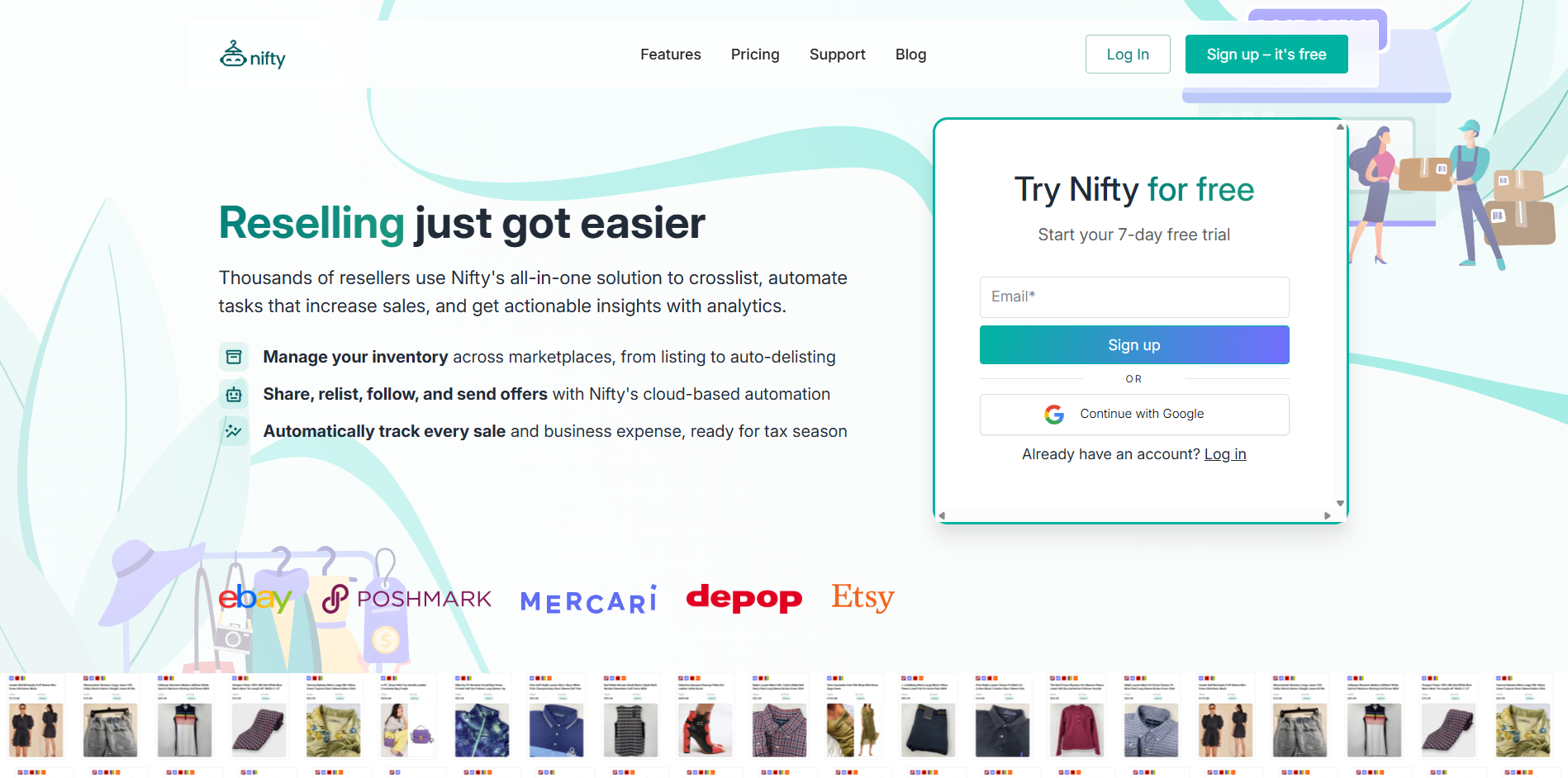
What it does: Nifty replaces manual crosslisting and inventory syncing with AI-powered automation across six major resale platforms.
Best for: Resellers of all sizes managing listings on Poshmark, eBay, Mercari, Depop, Etsy, and Whatnot (more platforms coming soon!) who need crosslisting, automation, and AI listing generation.
Nifty is our own crosslisting and automation tool built to reduce manual reseller work. It replaces separate apps for listing, sharing, and bookkeeping with a single command center that supports bulk inventory edits, Poshmark sharing automation, and cost and revenue analytics.
Users have reported that switching to Nifty is quick and easy, helping them get more shares on Poshmark. Others describe it as the best crosslister on the market.
Overall, Nifty’s crosslisting ability on popular marketplaces, coupled with its AI and automation capabilities, makes it the best Sellbrite alternative.
Advantages over Sellbrite
- AI listing generation: Builds SEO-optimized titles, descriptions, and tags from a single photo upload.
- Cloud-based automation: Runs your pre-scheduled sharing, relisting, and offer campaigns in the cloud without keeping devices powered on.
- Cross-platform auto-delisting: Detects sales and removes duplicate listings from all connected marketplaces automatically once you turn it on.
Pros
- Mobile-optimized: Create and manage listings from phones and tablets.
- Powerful analytics suite: See cost and revenue metrics across all connected platforms and get profit and loss (P&L) statements to make your accountant happy during tax season.
Cons
- Feature set requires time: Nifty offers many features, such as analytics, automation, AI features, and even a photo-editing suite, so you’ll need to read the documentation to fully learn the tool.
Pricing
Nifty’s automation plans start at $25/month, with crosslisting plans starting at $39.99/month. But if you go with the annual subscription, you can save up to 12%.
Bottom line
Nifty reduces manual tasks and provides better AI and analytics capabilities than Sellbrite. These features, combined with crosslisting and automation, make Nifty our best overall Sellbrite alternative.
2. Linnworks: Best for high-SKU multi-marketplace sellers
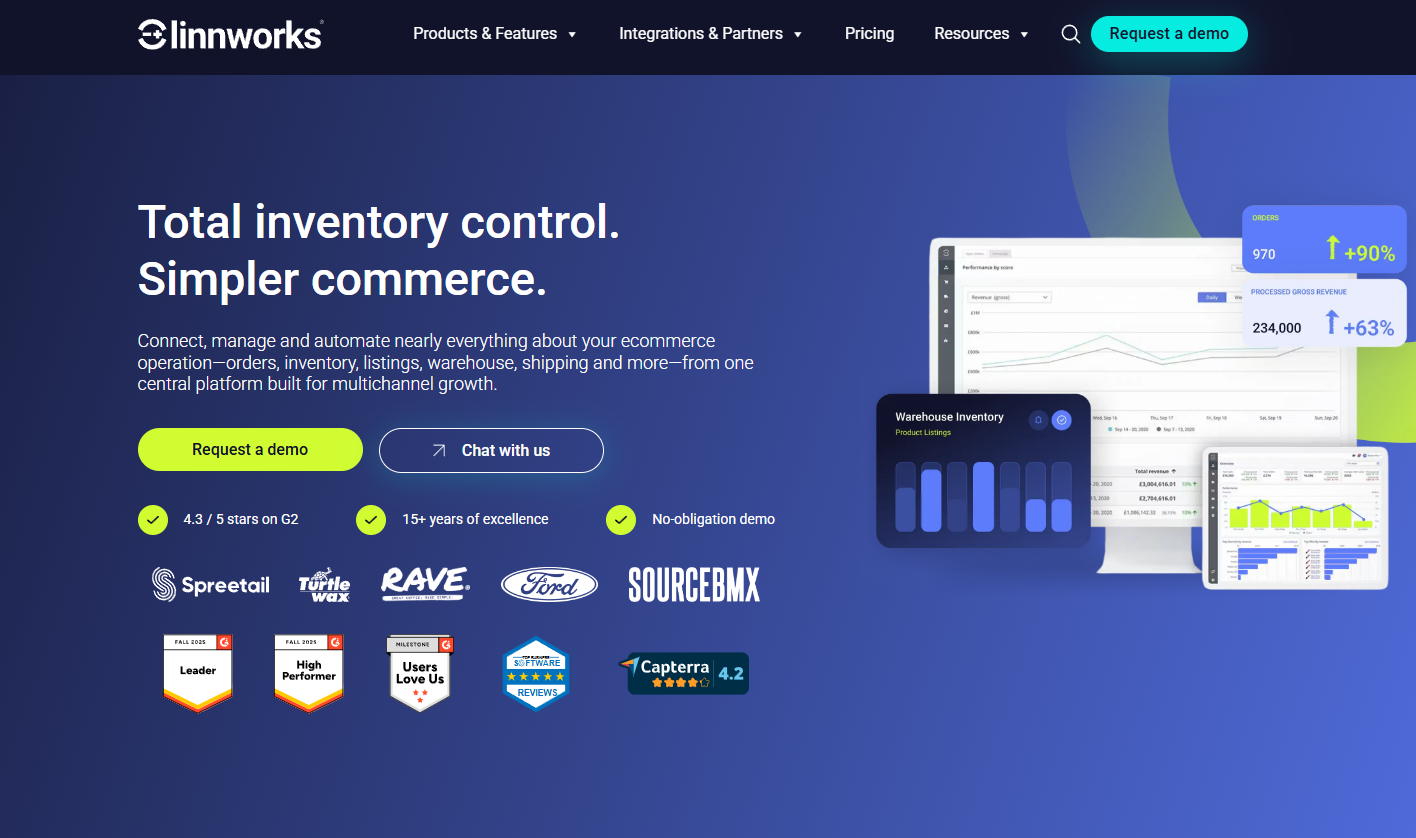
What it does: Linnworks centralizes inventory, order, and warehouse operations for multichannel e-commerce businesses.
Best for: Large operations and e-commerce teams managing multichannel catalogs and multiple warehouses or fulfillment partners.
I tested Linnworks by syncing my inventory, Essentials Fear of God hoodies, across Amazon, Walmart, and eBay. Stock adjustments, whether through purchasing new inventory or sales, are updated to all platforms within two minutes of saving changes.
Advantages over Sellbrite
- Warehouse management system: Handles multi-location inventory, pick/pack workflows, and barcode scanning for physical operations.
- Advanced automation rules: Creates conditional workflows for order routing, repricing, and supplier reordering based on predefined rules.
- Direct shipping integrations: Connects with carriers like FedEx and UPS for live rate calculations and bulk label printing.
Pros
- Near-real-time inventory sync: Updates stock counts across channels shortly after warehouse adjustments or sales to reduce overselling risk.
- Enterprise API: Supports custom integrations with ERP systems, third-party logistics providers, and proprietary software.
Cons
- Steep learning curve: Requires significant training time before you can operate the system without making configuration errors.
Pricing
Contact Linnworks to receive a custom quote.
Bottom line
Linnworks suits the complex inventory management needs of large-volume sellers. The warehouse management features separate it from lighter tools, as long as you can find the time to configure the system.
3. Extensiv: Best for advanced inventory and order automation
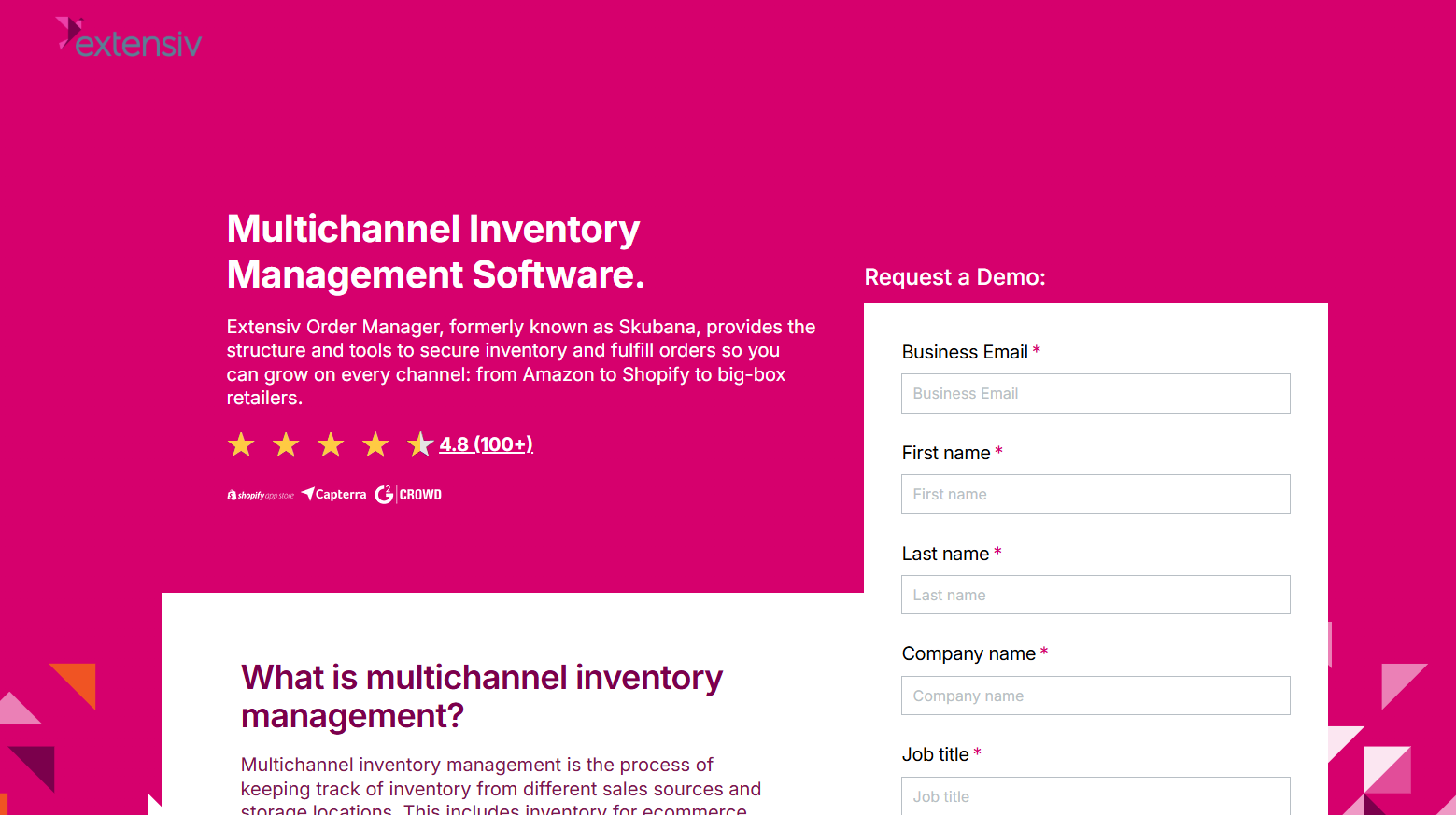
What it does: Extensiv centralizes multichannel inventory and order data, supports inventory forecasting, and provides detailed analytics across multiple channels and warehouses.
Best for: Mid-market brands processing 500+ daily orders who need supplier management and landed cost calculations built in.
I tested Extensiv by dividing 500 SKUs and routing most orders to 4 appropriate warehouses using my pre-configured rules. Extensiv correctly routed 94% of orders to the closest facility, all automatically. The remaining 6% needed manual intervention for correct routing.
Advantages over Sellbrite
- 3PL network integration: Connects directly with hundreds of fulfillment centers for automated order transmission and inventory syncing.
- Intelligent order routing: Assigns orders to the best warehouses based on shipping costs, inventory location, and priority rules.
- Multi-warehouse allocation: Distributes inventory across facilities and prevents overselling when stock splits between multiple locations.
Pros
- Zone-based shipping logic: Uses routing rules to send orders to the closest eligible warehouse to help minimize shipping times and potentially reduce costs.
- Warehouse performance metrics: Reporting provides detailed views into inventory value, aging, SKU profitability, COGS, and shipping fees.
Cons
- Complex setup requirements: Implementation typically takes several weeks to connect third‑party logistics, configure routing rules, and test order flows.
Pricing
Contact Extensiv for a custom quote.
Bottom line
Extensiv works when you need to connect multiple third-party logistics providers with orders and a warehouse. Routing automation and centralized warehouse visibility can reduce manual coordination and organize multichannel fulfillment workflows.
4. Shopify Marketplace Connect (Codisto): Best for Shopify sellers
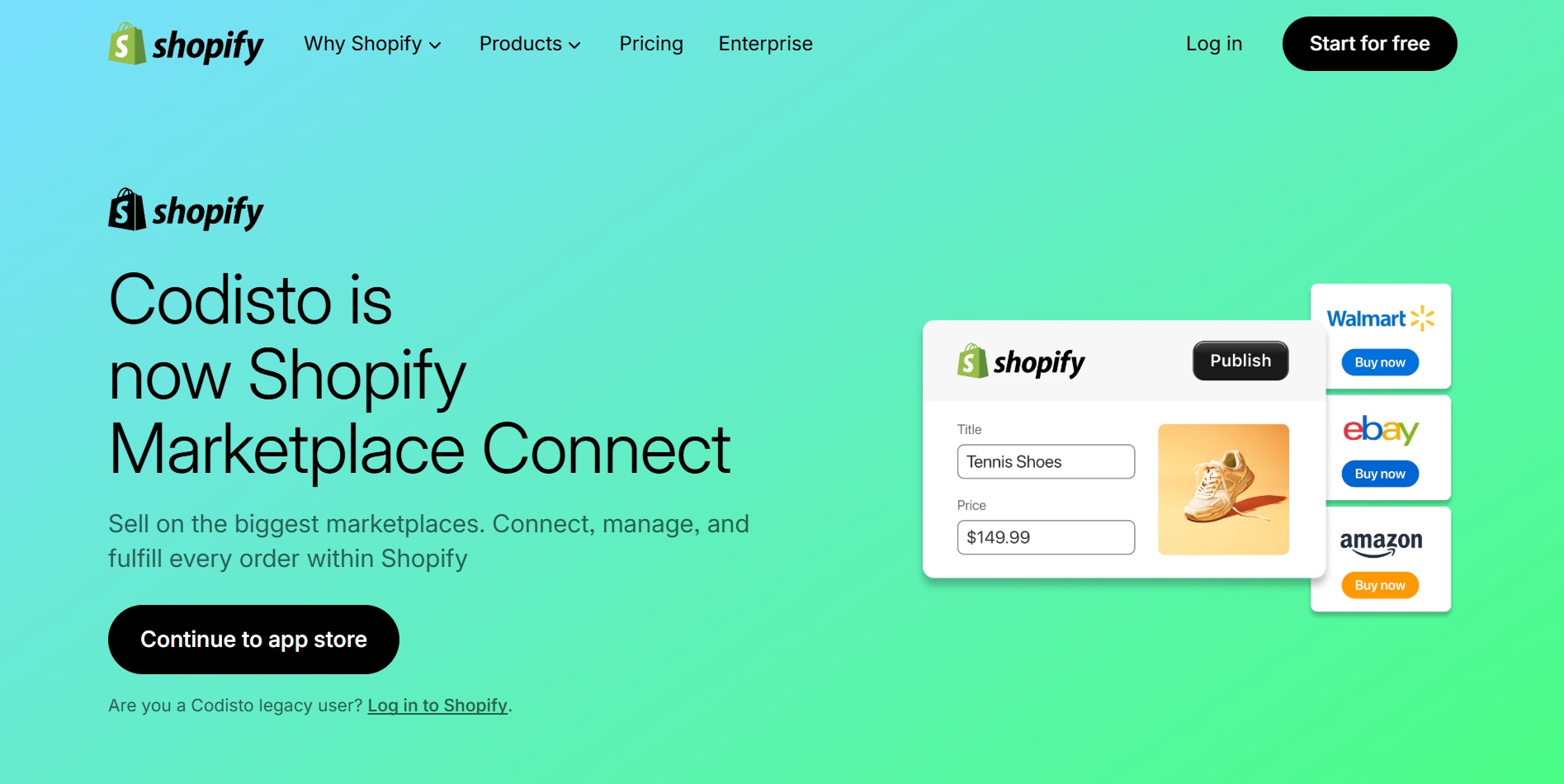
What it does: Shopify Marketplace Connect connects Shopify product catalogs to eBay and Amazon without rebuilding listings or managing separate inventory systems.
Best for: Shopify merchants expanding to eBay or Amazon.
During testing, Market Connect handled a bulk catalog migration of hoodie listings from Shopify to eBay, connecting a store with 150 hoodie listings and pushing to eBay in one batch. The platform mapped Shopify variants to eBay's item specifics automatically, though 12 listings required manual corrections.
Advantages over Sellbrite
- Shopify-native integration: Installs from the Shopify App Store and works inside Shopify Admin, using Shopify’s product and order data while handling marketplace API connections behind the scenes.
- eBay category mapping: Lets you assign and manage eBay categories for your products from within the app.
- Order consolidation dashboard: Shows all marketplace orders inside the Shopify admin for centralized fulfillment and customer management.
Pros
- Fast initial setup: Many merchants can connect their Shopify store to marketplaces like eBay quickly using guided onboarding, though total setup time varies with catalog complexity and requirements.
- Automatic inventory updates: Updates stock changes from Shopify to connected marketplaces automatically, typically in near real time.
Cons
- Shopify dependent: Requires Shopify as the primary platform, making it unusable for BigCommerce or WooCommerce stores.
Pricing
Shopify Marketplace Connect is free to install and includes 50 marketplace-synced orders a month, then charges 1% per additional synced order (capped at $99/month). You’ll also need a Shopify plan, and the Basic plan billed yearly starts at $29/month.
Bottom line
Market Connect works well for Shopify merchants expanding to eBay or Amazon who want Shopify to remain their operational hub.
5. Zoho Inventory: Best for inventory-first operations
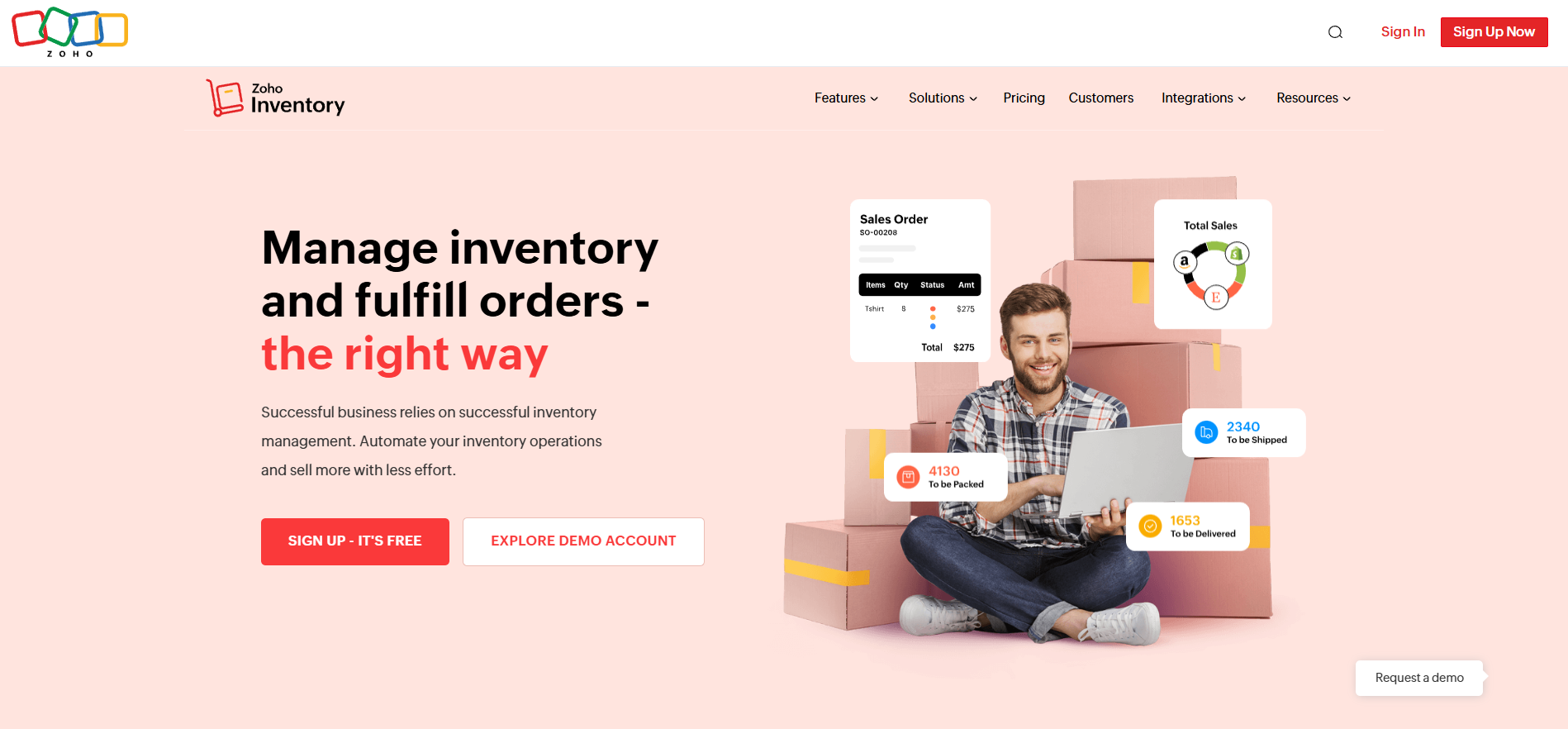
What it does: Zoho Inventory provides cloud-based inventory and order management, as well as purchase and sales order workflows across several marketplaces.
Best for: Retailers or wholesalers managing physical inventory across one or more warehouses that need integrated purchasing and sales order workflows.
I tested Zoho Inventory during a multi-warehouse inventory transfer test between two locations. Once I sent a transfer request, the tool generated a packing slip, ready to download and print. When I tested its reordering capabilities, the system alerted me to low‑stock items and could generate purchase orders (or PO drafts) that I could forward to suppliers.
Advantages over Sellbrite
- Serial number tracking: Supports assigning and tracking unique identifiers for individual units across receiving, storage, and sales for serial‑tracked items.
- Purchase order automation: Uses reorder points to trigger low‑stock notifications, and with configured automations or extensions, can draft purchase orders when stock drops below thresholds.
- Landed cost calculation: Allocates shipping, customs, and import fees to individual SKUs for accurate unit cost tracking.
Pros
- Zoho ecosystem integration: Connects natively with Zoho Books, CRM, and Analytics for unified business data flow.
- Barcode scanning support: Offers barcode generation and scanning, including via mobile for stock counting, receiving, and related operations.
Cons
- Slow customer support: Users have complained that customer service response times are slow.
Pricing
Zoho Inventory has a free plan for up to 50 orders a month, and paid pricing starts at $39/month per organization ($29/month billed annually).
Bottom line
Zoho Inventory delivers strong value if you’re moving hundreds of SKUs and need detailed stock control and warehouse management more than a long list of marketplace integrations.
6. Ordoro: Best for dropshipping & multichannel sellers
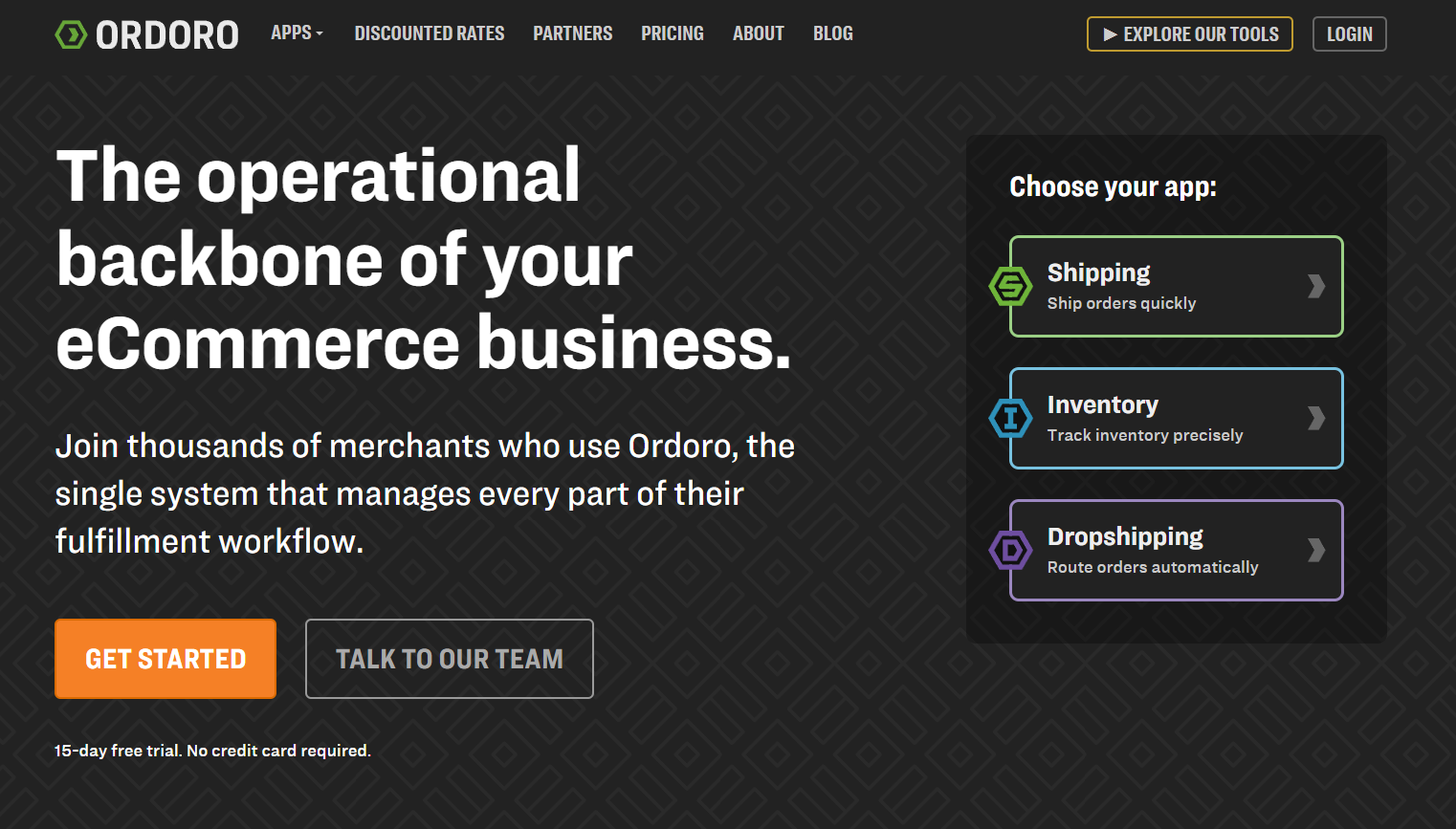
What it does: Ordoro consolidates orders from multiple marketplaces and shopping carts and connects to major shippers.
Best for: Small and growing dropshippers or e-commerce businesses with warehouse space selling on several online channels that need unified order, stock, and basic warehouse/shipping workflows.
I tested how Ordoro could handle shipping across connected marketplaces during peak sales hours. The shipping integration generated labels after I confirmed sales for a batch of 15 orders from eBay and Walmart. Ordoro pulled correct addresses, calculated weights, and printed USPS labels directly without requiring individual carrier website logins.
Advantages over Sellbrite
- Batch label printing: Supports batch generation and printing of shipping labels for many orders at once via integrated carriers.
- Dropshipping automation: Provides dropship automation that sends orders to suppliers automatically, with configurable routing rules.
- Accounting exports: Offers native QuickBooks integrations that connect inventory valuation and COGS journals, reducing manual export/import work.
Pros
- Strong shipping hub: Centralizes orders from multiple channels and offers discounted USPS and other carrier rates, batch label printing, and shipping automation.
- Excellent dropshipping workflows: Automates routing of dropship orders to suppliers, supports hybrid stocked/dropshipped items, and tracks dropship status in one place.
Cons
- High pricing: Dropshipping plans start at almost $300/month, which can be difficult for smaller dropshippers.
Pricing
Ordoro pricing starts at $299/month for dropshipping and $349/month for inventory, while its Shipping app has a free plan (paid Shipping plans start at $59/month).
Bottom line
Ordoro suits e-commerce businesses that ship a lot and/or rely on dropshipping, and are willing to pay a premium price for inventory management and automation features.
7. Rithum: Best for enterprise sellers
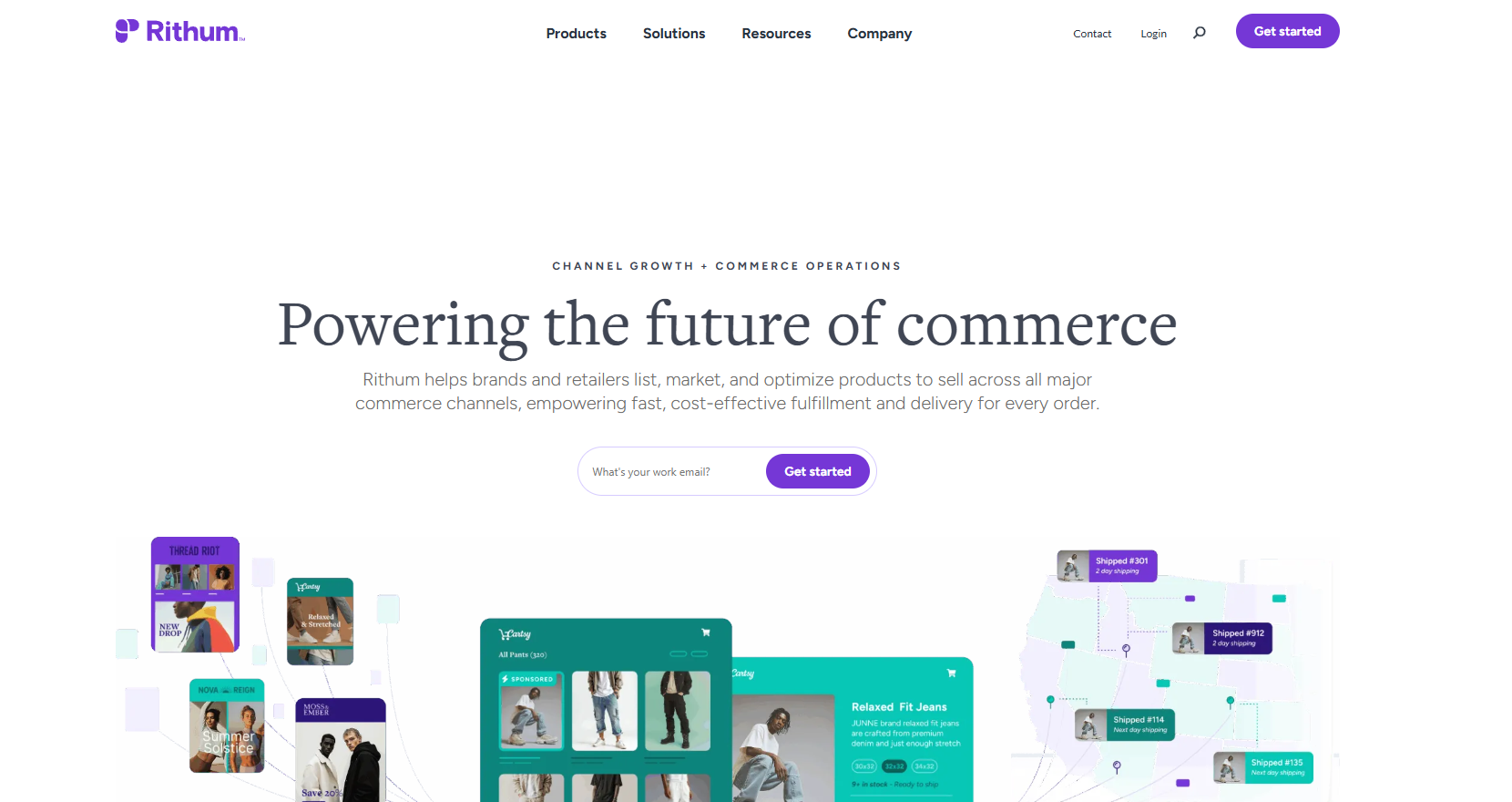
What it does: Rithum connects brands and retailers to over 600 global marketplaces through a single API.
Best for: Large brands selling through retail partners and managing dropship fulfillment who need access to the marketplace network without individual platform integrations.
During testing, I uploaded 500 SKUs through Rithum’s interface and pushed them to Amazon, Walmart, and eBay. The system automatically translated product attributes into each marketplace’s required data fields without manual entry or category fixes needed.
Advantages over Sellbrite
- Dropship vendor coordination: Routes orders to suppliers, monitors fulfillment status, and manages vendor performance tracking centrally.
- Brand protection controls: Supports Minimum Advertised Price-aware (MAP-aware) pricing strategies, authorized-seller onboarding and approval, and configurable merchandising and compliance rules across channels.
- Catalog info changing: Automates much of the work involved in converting catalog data for each marketplace’s requirements.
Pros
- International expansion support: Connects to European, Asian, and Latin American marketplaces with localized compliance and currency handling.
- Enterprise API capabilities: Integrates with existing ERP, PIM, and warehouse management systems through flexible API architecture.
Cons
- Glitches can cost you: Some customers have complained about system errors that have resulted in lost sales.
Pricing
Contact Rithum directly for a custom quote.
Bottom line
Rithum is built for enterprise-scale businesses with several supplier connections selling products on dozens of platforms. Its connected network and centralized dropship coordination can justify the higher investment.
How I tested these Sellbrite alternatives
I started testing with 20 Sellbrite alternatives. Using a set sample inventory and buyer data, I created accounts and executed sales to assess the following capabilities:
- Crosslisting: I tested how quickly each tool could distribute product listings across multiple marketplaces and assessed whether they required manual work.
- Inventory sync accuracy: I tracked how each tool handled stock updates after sales occurred on different marketplaces to evaluate if the tool could actually prevent double-selling.
- Automation capabilities: I evaluated each tool's ability to handle repetitive tasks like repricing, relisting, and order routing without manual intervention.
Here are some additional factors I considered:
- Stability during peak periods: You’ll need a tool that can handle several purchases that occur within moments of each other, especially if you’re a large-volume seller.
- Customer support responsiveness and quality: Sometimes, tools have bugs, and there’s nothing more frustrating than an unanswered support ticket when you have sales on the line. Good tools should have support that responds within minutes.
My final verdict: Which Sellbrite alternative should you choose
Each of my Sellbrite alternatives serves different seller types based on inventory complexity and operational scale. Here's how to pick the right one:
Choose Nifty if you …
Resell fashion, collectibles, or vintage goods on Poshmark, eBay, Mercari, Depop, Etsy, or Whatnot.
Choose Linnworks if you …
Manage thousands of SKUs across multiple warehouses and need advanced inventory control.
Choose Extensiv if you …
Work with multiple third-party logistics providers and need intelligent order routing.
Choose Shopify Marketplace Connect if you …
Run your primary business on Shopify and want to expand to eBay or Amazon.
Choose Zoho Inventory if you …
Need purchase order automation, serial tracking, and are familiar with the Zoho ecosystem integration.
Choose Ordoro if you …
Process high shipping volumes or are a high-volume dropshipper.
Choose Rithum if you …
Operate at enterprise scale, selling through major retail partners.
Sell smarter with Nifty, the best Sellbrite competitor
If you’re looking for a Sellbrite alternative that generates listing titles and descriptions from photos and lets you crosslist on multiple platforms, go with Nifty. It provides the features resellers of all sizes need without complex enterprise configuration or steep pricing.
Here’s why over 10,000 sellers trust Nifty:
- AI listing generation: Nifty builds complete listings with SEO-optimized titles, descriptions, and hashtags directly from your photos. No more staring at blank description boxes or researching keywords manually.
- Easy crosslisting: Post items to Poshmark, eBay, Mercari, Depop, Etsy, and Whatnot without retyping product details or adjusting fields for each platform.
- Automatic sales detection: When an item sells on any connected marketplace, Nifty removes it from all other platforms within minutes once you turn on auto-delisting. No more manual delisting or double-sale refunds that hurt your seller metrics.
- Cloud-based automation: Schedule shares, relists, and offers that run 24/7 without keeping your computer on. Your inventory stays active even when you're offline or sourcing new products.
- Profit tracking dashboard: See real revenue after fees, shipping costs, and expenses across all platforms. Know which items actually make money and which categories waste your time and storage space.
After using Nifty for just a few weeks, it pays for itself. So what are you waiting for? Start your 7-day free trial now.
FAQs
1. Which Sellbrite alternative works best for resellers?
The best Sellbrite alternative for resellers is Nifty because it combines AI listing generation, crosslisting automation, and profit tracking specifically for resellers. It allows you to crosslist on Poshmark, eBay, Mercari, Depop, Etsy, and Whatnot. Unlike enterprise tools, Nifty focuses on reseller needs without the complexity of warehouse management.
2. Can Sellbrite alternatives delist sold inventory after a sale happens?
Yes, Sellbrite alternatives can delist inventory after a sale. Nifty (with auto-delisting turned on), Linnworks, and Extensiv automatically update inventory across channels after customers place orders. Actual delisting sync speed depends on each platform’s settings, channel APIs, and data volume.
3. When does it make sense to switch from Sellbrite to another tool?
It makes sense to switch from Sellbrite to another tool when you outgrow its SMB-focused multichannel model. Resellers expanding heavily into Poshmark, Mercari, and Depop often benefit from Nifty’s AI-powered crosslisting and automation. Brands running complex multi-warehouse or 3PL-driven operations may get more value from Extensiv or Rithum.



.png)
.png)