The 13 best vendors for reselling in 2026 (with MOQs)

The best vendors for reselling are 888 Lots for small manifested liquidation lots, Alibaba for bulk private-label orders, and Goodwill Outlets for clothing by the pound. Your pick depends on how much cash you can tie up and whether you hold a resale certificate.
I compared 13 vendors that serve US resellers on minimum order, landed cost, buyer protection, and account rules, and flagged the one that refuses orders from marketplace sellers.
TL;DR
- 888 Lots has the lowest entry point for manifested liquidation stock, and B-Stock sells full pallets from retailers like Target and Costco.
- Alibaba suits private-label bulk orders, and DHgate suits test batches of 1 to 20 units.
- Goodwill Outlets sell secondhand clothing by the pound, and Fleek sells it in graded bundles from 10 to 20 pieces.
- Faire won’t fulfill orders for retailers who sell on marketplaces like eBay, Poshmark, Etsy, or Whatnot, so marketplace resellers need another wholesale source.
- Liquidation auctions add a buyer’s premium, freight, and sales tax (unless you hold a resale certificate) on top of the winning bid.
How I evaluated these vendors for reselling
I checked each vendor’s published policies, fee pages, and recent buyer reviews against four criteria that decide whether a sourcing channel turns a profit:
- Minimum order and landed cost: I added buyer’s premiums, shipping, case-pack rules, and import duties to the sticker price to see what a first order costs in total.
- Buyer protection: How many days you get to report a short or damaged order, and who pays return shipping when something goes wrong.
- Account requirements: Whether you need a state resale certificate, a live boutique website, or a US business address before the vendor approves you.
- Marketplace fit: Whether the stock sells on eBay, Poshmark, Mercari, Depop, and Whatnot, and whether the vendor’s terms let you sell there at all.
The 13 best vendors for reselling: Compared
Wholesale marketplaces and directories
Wholesale vendors sell new stock, usually by the case or by a supplier-set minimum. You get consistent sizes and conditions, which makes listing faster, but you compete with every other reseller who bought the same SKU.
Marketplaces like Alibaba and Faire hold your payment and run disputes. Directories like Wholesale Central and SaleHoo mostly hand you supplier contacts, so you negotiate with each supplier yourself.
1. Alibaba: Best for private-label bulk orders
Alibaba.com is a business-to-business marketplace where you message manufacturers and trading companies, mostly in China, request quotes, and pay for wholesale orders through the site.
Who it’s for: Resellers who know exactly what they want made in volume, such as blank tees for printing or branded phone accessories, and can wait several weeks for freight.
Key features
- Trade Assurance: If a supplier misses the agreed ship date or the goods fail the quality terms in your contract, Alibaba refunds the covered amount. Most buyers must request the refund within 30 days of delivery, and Alibaba Enterprise buyers get 60 days.
- Verified Supplier badges: Third-party inspection firms such as SGS and TÜV Rheinland audit these suppliers’ production capacity and quality control before Alibaba awards the badge.
- Request for Quotation (RFQ): You post one product request with quantity and specs, and suppliers send quotes to you instead of you messaging each factory.
Alibaba pros
✅ Products nobody else lists: You can order your own colorway, label, or packaging, so you aren’t competing with 40 other sellers on an identical listing.
✅ Room to negotiate: Listed minimum order quantities (MOQs) are opening offers. Many suppliers agree to a smaller first run or a paid sample if you ask before you pay.
Alibaba cons
❌ Off-platform payments lose all protection: Suppliers who ask you to pay by bank transfer outside Alibaba.com take you outside Trade Assurance, and you can’t open a dispute afterward.
❌ Long lead times: Production plus sea freight to the US often takes 4 to 8 weeks, so seasonal stock has to be ordered a full season ahead.
What real users say
“The whole process from my initial enquiry, through the sales process and delivery was managed very professionally.” (Shaun D., Trustpilot, September 22nd, 2026)
“Alibaba sides with the seller 9 out of 10 times even when the seller is clearly in the wrong … Also got robbed of hundreds of dollars of fake merchandise.” (Caleb R., Trustpilot, September 22nd, 2026)
Alibaba minimums and costs
Joining Alibaba.com and using Trade Assurance costs buyers nothing. Each supplier sets its own MOQ, often 100 units or more for custom work. Budget for a sample fee, freight, customs brokerage, and US import duties on top of the unit price.
Bottom line
I’d only go to Alibaba once you have a proven product and want your own version of it at a lower unit cost. If you want to test a product with 5 to 10 units first, start on DHgate.
2. DHgate: Best for testing small batches
DHgate is a Beijing-based marketplace where Chinese sellers list wholesale goods in small quantities. DHgate holds your payment until you confirm delivery or the protection period ends.
Who it’s for: Resellers testing a new product line, such as hair accessories or phone cases, who want 1 to 20 units before committing to a factory order.
Key features
- Escrow-style payment: The seller gets paid only after you confirm receipt or the buyer protection period closes.
- Tiered pricing: Many listings show a per-unit price that drops at set quantities, such as 1, 10, and 50 units.
- Dispute center: You open a dispute from your account for missing or not-as-described orders, and DHgate rules on who keeps the money.
DHgate pros
✅ Cheap product tests: Spending $40 on five units tells you whether an item sells on Mercari before you put $400 into a factory order.
✅ Side-by-side sellers: Several sellers often list the same factory product, so one search lets you compare per-unit prices and seller ratings.
DHgate cons
❌ Counterfeit risk: US Customs and Border Protection seizes counterfeit goods in small parcels, and DHgate won’t compensate you. Listing a fake on eBay or Poshmark can also cost you your account.
❌ Duties on small parcels: The US ended duty-free de minimis entry for Chinese imports in May 2025, and for every country in August 2025, so even a $30 DHgate order can carry import duties.
What real users say
“Great experience so far on my orders. Great customer service. I have done multiple orders and always had a wonderful experience thus far.” (Anonymous, Trustpilot, August 15th, 2026)
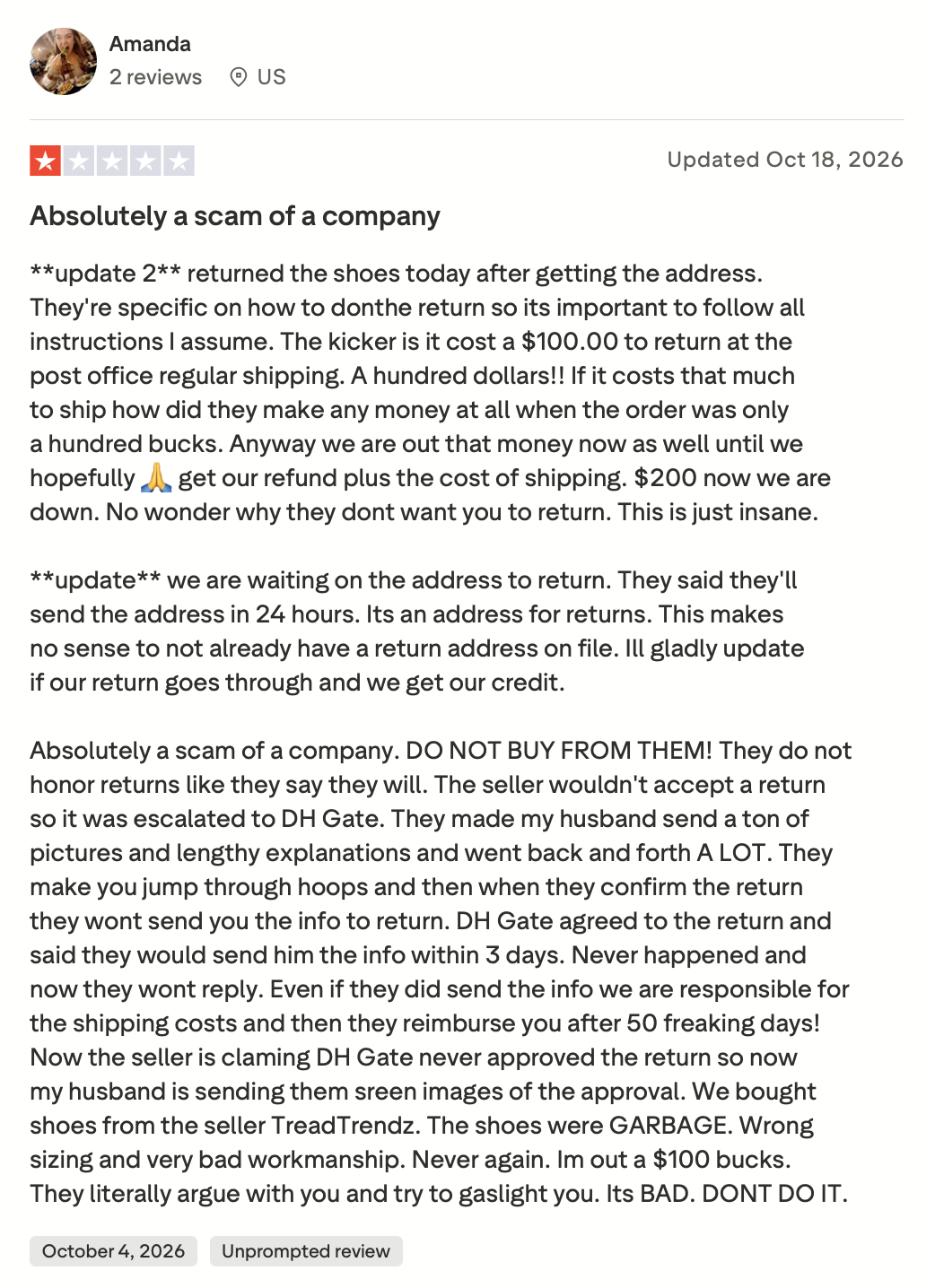
“Even if they did send the info, we are responsible for the shipping costs and then they reimburse you after 50 … days!” (Amanda, Trustpilot, October 7th, 2026)
DHgate minimums and costs
Buyer accounts are free, and most listings start at one unit. You pay the item price, the seller’s shipping rate, and any US import duties.
Returns to China are usually at your expense unless the listing offers Free Return, and refunds arrive after the seller receives the item.
Bottom line
I’d use DHgate to test an unbranded product in small quantities before committing to a larger order. If it sells consistently, I’d compare Alibaba suppliers for better bulk pricing and use Trade Assurance for eligible orders.
3. Faire: Best for boutiques with their own website
Faire is a wholesale marketplace where independent retailers buy from more than 100,000 brands, with Faire handling payment, payment terms, and returns.
Who it’s for: Boutique owners with a live online store, social shop, or brick-and-mortar location who want new, branded stock at wholesale prices.
Key features
- Net 60 terms: Eligible retailers receive stock now and pay up to 60 days later, interest-free.
- Minimum-order filters: You can filter brands by “No minimum order” or “$100 or less,” plus a “Not on Amazon” filter for brands that don’t sell there.
- Free returns on opening orders: Faire covers returns on your first order with each brand, typically within 60 days.
Faire pros
✅ Sell before you pay: Stock you order in October can sell through the holidays before the invoice comes due in December.
✅ Less price competition: “Not on Amazon” brands give you products shoppers can’t price-check against a Prime listing. Stocking them is one way to fill a consignment or boutique floor with new pieces.
Faire cons
❌ Marketplace sellers are excluded: Faire won’t fulfill orders for retailers selling on Amazon, eBay, Etsy, Poshmark, Whatnot, TikTok, or other marketplaces, so a Poshmark-only closet can’t qualify.
❌ Brand-specific purchasing requirements: Minimum order amounts, product availability, and wholesale terms vary by brand. You may need to meet different purchasing requirements for each supplier, making it harder to test several brands on a small budget.
What real users say
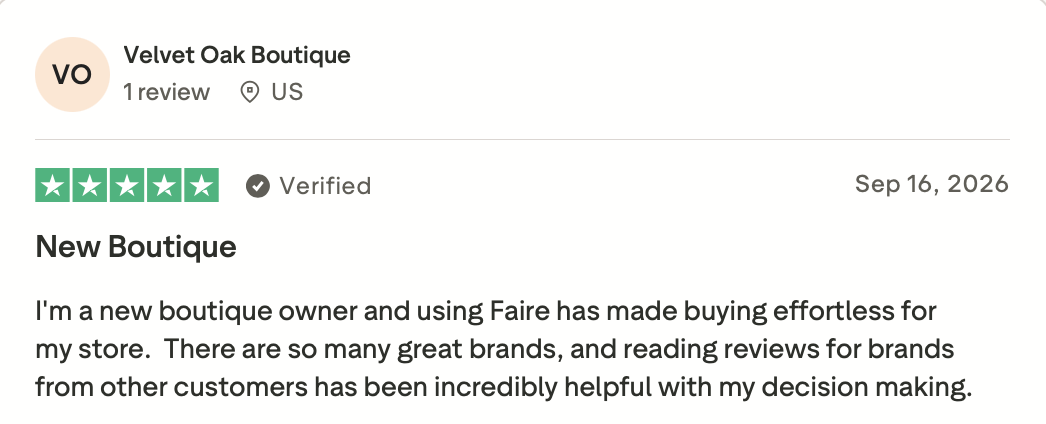
“There are so many great brands, and reading reviews for brands from other customers has been incredibly helpful.” (Velvet Oak Boutique, Trustpilot, September 15th, 2026)
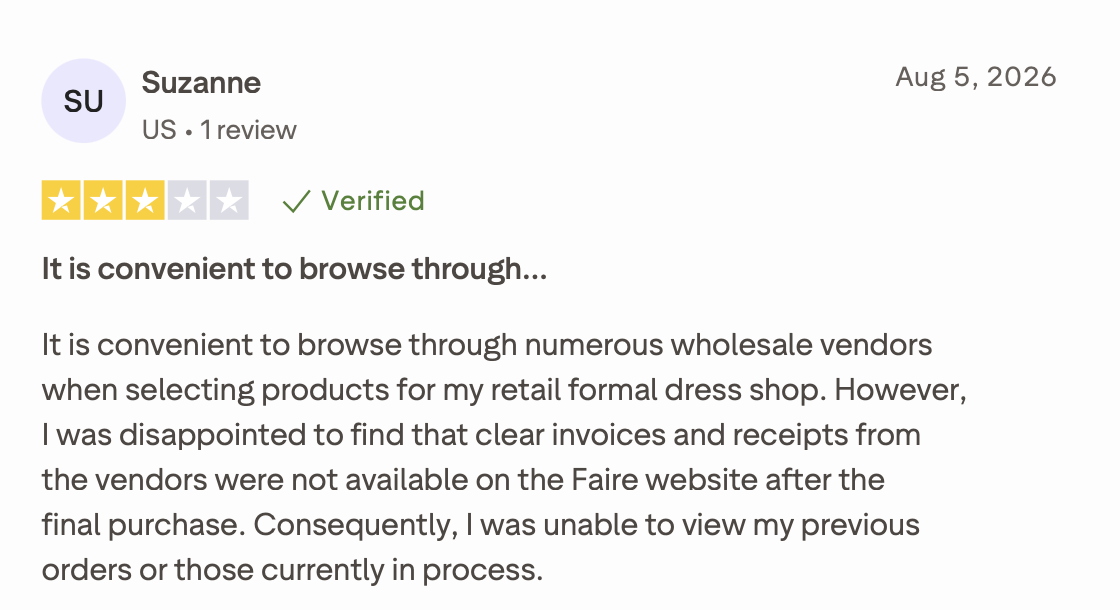
“I was disappointed to find that clear invoices and receipts from the vendors were not available on the Faire website after the final purchase.” (Suzanne, Trustpilot, August 5th, 2026)
Faire minimums and costs
Retailer sign-up is free. Each brand sets a first-order minimum and a lower reorder minimum. Shipping depends on the brand unless you pay for a Faire Insider membership, which adds free shipping on qualifying orders.
Bottom line
I’d choose Faire if I ran an independent boutique and wanted to test products from established brands. For a marketplace-only business, I’d look at 888 Lots or DollarDays instead.
4. DollarDays: Best for low-cost case packs
DollarDays is a US online wholesaler that sells new general merchandise, from socks to hygiene kits, mostly by the case to nonprofits, schools, and businesses.
Who it’s for: Resellers who build bundles, such as Whatnot sellers who need cheap giveaway items or eBay sellers listing multipacks of socks and sundries.
Key features
- Case-pack pricing: Most items ship in fixed case quantities, and DollarDays doesn’t split a case by color or size.
- Custom quotes: You can request a quote for large or mixed orders, and payment terms are extended case by case.
- Free shipping over $599: Orders over $599 ship free, except overweight and oversized items.
DollarDays pros
✅ No order minimum: You can place a one-case order instead of committing to a pallet.
✅ Fast dispatch: Most orders ship within 1 to 2 business days, so giveaway stock for a weekend Whatnot show can arrive in time.
DollarDays cons
❌ Strict returns: You have 14 days to request a return, cases must come back unopened, and you pay return shipping plus any restocking fee.
❌ Limited branded apparel: DollarDays stocks mostly donation-drive basics like hygiene kits and winter accessories, so fashion resellers find little with brand-name resale value.
What real users say
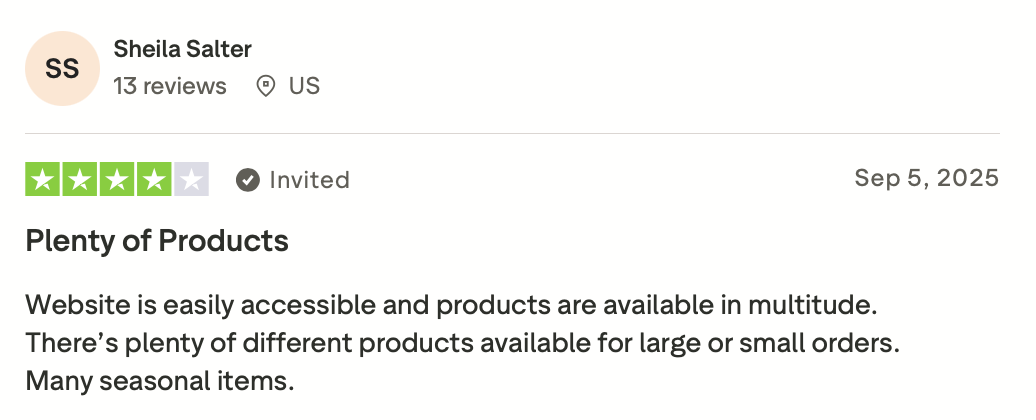
“Website is easily accessible, and products are available in multitude. There’s plenty of different products available for large or small orders. Many seasonal items.” (Sheila S., Trustpilot, September 5th, 2025)
“Our church shops routinely with DollarDays for hygiene products, socks, t-shirts, blankets, and the like to assist with our unhoused population. Prices are reasonable, and they have many options on products, and shipping time is good.” (Steve R., Trustpilot, August 28th, 2025)
DollarDays minimums and costs
There’s no minimum quantity or dollar amount. Below $599, DollarDays charges shipping by weight and distance.
Bottom line
I’d use DollarDays for cheap, new add-ons that pad out bundles and giveaways. For branded clothing with higher resale value, Goodwill Outlets or 888 Lots return more per dollar spent.
5. Wholesale Central: Best for free supplier research
Wholesale Central is a free directory, online since 1997, that lists wholesalers, importers, and closeout dealers across more than 120 product categories. You contact each supplier directly, and some suppliers now sell through the site’s own checkout.
Who it’s for: Resellers who want US-based suppliers and don’t mind emailing or calling several before one fits.
Key features
- Product and supplier search: You search by product or category and get supplier profiles with contact details and links to their own sites.
- Closeouts section: Suppliers post discounted overstock and closeout lots in a separate section of the site.
- Buyers Network: Wholesale Central emails subscribers promotions, news, and industry trends for free.
Wholesale Central pros
✅ Zero cost to search: Suppliers pay to be listed, so you browse without a subscription or credit card.
✅ Shorter shipping: Many listed suppliers ship from US warehouses, which avoids import duties and cuts delivery to days instead of weeks.
Wholesale Central cons
❌ No payment protection: In its disclaimer, Wholesale Central says it isn’t involved in deals between buyers and suppliers, so if a supplier doesn’t deliver, your card issuer’s chargeback is your main way back.
❌ Uneven listings: Some supplier profiles are outdated or unresponsive, so expect to contact several suppliers to get one working account.
What real users say
“I want to thank Charlie Sumner, Managing Director of Wholesale Central. He supported us regarding an issue caused by one of the wholesalers, and he supported us to get a refund.” (Mana Global, Trustpilot, April 6th, 2026)
“Helpful for finding niche suppliers, though expect to sort through many inactive or scam accounts. Had positive experiences with Green Earth Wholesale, but the lack of vetting is concerning.” (Betty H., Trustpilot, April 14th, 2025)
Wholesale Central minimums and costs
Searching is free for buyers. Each supplier sets its own MOQ, pricing, and payment terms, so ask for a current price list and case-pack sizes before you order.
Bottom line
Wholesale Central is a free starting point for finding US suppliers. If you’d rather pay for a pre-screened list with order guidance, try SaleHoo.
6. SaleHoo: Best for vetted supplier contacts
SaleHoo is a paid directory of more than 8,000 vetted wholesale and dropship suppliers, with product research tools and a Shopify import integration.
Who it’s for: Online sellers, especially Shopify store owners and dropshippers, who want pre-screened supplier contacts instead of cold searches.
Key features
- Supplier directory: Profiles list contact details for 8,000+ suppliers that SaleHoo has screened.
- Plan-based limits: Starter lets you contact up to 100 suppliers and import 200 products a month. Pro removes the contact cap and raises imports to 600.
- Seller community: You get access to a seller community of more than 137,000 members.
SaleHoo pros
✅ Fewer fake wholesalers: SaleHoo screens out many of the “wholesalers” that turn out to be middlemen reselling retail stock.
✅ Risk-free trial period: SaleHoo offers a 60-day money-back guarantee, so you have two months to test the directory for a full refund.
SaleHoo cons
❌ Dropshipping focus: SaleHoo built its tools around Shopify product imports, which do little for resellers who list secondhand stock on Poshmark or Depop.
❌ You still buy from each supplier: You negotiate MOQs and pay each supplier separately, with no SaleHoo payment protection on the order itself.
What real users say
“I am new to SaleHoo and Rhea has been extremely helpful. She has answered all of my questions with a great knowledge base and very quick to respond.” (Cecile B., Trustpilot, September 29th, 2025)
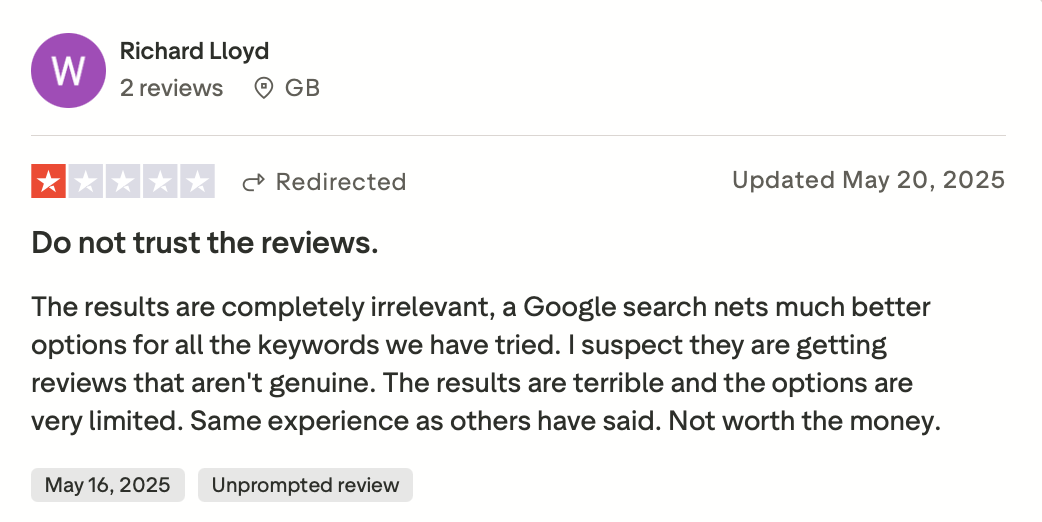
“The results are completely irrelevant, a Google search nets much better options for all the keywords we have tried.” (Richard L., Trustpilot, May 19th, 2025)
SaleHoo minimums and costs
- Starter: $9/month billed annually, or $299 for lifetime access.
- Pro: $49/month billed annually, or $1,699 for lifetime access.
- Enterprise: $499/month on a one-year term.
Bottom line
SaleHoo pays off if you run a Shopify store and want vetted suppliers fast. For secondhand marketplace stock, put the subscription money toward a Goodwill Outlets haul instead.
Liquidation and returns vendors
Liquidation vendors like B-Stock, 888 Lots, Liquidation.com, and Direct Liquidation sell customer returns, overstock, and shelf pulls that retailers can’t put back on the shelf.
You buy by the item, box, pallet, or truckload, often for a fraction of retail, and accept that some units arrive damaged or incomplete.
Your profit depends on the manifest, the freight bill, and how fast you can test, photograph, and list. For a wider look at bulk channels, see our guide to where to buy things in bulk to resell.
7. B-Stock: Best for pallets direct from big retailers
B-Stock operates online liquidation marketplaces for retailers and brands such as Amazon, Walmart, Target, Costco, and Home Depot. Approved businesses buy returns and overstock by the case, pallet, or truckload.
Who it’s for: Resellers with a state resale certificate, garage or storage space, and enough cash to buy full pallets from a single retailer.
Key features
- Three ways to buy: You can bid at auction, use Buy Now, or make an offer, depending on the listing.
- Proxy bidding: You enter your maximum, and B-Stock bids for you one increment at a time. Target’s marketplace uses $25 increments.
- Separate marketplace approvals: You apply to each retailer’s marketplace separately. Once B-Stock Supply approves you, you don’t need to upload your resale certificate again for each one.
B-Stock pros
✅ Known source: B-Stock lists the retailer and condition program on each lot, so you know whether you’re buying Target returns or Costco overstock before you bid.
✅ Payment flexibility: Registered businesses can apply for B-Stock Net Terms and pay in 30 days for a small fee, but sole proprietorships aren’t eligible.
B-Stock cons
❌ Resale certificate required: Buyers in states with sales tax must submit a state-issued reseller’s certificate. An EIN alone doesn’t qualify.
❌ Fast payment deadlines: On Target’s marketplace, winners must wire payment within 72 hours, so you need cash on hand before you bid.
What real users say
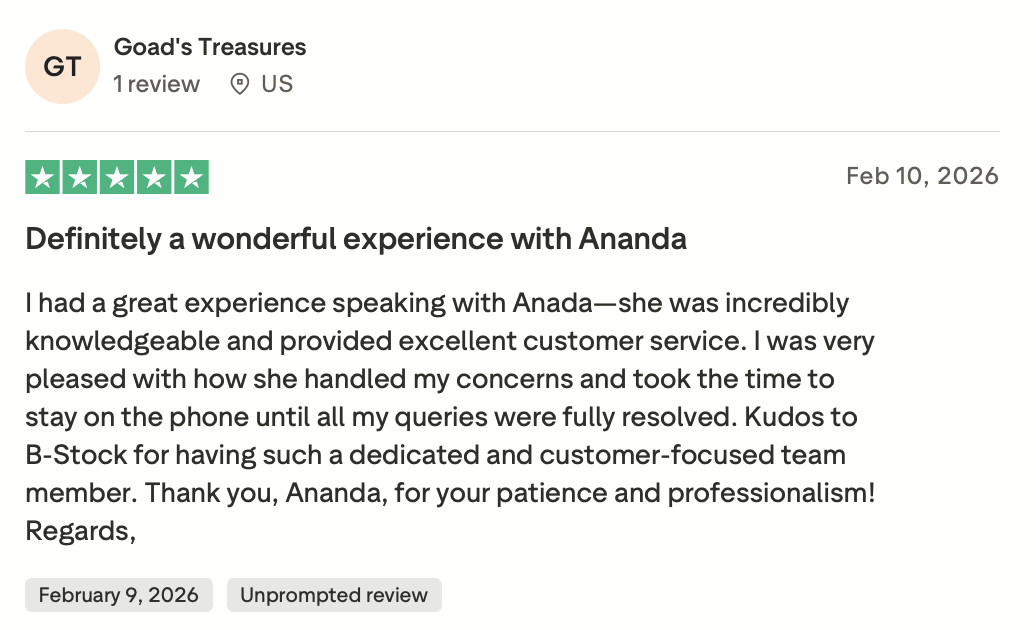
“She was incredibly knowledgeable and provided excellent customer service … and took the time to stay on the phone until all my queries were fully resolved.” (Goad’s Treasures, Trustpilot, February 10th, 2026)
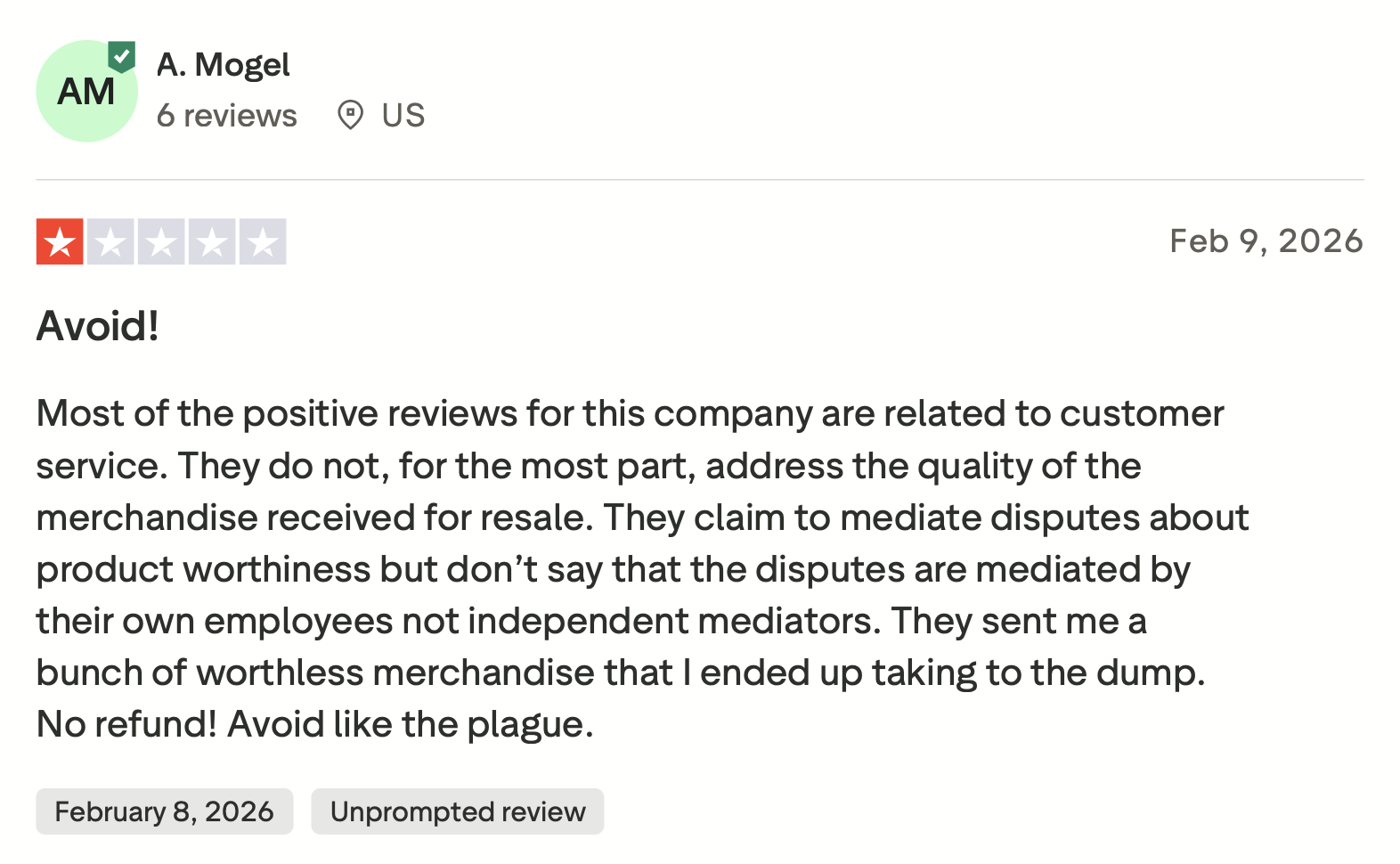
“They claim to mediate disputes about product worthiness but don’t say that the disputes are mediated by their own employees, not independent mediators.” (A. M., Trustpilot, February 8th, 2026)
B-Stock minimums and costs
Applying is free. You pay the winning bid, a B-Stock Fee on each order (10% of the final bid on B-Stock Supply), and shipping, which is either fixed on the listing or arranged by you. Your resale certificate removes sales tax.
Bottom line
I’d consider B-Stock once I had enough cash, storage space, and time to process full pallets. Until then, I’d stick to single items or smaller lots from 888 Lots.
8. 888 Lots: Best for small manifested lots
888 Lots is a New Jersey liquidation wholesaler that sells single items, lots, and truckloads of Amazon returns, overstock, and distribution stock.
Who it’s for: US resellers with a resale certificate who want new or inspected stock in small quantities. Shoes and clothing are its largest categories, with more than 32,000 combined listings in November 2026.
Key features
- Detailed manifests: Each lot’s manifest, an itemized list of its contents, shows product images, condition, sales rank, and pricing, updated daily from a live retail data feed.
- Price negotiation: You can send an offer on most products 48 hours after they’re listed, as long as your completed-offer buying ratio stays above 70%.
- Local pickup: “Pickup & Save” items sell at lower prices if you collect them from the New Jersey warehouse.
888 Lots pros
✅ Single-unit buying: Some SKUs carry an MOQ of one, so you can test one pair of a shoe style before buying a case.
✅ Big first-order discount: New customers get up to 60% off a first order of up to $1,000.
888 Lots cons
❌ US businesses only: You need a valid US resale certificate and must pass a know-your-customer (KYC) identity check. 888 Lots doesn’t accept international buyers.
❌ All sales final: 888 Lots doesn’t accept returns or cancel paid orders. If it does approve a return, you pay the return shipping, whatever the reason.
What real users say
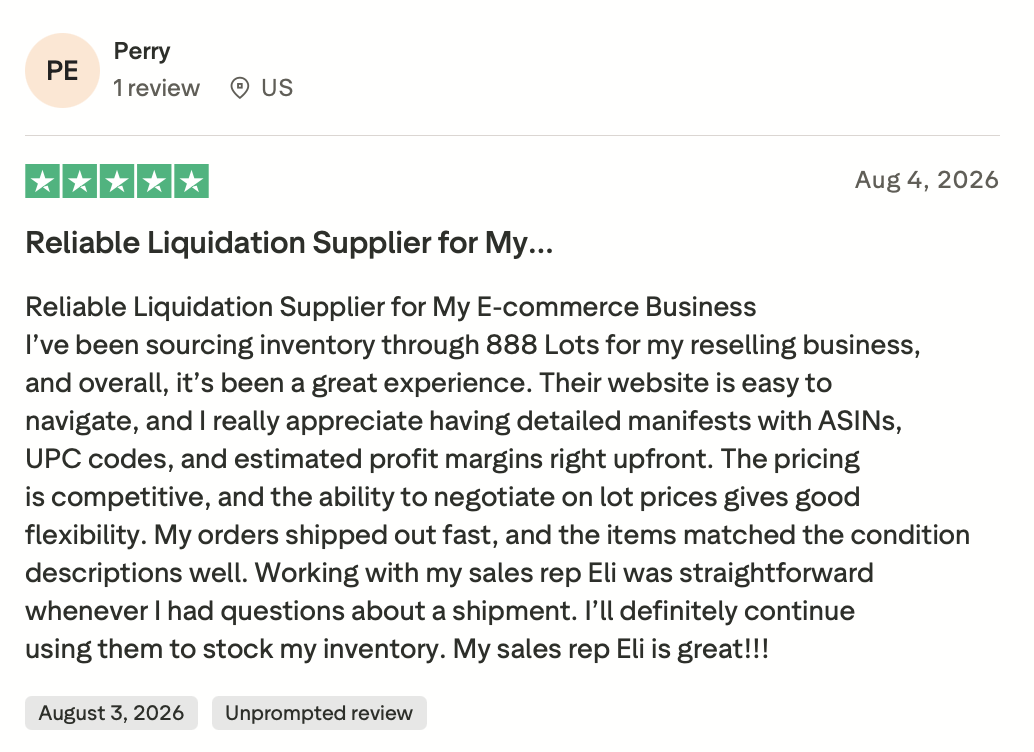
“I really appreciate having detailed manifests with ASINs, UPC codes, and estimated profit margins right upfront. The pricing is competitive, and the ability to negotiate on lot prices gives good flexibility.” (Perry, Trustpilot, August 3rd, 2026)
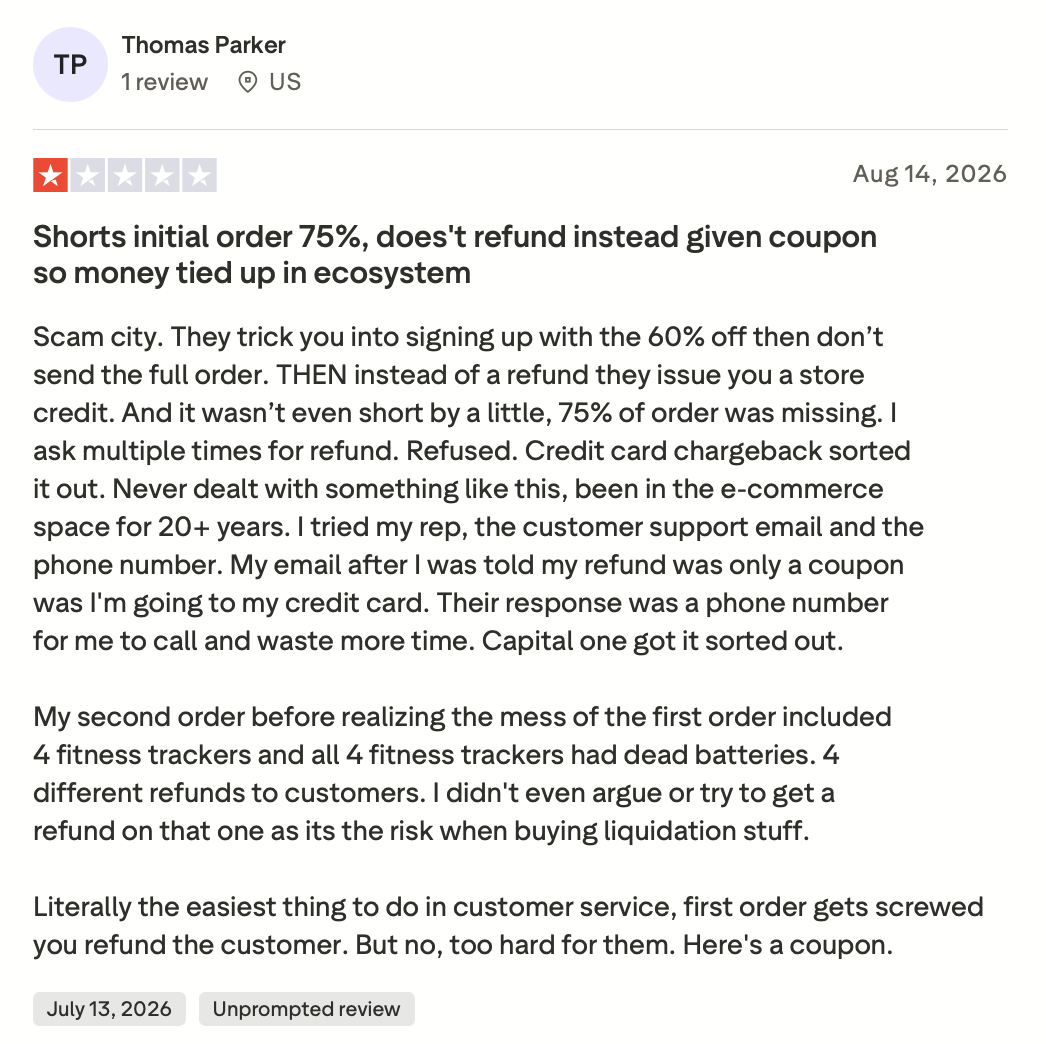
“They trick you into signing up with the 60% off, then don’t send the full order. THEN, instead of a refund, they issue you a store credit. And it wasn’t even short by a little; 75% of [the] order was missing.” (Thomas P., Trustpilot, August 14th, 2026)
888 Lots minimums and costs
Registration is free once your application clears. Prices are per item or per lot, with shipping added at checkout. Credit card purchases are capped at $25,000 per 30 days.
Bottom line
I’d start with 888 Lots if I wanted to test liquidation stock without buying a full pallet. Its single-unit listings and detailed manifests make smaller purchases possible. I’d still film every unboxing and check the contents against the manifest immediately.
9. Liquidation.com: Best for low-bid mixed lots
Liquidation.com is an auction marketplace run by Liquidity Services, the company behind GovDeals and AllSurplus. Liquidation.com and independent sellers list returns, overstock, and mystery lots.
Who it’s for: Experienced auction buyers who can price a manifest quickly and absorb the occasional bad lot.
Key features
- Auction format: Lots sell to the highest bidder, with a buyer’s premium added to the winning bid at checkout.
- Named sellers: Each listing shows which seller account posted it, including independent resellers clearing their own stock.
- Mystery lots: “Lost mail” and unmanifested boxes sell with a general description instead of an item list.
Liquidation.com pros
✅ Low entry bids: Many boxed lots close under $200, so you can test the site without a freight bill.
✅ Seller tracking: Because seller names appear on listings, you can keep buying from sellers whose manifests matched and skip the rest.
Liquidation.com cons
❌ Lowest trust score on this list: Liquidation.com holds a 1.2/5 TrustScore from 164 reviews, 97% of them one-star (November 2026).
❌ Short claim window: Liquidation.com gives you three business days after delivery to file a dispute, and if you pick up yourself, you must raise problems before the lot leaves the warehouse.
What real users say
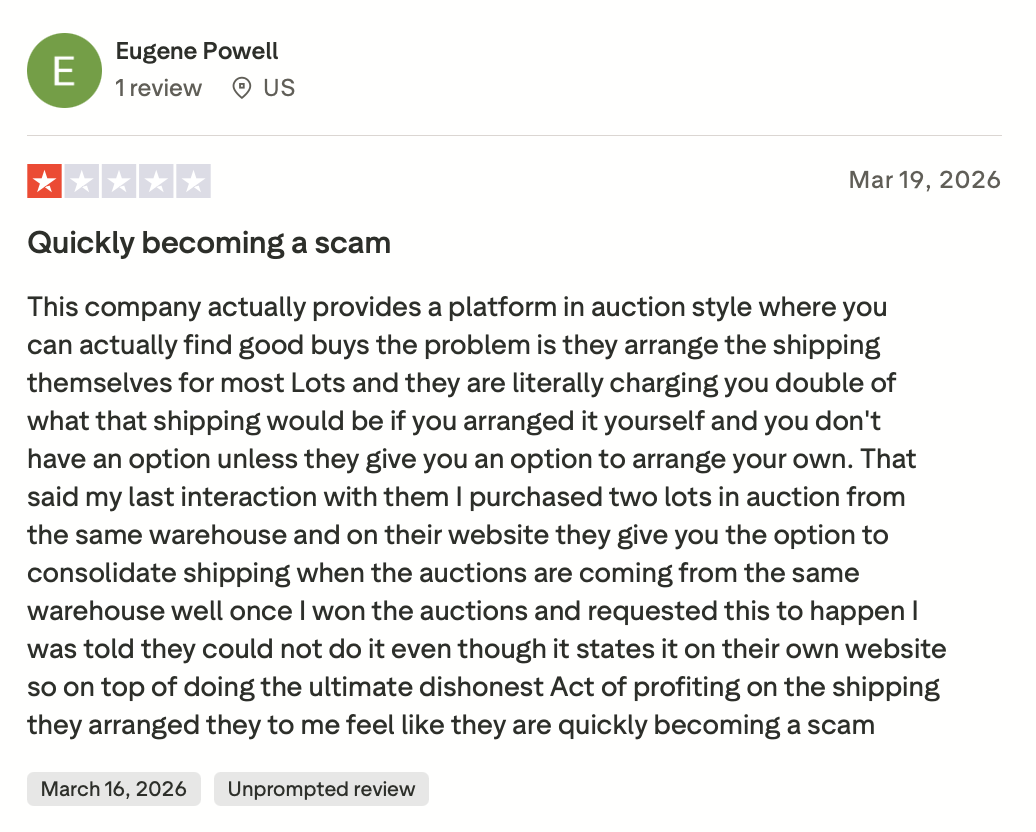
“This company actually provides a platform in auction style where you can actually find good buys; the problem is they arrange the shipping themselves for most lots, and they are literally charging you double.” (Eugene P., Trustpilot, March 18th, 2026)
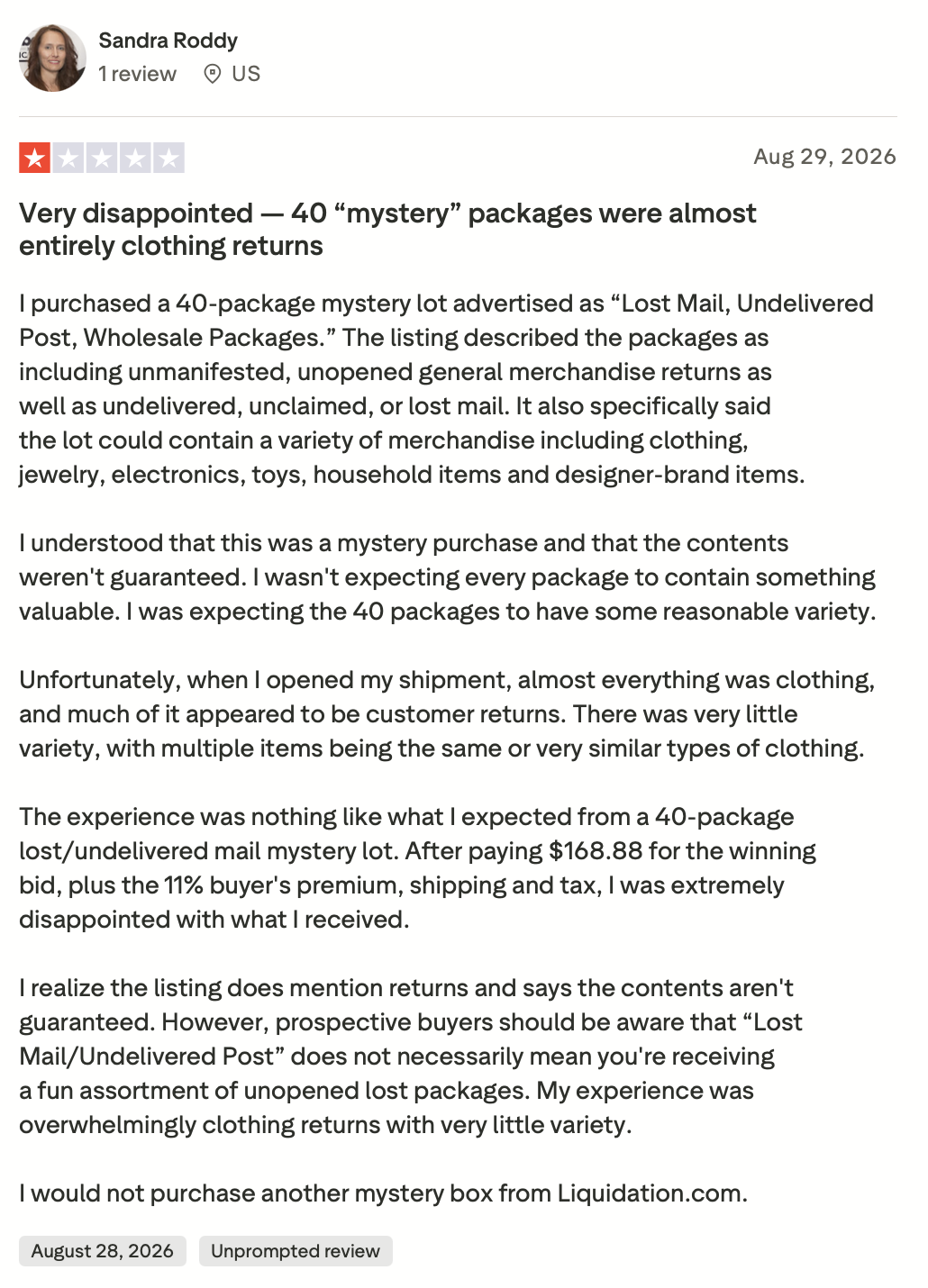
“After paying $168.88 for the winning bid, plus the 11% buyer’s premium, shipping and tax, I was extremely disappointed with what I received.” (Sandra R., Trustpilot, August 29th, 2026)
Liquidation.com minimums and costs
Registration is free. You pay the winning bid, the buyer’s premium shown on the listing, shipping, and sales tax unless you have a resale certificate on file.
Bottom line
I’d only use Liquidation.com if I could calculate my maximum bid, including fees and shipping, before an auction. I’d avoid mystery lots and choose manifested stock from established sellers. For a first liquidation purchase, I’d prefer 888 Lots.
10. Direct Liquidation: Best for pallet pickup near a warehouse
Direct Liquidation is a liquidation marketplace owned by Miami-based returns company ReturnPro. It sells customer returns, overstock, and refurbished goods from major retailers by the box, pallet, or truckload.
Who it’s for: Resellers within driving distance of one of its regional warehouses who can collect pallets themselves.
Key features
- Auction, Buy Now, and offers: Each lot sells by bidding, at a fixed Buy Now price, or through an offer you submit.
- Multi-pallet checkout: You can check out several pallets from different sellers in one order.
- Warehouse pickup or delivery: You can collect from a regional warehouse or pay for delivery, which ReturnPro took over managing at the July 2025 relaunch.
Direct Liquidation pros
✅ Freight without a carrier account: Direct Liquidation books delivery, so you don’t need to source your own less-than-truckload (LTL) freight quote for a single pallet.
✅ Cheaper with pickup: If you can bring a dock-height truck, collecting from the warehouse replaces a freight bill with a fuel bill, and the savings are biggest on heavy categories like appliances.
Direct Liquidation cons
❌ Delivery costs can appear late: The offer form doesn’t always show shipping, so you may see the delivery charge only after Direct Liquidation accepts your offer.
❌ Backing out costs money: Since the relaunch, Direct Liquidation takes a deposit on every offer and charges a 10% restocking fee, refunded as store credit, on canceled orders, so only bid on lots you’re sure you’ll collect.
What real users say
Customer experiences with Direct Liquidation vary by warehouse. One Trustpilot reviewer praised the Arkansas location for accurate descriptions and helpful staff but reported a poor experience at the Fort Worth, Texas, location:
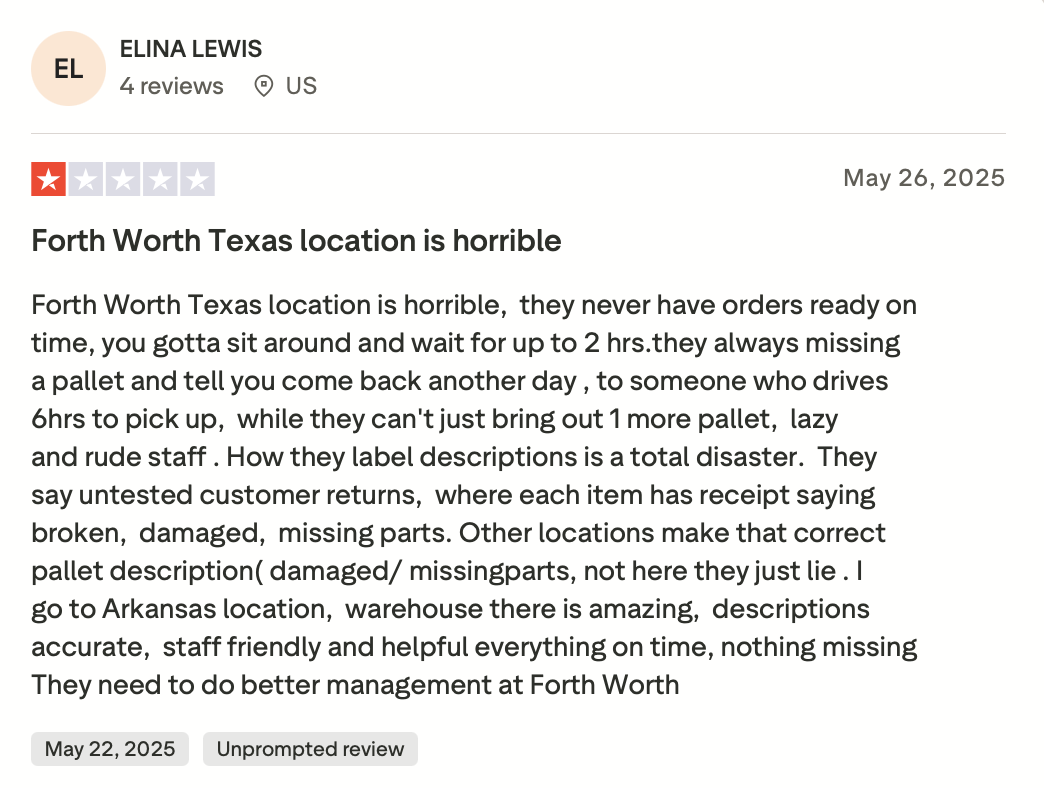
“I go to [the] Arkansas location, [the] warehouse there is amazing, descriptions accurate, staff friendly and helpful, everything on time, nothing missing.” (Elina L., Trustpilot, May 25th, 2025)
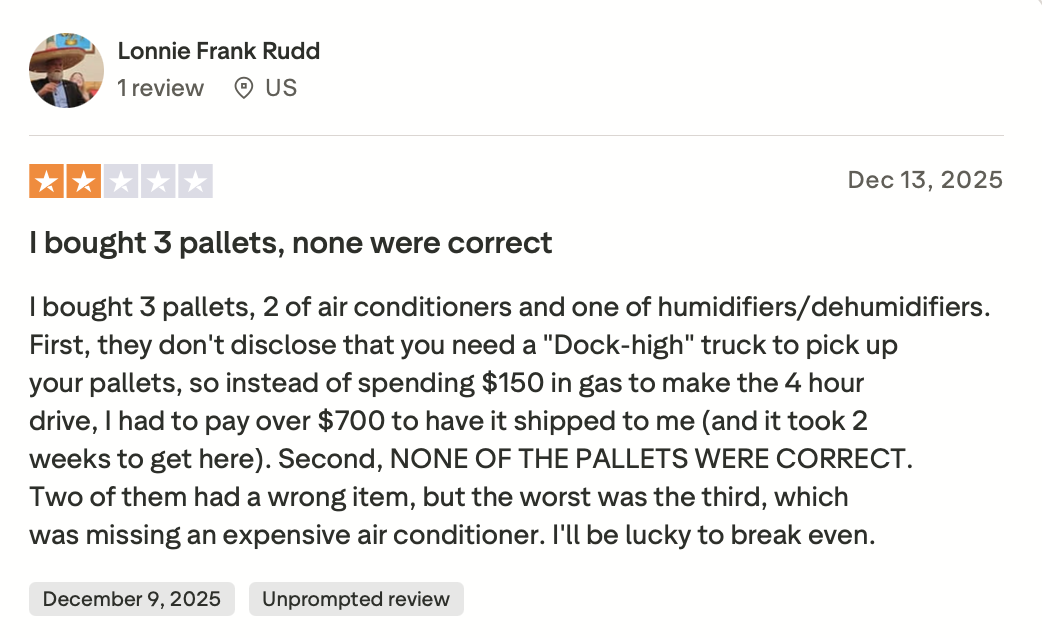
“They don’t disclose that you need a ‘Dock-high’ truck to pick up your pallets, so instead of spending $150 in gas to make the 4-hour drive, I had to pay over $700 to have it shipped to me.” (Lonnie R., Trustpilot, December 13th, 2025)
Direct Liquidation minimums and costs
Registration is free. You pay the winning bid, Buy Now price, or accepted offer, plus delivery unless you pick up. Check the total in the checkout screen before you confirm.
Bottom line
Direct Liquidation suits buyers who live near a well-run warehouse and can bring a truck that meets dock height. If you’re far from one, 888 Lots ships small orders without freight.
Thrift, outlet, and secondhand vendors
Thrift sources like Goodwill Outlets sell donated goods one piece or one pound at a time, with no manifest and no resale certificate needed. Margins are the widest on this list, but you pay in hours: sorting, cleaning, and photographing every item.
With online arbitrage, you do the same hunt on auction sites like ShopGoodwill, trading drive time for shipping costs and bidding competition from other resellers.
Secondhand wholesale marketplaces like Fleek sell donated clothing in graded bundles, so you skip the digging but wait weeks for delivery.
11. Goodwill Outlets: Best for clothing by the pound
Goodwill Outlets, known as “the bins,” are stores where local Goodwill organizations sell unsold donations from their regular shops by weight. Apartment Therapy counts 159 outlets against about 3,300 regular Goodwill stores in North America.
Who it’s for: Clothing resellers on Poshmark, Depop, eBay, and Mercari who can dig in person and process dozens of items a week.
Key features
- Per-pound pricing: You pay by weight at the register, at rates each local Goodwill sets and posts in-store. Some outlets price certain categories, such as furniture, per item instead.
- Bin rotations: Staff roll out fresh bins several times a day, and shoppers wait behind a line until staff signal the start.
- Weight discounts: Some outlets cut the per-pound rate on bigger hauls. Goodwill in Cleveland charges $1.89 a pound for textiles, dropping to $1.79 once you buy 25 pounds or more.
Goodwill Outlets pros
✅ Lowest cost per item: Most outlets charge about $1.50 to $2 a pound, so a few lightweight tops can cost well under a dollar each. Check our list of the best items to resell to see what to dig for.
✅ Second-chance stock: Regular Goodwill stores send unsold racks to the outlets, so branded and vintage pieces that were overpriced upstairs turn up for cents.
Goodwill Outlets cons
❌ No manifest, no returns: You find stains, holes, and missing buttons only once you’re home, and you can’t take them back.
❌ Labor per pound: Every piece needs inspecting, washing, and photographing, and a share of each haul goes straight to donation or textile recycling.
What real users say
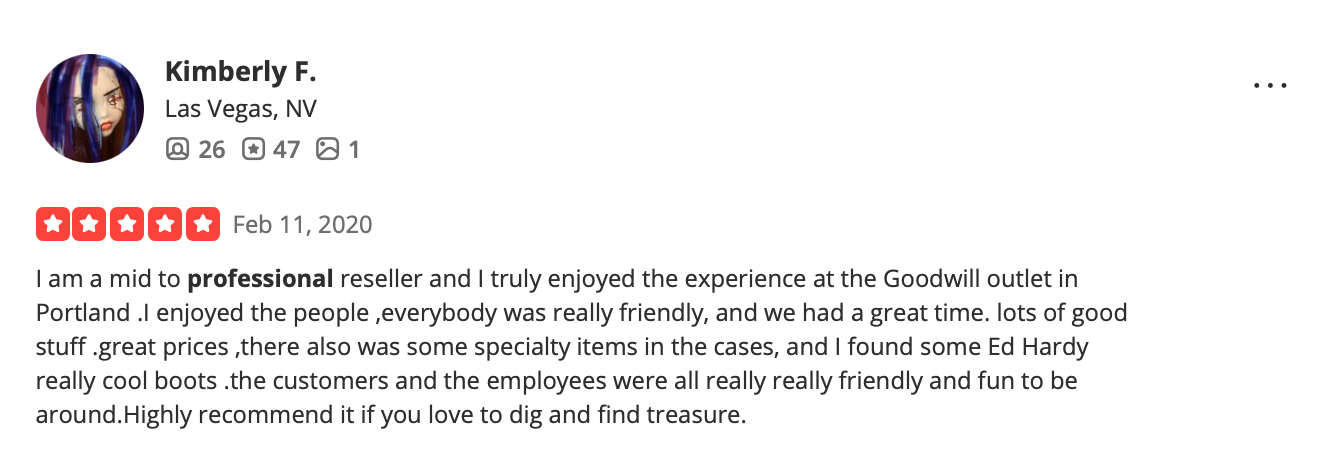
“I am a mid to professional reseller and I truly enjoyed the experience at the Goodwill outlet in Portland. … Lots of good stuff, great prices, there also was some specialty items in the cases, and I found some Ed Hardy really cool boots.” (Kimberly F., Yelp, February 11th, 2020)
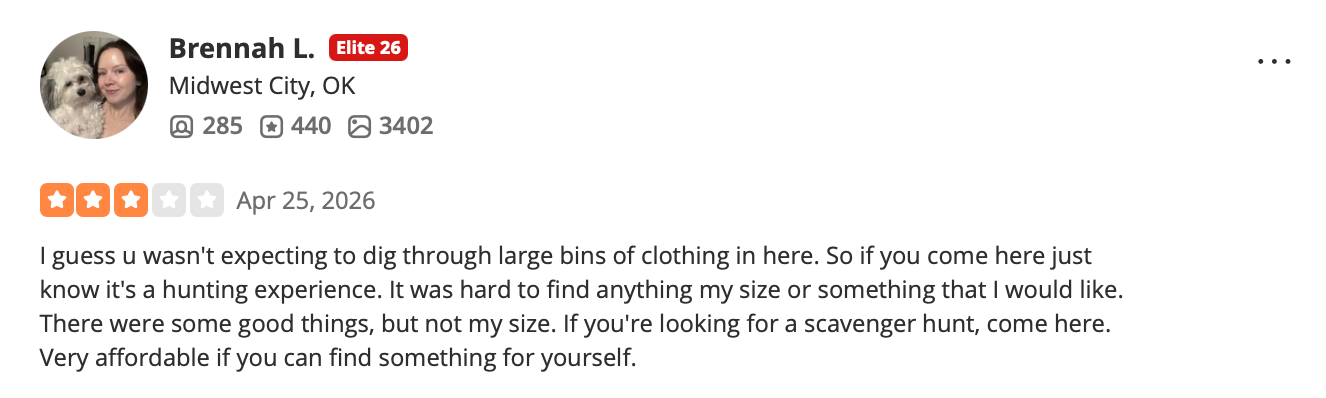
“I guess [I] wasn’t expecting to dig through large bins of clothing in here. … It was hard to find anything my size or something that I would like. There were some good things, but not my size.” (Brennah L., Yelp, April 25th, 2026)
Goodwill Outlets minimums and costs
There’s no membership or minimum, but rates vary widely by region. Goodwill Southern California charged $3.19 a pound for clothing and $1.19 for home goods in August 2024. Call your nearest outlet for its current rate.
Bottom line
Goodwill Outlets give clothing resellers the widest margins on this list if you have the hours to sort. If you can’t get to the bins, you can bid on the best Goodwill finds from home on ShopGoodwill.
12. ShopGoodwill: Best for niche single items
ShopGoodwill is an online auction site owned by Goodwill of Orange County, where Goodwill organizations list donated items for auction.
Who it’s for: Resellers who specialize in a niche, such as vintage Pyrex, designer bags, or film cameras, and want to source from home.
Key features
- Saved searches: You save a search, such as “Coach leather bag,” and check new matches without re-entering filters.
- Pickup scheduling: You can collect wins from the listing Goodwill instead of having them shipped, using the Pickup Schedule in your account.
- Wide seller pool: More than 130 Goodwill organizations in the US and Canada list on the site.
ShopGoodwill pros
✅ No business paperwork: Anyone can register and bid, with no resale certificate or minimum order.
✅ Pre-sorted donations: Goodwill staff pull higher-value donations for ShopGoodwill, so you skip the racks of everyday basics.
ShopGoodwill cons
❌ Shipping per Goodwill: Each Goodwill sets its own shipping and handling. Combined shipping covers only eligible wins from the same Goodwill.
❌ Bidding wars on known brands: Other resellers watch the same searches, which pushes prices on popular brands close to their resale value.
What real users say
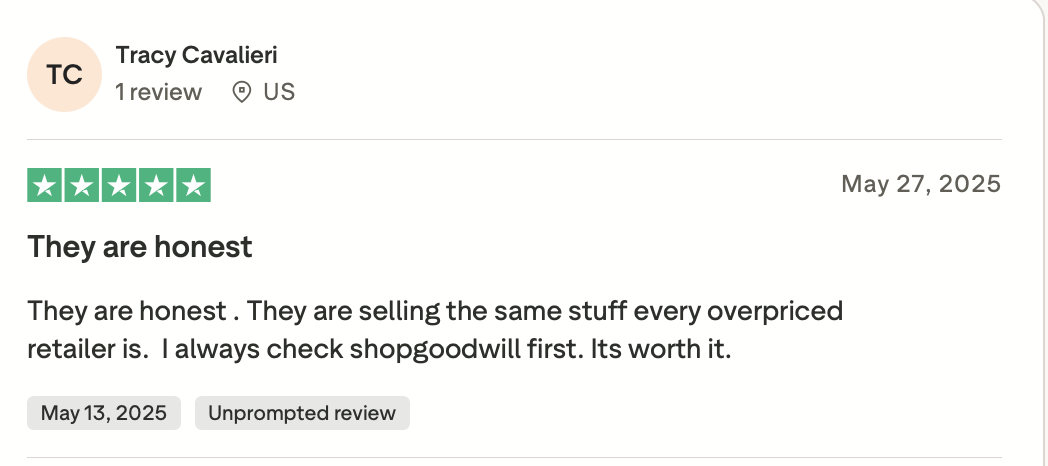
“They are honest … I always check ShopGoodwill first.” (Tracy C., Trustpilot, May 27th, 2025)
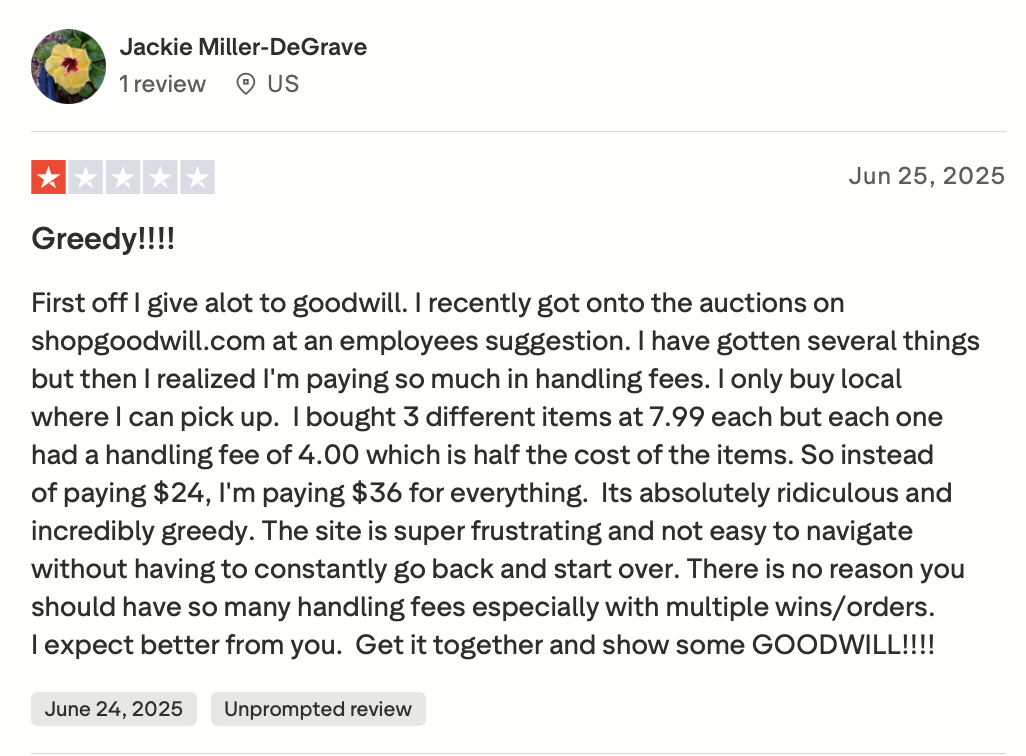
“I only buy local if I can pick up. I bought 3 different items at $7.99 each, but each one had a handling fee of $4.00, which is half the cost of the items.” (Jackie M., Trustpilot, June 24th, 2025)
ShopGoodwill minimums and costs
Registration is free, and you pay the winning bid plus shipping and handling. Scheduling a pickup removes the shipping charge but not the handling fee.
Bottom line
ShopGoodwill works when you know your niche’s sold prices well enough to set a hard maximum bid. Add shipping to that number before you place a bid.
13. Fleek: Best for secondhand clothing bundles
Fleek is a wholesale marketplace where resellers buy bundles of secondhand and vintage clothing from more than 1,000 verified suppliers. Most of its stock passes through sorting hubs in India and Pakistan before it ships.
Who it’s for: Clothing resellers on Depop, Poshmark, and eBay who want to restock by brand or category instead of hunting piece by piece.
Key features
- Graded bundles: Suppliers grade stock A, B, or C. According to Fleek, A-grade pieces are ready to list, and C-grade pieces need repairs but carry the highest margins.
- Supplier ratings: Other resellers rate and review each supplier, so you can check a supplier’s record before you order.
- In-app tracking: You can follow each order in the Fleek app from preparation through quality checks to delivery.
Fleek pros
✅ Restock by brand: You can buy bundles of one brand or style, such as Levi’s denim, graphic tees, or Y2K pieces, and then reorder the categories that sold.
✅ Returns on misdescribed items: If items don’t match the listing, Fleek accepts full returns and covers the return shipping, according to co-founder Abhi Arora.
Fleek cons
❌ Slow international delivery: Orders shipped from India or Pakistan usually take 21 to 28 working days, and the first leg can take up to 10 days without tracking.
❌ Cleanup on every bundle: Fleek expects about 20% of the items in a bundle to need minor cleaning or repair, so budget time to wash and mend stock before you list it.
What real users say
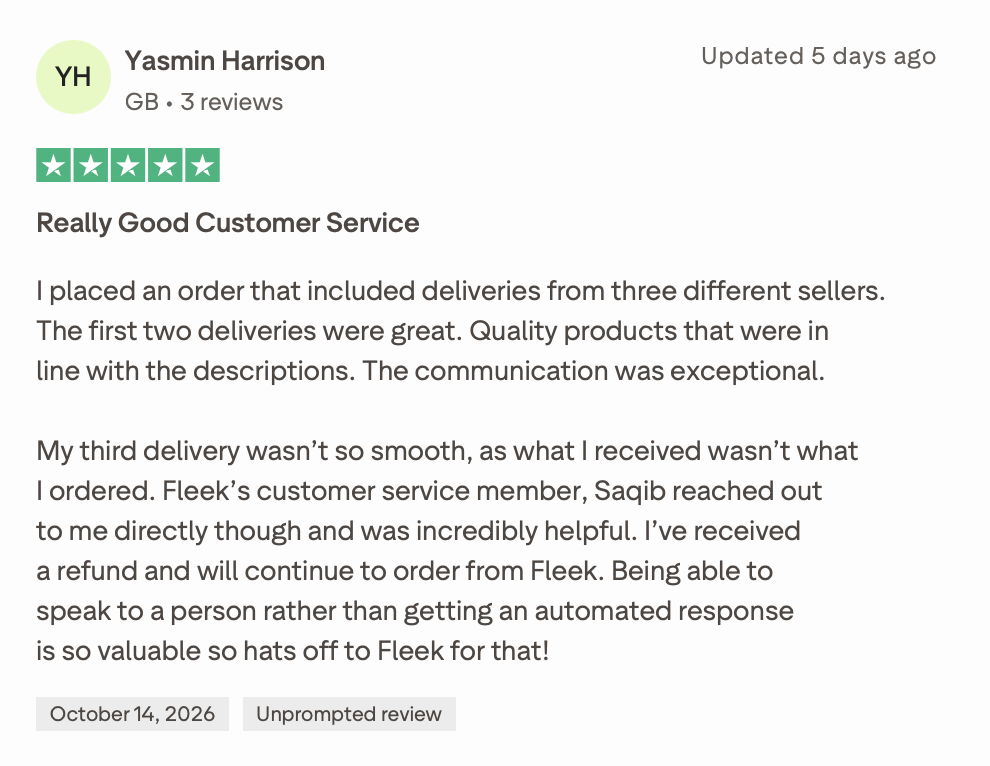
“My third delivery wasn’t so smooth, as what I received wasn’t what I ordered. Fleek’s customer service member, Saqib, reached out to me directly though and was incredibly helpful. I’ve received a refund and will continue to order from Fleek.” (Yasmin H., Trustpilot, October 14th, 2026)
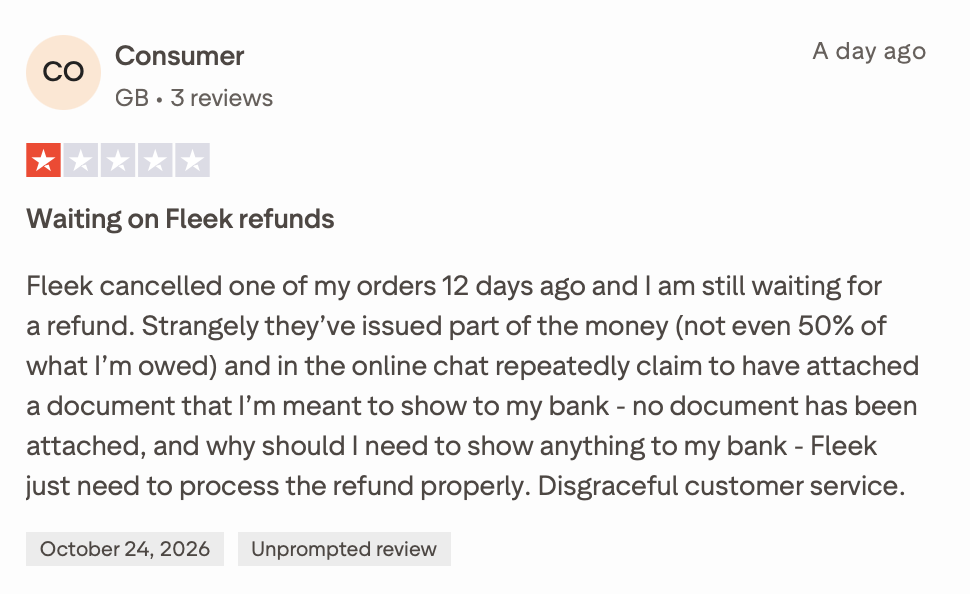
“Fleek cancelled one of my orders 12 days ago, and I am still waiting for a refund. Strangely, they’ve issued part of the money (not even 50% of what I’m owed).” (Anonymous, Trustpilot, November 4th, 2026)
Fleek minimums and costs
The Fleek app is free to download and join. Fleek says bundles start at 10 to 20 pieces, and you pay the bundle price plus a buyer protection fee at checkout.
Fleek says its listing prices already include shipping, duties, and taxes, so the price you see covers the trip from India or Pakistan.
Bottom line
Fleek suits resellers who know which brands sell for them and can wait about a month for a restock. If you need stock this week, Goodwill Outlets sell the same kind of donated clothing by the pound, though you sort it yourself.
How to vet a vendor for reselling
A legitimate vendor tells you who it is, what’s in the lot, and how you get your money back. Run these checks before you pay any vendor you haven’t bought from:
- Business identity: Look for a street address, phone number, and company name that match the domain’s registration and a Google Maps listing.
- Paper trail on stock: Ask for a manifest, a recent lot photo, or a paid sample. Vendors selling genuine returns or overstock can show where the goods came from.
- Payment method: Pay through the platform’s checkout or by credit card so you keep dispute and chargeback rights. Never pay a new supplier by wire, Zelle, crypto, or gift card.
- Written claim terms: Find the number of days you get to report shortages and who pays return shipping, then screenshot it before you order.
- Recent reviews: Sort Trustpilot and Reddit by most recent. A vendor with good reviews from 2023 can have new owners or a new warehouse team today.
Calculate cost per sellable item
To calculate cost per sellable item, divide the purchase price, inbound freight, buyer’s premium, import charges, and prep costs by the number of units you expect to sell, not the number in the lot.
A $300 lot with $90 freight costs $390. If 15 of its 50 items are unsellable, each sellable item costs $11.14, not the $7.80 you get by dividing across all 50.
Then subtract selling fees and outbound shipping from your expected sale price. Poshmark keeps 20% of sales of $15 or more, which turns a $25 sale into a $20 payout before shipping supplies.
🚩 Red flags
- Brand-name stock far below wholesale: New Nike, Lululemon, or Stanley stock at a fraction of retail with no manifest is usually counterfeit or stolen.
- Pressure to move off-platform: Beware of suppliers who offer a discount for paying outside Alibaba, DHgate, or eBay, because you’ll be giving up your buyer protection.
- Stock photos of pallets: Legitimate liquidators will have photographs of the actual lot. Sellers who reuse the same warehouse images across listings often resell someone else’s stock, or have none.
- No resale certificate check on wholesale prices: Established B2B liquidators like 888 Lots and B-Stock ask for one. A “wholesaler” that sells pallets with no paperwork deserves extra checks.
Is it legal to resell goods from “1:1 vendors”?
No, reselling goods from 1:1 vendors isn’t legal. A “1:1” or replica vendor list, sold through Instagram pages, Etsy shops, and standalone sites, is a list of suppliers who copy branded goods down to the logo. Reselling those goods as the brand is trademark counterfeiting under US law.
Marketplaces enforce this too. eBay bans replicas and fakes under its counterfeit policy, and Poshmark removes counterfeit listings and can suspend the closet that posted them.
Reselling genuine goods is legal. Under the first-sale doctrine, once a brand sells an authentic item, you can resell it, including items bought from liquidators, thrift stores, and wholesalers.
Which vendor type fits your business stage?
Match your vendor type to how many listings you manage and how much cash you can tie up in one order:
Skip vendors entirely if you:
- Haven’t sold your first 20 items yet: Resell what’s already in your home first, and use those sales to learn which categories move on your marketplaces before you buy stock. Our guide to starting a reselling business covers that first step.
- Have nowhere to store a pallet: A standard pallet takes up a 48-by-40-inch footprint and can stand over 5 feet tall, plus room to sort it.
Buy from 2+ vendor types if you:
- Sell on several marketplaces: Branded thrift finds suit Poshmark and Depop, while new-condition liquidation stock moves faster on eBay and Whatnot. A crosslisting tool like Nifty lets you list each item once and send it to Poshmark, Depop, eBay, and Whatnot.
- Want steadier supply: Thrift and outlet stock changes every trip, while wholesale and liquidation vendors let you reorder a category that already sold.
Sell more with Nifty
The best vendors for reselling solve your supply problem, but every item you buy still has to be listed. A large haul or a manifested lot means dozens of listings on every marketplace you sell on.
Nifty, a crosslisting and automation tool, lets you list and manage that inventory from one interface.
Here’s why sellers and resellers trust Nifty:
- Customized AI listings: Upload photos and let Nifty generate search-optimized titles, descriptions, and item details. Review the draft, then use custom instructions to shape its writing style.
- Crosslist now: List eligible items across eBay, Etsy, Poshmark, Whatnot, Mercari, and Depop from one interface instead of re-entering the details on each marketplace. Marketplace access and features depend on your connected accounts and plan.
- Bulk crosslisting: Select multiple existing listings in Nifty, choose your target marketplaces, pricing, and shipping, then save the AI-generated results as drafts or publish them.
- Marketplace-specific Pricing Rules: Set a primary marketplace and rules for how prices should change on other marketplaces, so you don’t have to calculate every crosslisted price from scratch.
- Built-in auto-delisting: Enable auto-delisting and Nifty can remove an eligible sold item from your other connected marketplaces, so you don’t risk selling the same item twice.
- Bulk tools = less busywork: Relist selected items in batches, schedule ready-to-publish drafts, and use supported automations to handle recurring selling tasks.
- Analytics and profits, made clearer: Track sales, fees, profit, and your top-selling brands and categories. You can also set seller goals and check your progress from Nifty’s home screen.
Start with a 7-day free trial and see how Nifty can help you list sourced inventory across multiple marketplaces. If you’re in Australia or the UK and selling on eBay, Etsy, Whatnot, and/or Depop, Nifty’s now available.
FAQs
1. Who is the most trusted vendor for reselling?
888 Lots is our pick for the most trusted liquidation vendor on this list, based on its detailed manifests, low minimum orders, and buyer feedback. Faire is a wholesale option for retailers with their own stores. Check the latest 888 Lots reviews and Faire reviews before ordering.
2. How do I get a vendor for reselling?
To get a vendor for reselling, register a business, get your state’s resale certificate, and apply to the vendor’s buyer program. Liquidators like B-Stock and 888 Lots approve you only after checking the certificate, while thrift sources need no paperwork.
3. How can I find suppliers for reselling?
You can find suppliers for reselling through free directories like Wholesale Central, paid ones like SaleHoo, wholesale marketplaces like Alibaba and Fleek, and liquidation sites like B-Stock. Vet each one with a sample or small first order before you scale up.
4. Is buying from reselling vendors legal?
Buying from reselling vendors is legal when the goods are genuine, thanks to the first-sale doctrine. Reselling goods from “1:1” or replica vendors isn’t: selling copies of branded goods is trademark counterfeiting, and eBay and Poshmark remove those listings.
5. Do I need a resale certificate to buy from vendors?
You need a resale certificate to buy from most liquidation vendors. B-Stock asks for one in states with sales tax, and 888 Lots asks every US buyer. Goodwill Outlets, ShopGoodwill, and DHgate don’t require one, though ShopGoodwill waives sales tax if you upload yours.