Best place to sell clothes online: 8 top sites in 2026

The best place to sell clothes online is Poshmark for everyday brands, Depop for vintage and streetwear, and Vinted for avoiding seller fees. For designer pieces, try The RealReal or Vestiaire Collective. ThredUp suits sellers who want someone else to handle a closet cleanout.
I compared these sites by fees, payment timing, listing work, and clothing fit. This guide focuses on U.S. sellers. The right choice depends on what you can earn after costs and how much time you want to spend earning it.
The 8 best places to sell clothes online: TL;DR
- Poshmark: Best for everyday brands
- Mercari: Best for mixed closets
- Vinted: Best for avoiding seller fees
- Depop: Best for vintage, Y2K, and streetwear
- eBay: Best for vintage, menswear, and sneakers
- The RealReal: Best for hands-off designer consignment
- Vestiaire Collective: Best for designer pieces you price yourself
- ThredUp: Best for hands-off closet cleanouts
How I evaluated these clothing resale sites
At first glance, most clothing resale sites seem similar. But to find out which ones were worth your time, I reviewed marketplace help pages, fee schedules, selling workflows, and customer feedback.
- Seller fees: What the site deducts, what the fee applies to, and whether payment processing or optional promotions cost extra.
- Payment timing: When sale proceeds become available and how long a withdrawal takes. Those are separate waits.
- Selling work: Whether you handle photos, listings, questions, and shipping, or send your clothes to a consignment service.
- Clothing fit: Where I’d start with everyday brands, vintage pieces, mixed stock, or designer clothing.
The best places to sell clothes online: Compared
1. Poshmark: Best for everyday brands
Poshmark is a U.S. and Canadian marketplace for clothing, shoes, and accessories, where buyers follow sellers’ closets and most sales start as offers.
Who it’s for: Sellers of brand-name clothing that typically sells for $15 or more.
Key features
- Prepaid shipping: Poshmark’s standard U.S. label costs buyers $6.49 and covers up to 5 lb through USPS Ground Advantage. If you offer a shipping discount, you pay the difference.
- Sharing: Each share moves a listing to the top of the "Just Shared" sort. Poshmark's web search now defaults to Relevance, where active, responsive closets are more likely to rank higher.
Poshmark pros
✅ One label for bundles: A buyer’s bundle under 5 lb ships on a single label, so several sales go out in one parcel.
✅ Free visibility: Sharing costs nothing, so you can keep listings near the top of search without buying promoted placement.
Poshmark cons
❌ High cut on cheap pieces: The $2.95 flat fee takes 25% of a $12 sale.
❌ Daily sharing: Each share drops down the feed as other sellers share, so staying visible means sharing your closet every day.
What real users say
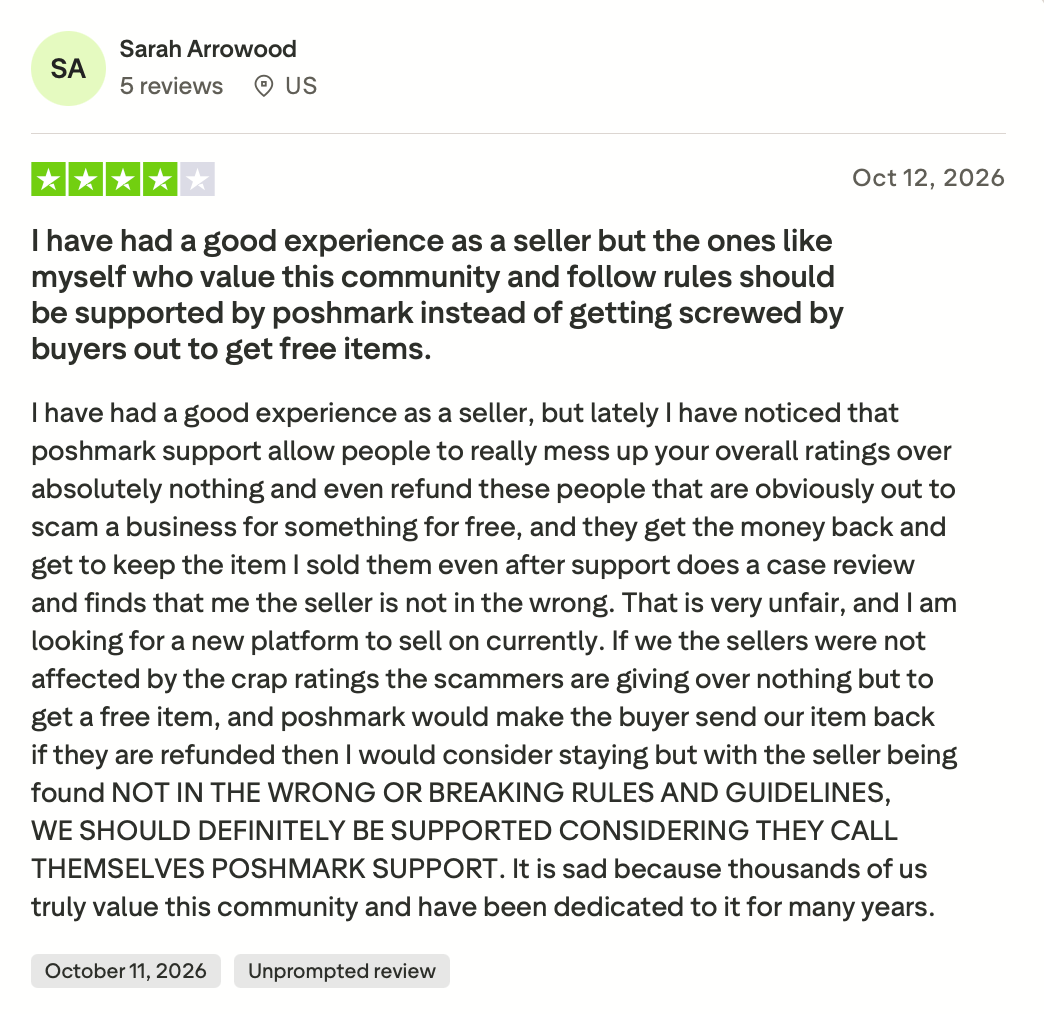
A U.S. seller rated Poshmark 4 stars for her selling experience. She also said Poshmark refunded buyers who kept her items, even after a case review cleared her. (Sarah A., Trustpilot, October 11th, 2026)
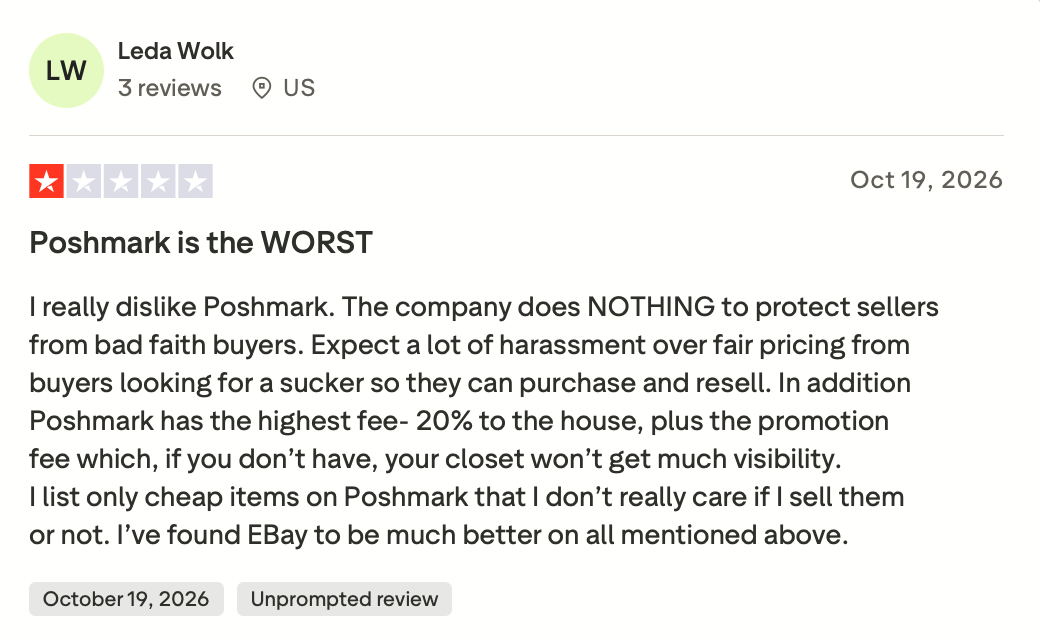
Another U.S. seller said she now lists only low-value items on Poshmark. She gave three reasons: the 20% fee, weak protection from bad-faith buyers, and low visibility without paid promotion. She said eBay worked better for her. (Leda W., Trustpilot, October 19th, 2026)
Poshmark fees and payout timing
- Selling fee: Poshmark charges $2.95 below $15 and 20% at $15 or more. A $40 blouse leaves $32 before other seller costs. Additional tax on fees applies to Texas sellers.
- Funds release: Poshmark releases earnings when the buyer accepts the order, or automatically three days after delivery if the buyer doesn’t report a problem.
- Bank transfer: Free direct deposits normally take two to three business days after you request them.
Bottom line
Choose Poshmark when you like its shipping setup and have enough margin to absorb the commission. For a pile of low-priced basics, I’d compare Vinted first.
2. Mercari: Best for mixed closets
Mercari is a general U.S. marketplace where buyers message sellers and make offers, as on Poshmark. To push a listing up, you use Mercari’s Promote feature.
Who it’s for: Sellers clearing clothing, shoes, toys, and other eligible household items.
Key features
- Smart Pricing: Set a starting price and a floor, and Mercari can lower the price over time based on demand.
- Shipping choices: Mercari recommends a shipping weight and the cheapest carrier in that weight class, and you choose whether you or the buyer pays.
Mercari pros
✅ Lower commission than Poshmark: Mercari takes 10% of the item price plus any buyer-paid shipping, against Poshmark's 20% on items $15 and over.
✅ Useful for a mixed clearout: You can work through several categories of unwanted items with the same listing routine.
Mercari cons
❌ Shipping counts in the fee: Buyer-paid postage increases your selling fee, even though that money goes on delivery.
❌ New accounts start at 100 listings: Mercari raises the cap by 100 with each completed sale, so crosslisting a full closet to a new account stalls before your first sale.
What real users say
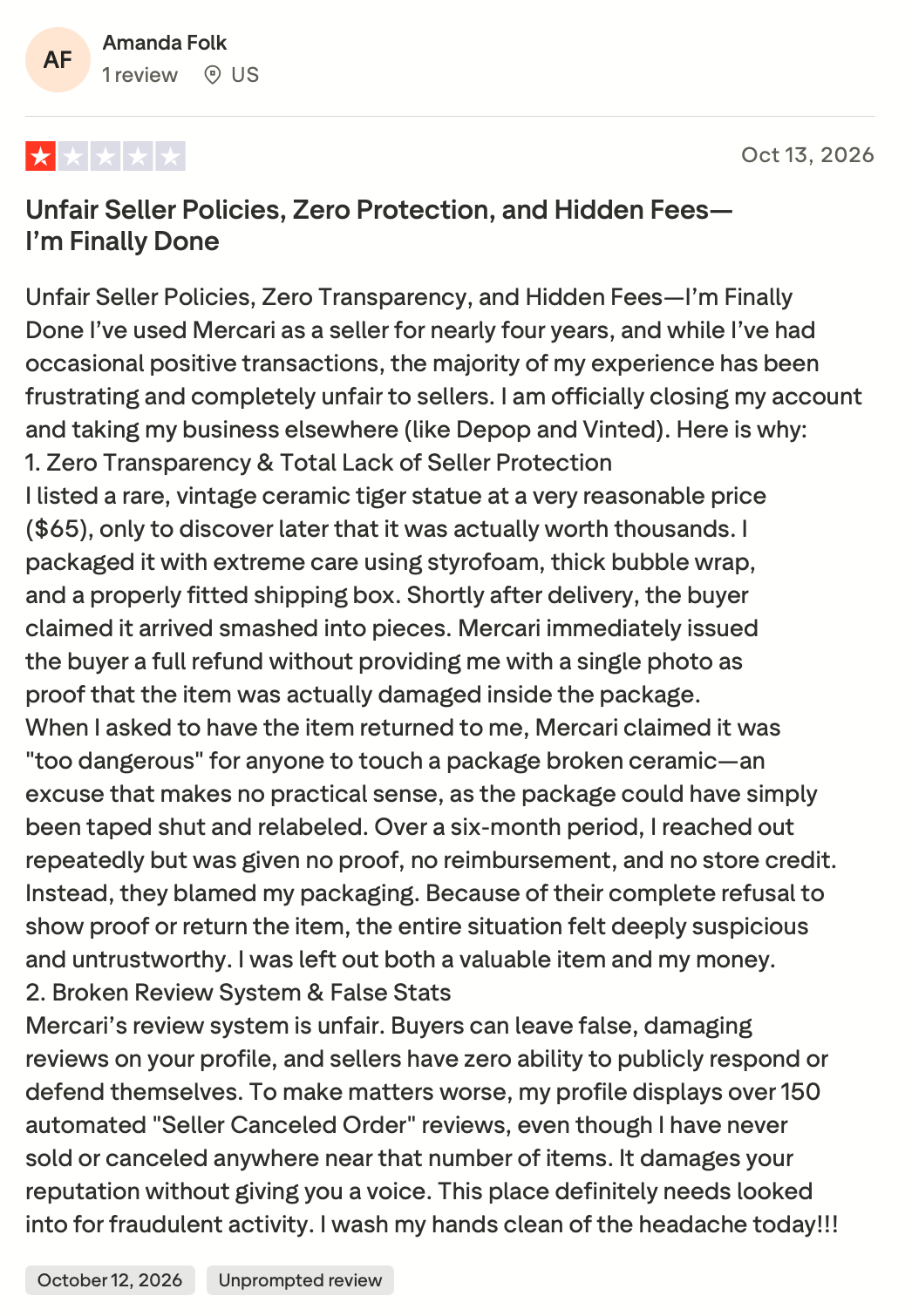
A seller of nearly four years said she’d had some positive transactions on Mercari. She closed her account after Mercari refunded a buyer’s damage claim on her $65 ceramic statue without showing her any photos. (Amanda F., Trustpilot, October 12th, 2026)
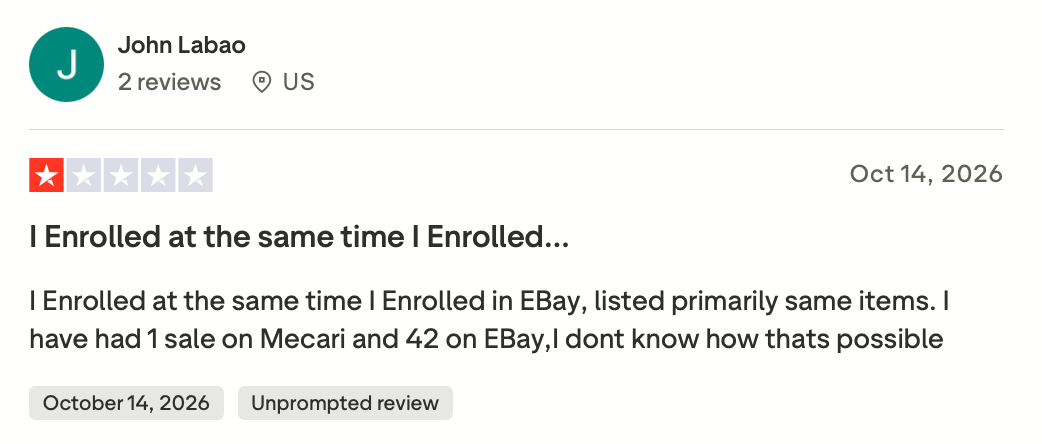
A U.S. seller listed mostly the same items on Mercari and eBay and reported 1 sale on Mercari against 42 on eBay. (John L., Trustpilot, October 14th, 2026)
Mercari fees and payout timing
- Selling fee: Mercari charges 10% of the item price plus buyer-paid shipping.
- Funds release: Payment becomes available after rating, or automatically after 72 hours from confirmed delivery if no issue pauses the transaction.
- Cash-out: Direct deposit is free and typically arrives within five business days. Instant Pay costs $3, can take up to 30 minutes, and is limited to one cash-out a day and $600 a month.
Bottom line
Try Mercari when clothing is part of a bigger cleanout. Weigh your packed parcels before choosing postage, and use our Mercari fee breakdown to plan your margin.
3. Vinted: Best for avoiding seller fees
Vinted is a secondhand fashion marketplace that charges buyers a protection fee at checkout instead of charging sellers a commission.
Who it’s for: People selling clothes they already own, particularly basics and children’s clothing.
Key features
- Bundle discounts: You can set a percentage off for buyers who buy several of your items at once.
- Prepaid labels: The buyer picks and pays for shipping at checkout, and Vinted sends you the label.
Vinted pros
✅ You keep the full sale price: A $12 top pays you $12, against $9.05 on Poshmark.
✅ No listing cap: You can list as many items as you like without paying for a listing allowance.
Vinted cons
❌ Listing reviews can delay posting: Vinted says screening can take 3 to 4 days in some cases, so a listing may not go live immediately.
❌ No buying and reselling for profit: Vinted's U.S. rules bar standard accounts from buying items to resell for profit, and Vinted Pro isn't available in the U.S.
What real users say
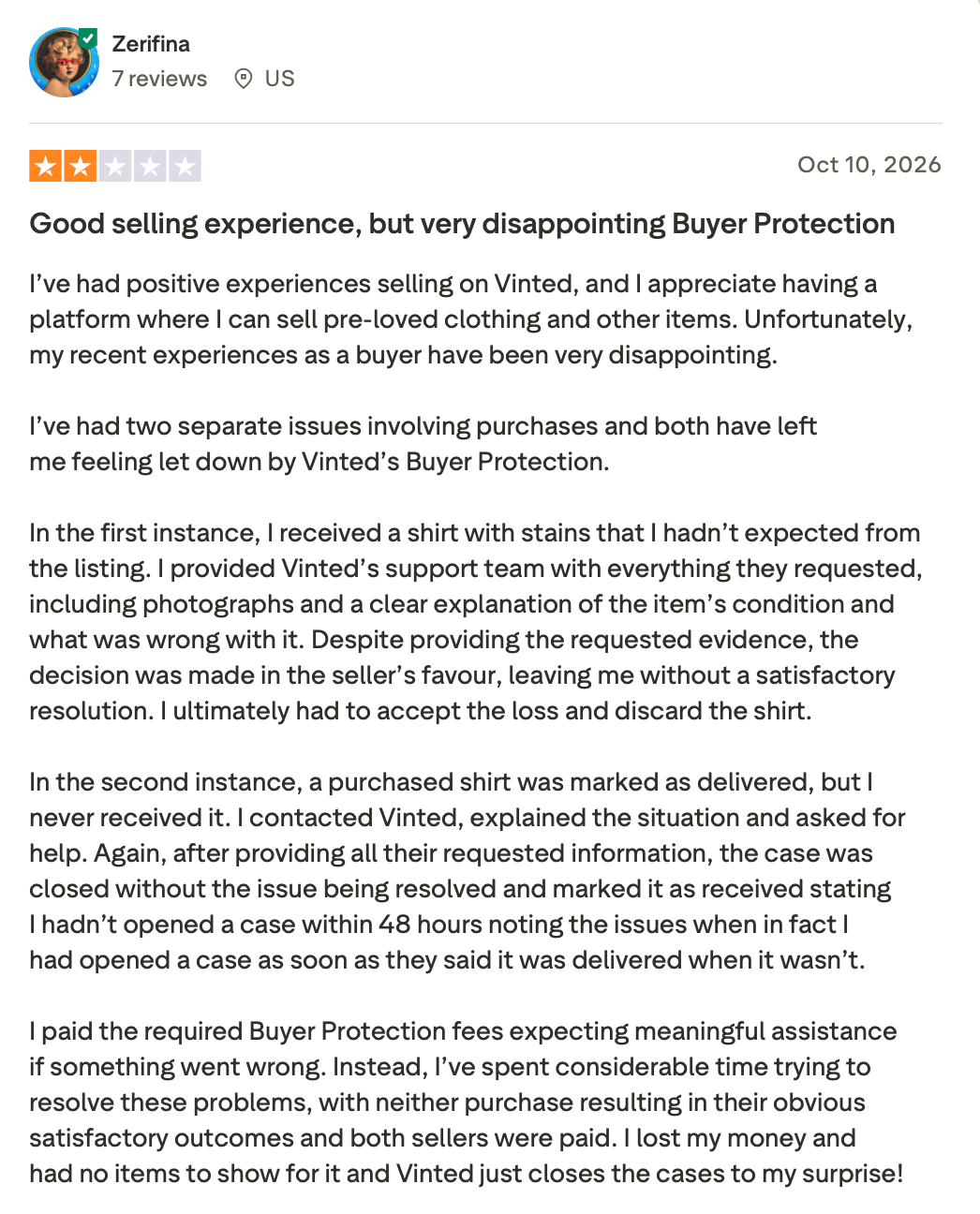
A U.S. member described selling on Vinted as a positive experience. The same member rated Vinted 2 stars because Vinted closed two buyer-protection cases without a refund. (Zerifina, Trustpilot, October 10th, 2026)
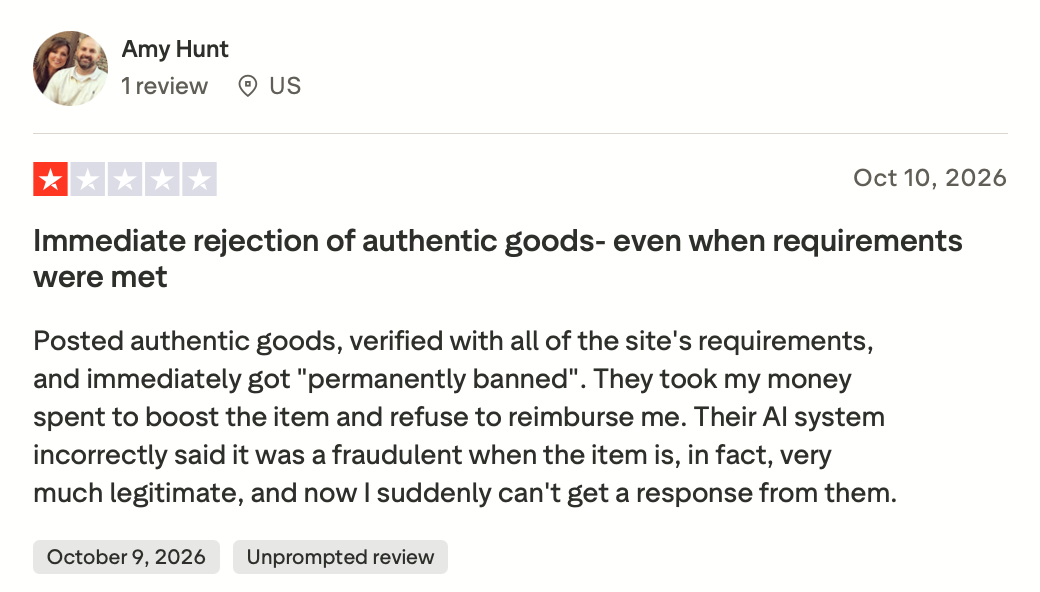
A U.S. seller said Vinted permanently banned her after flagging an authentic item as fraudulent. Vinted also kept the money she’d spent boosting it. (Amy H., Trustpilot, October 9th, 2026)
Vinted fees and payout timing
- Selling fee: No standard seller commission or listing fee. Optional promotion can add costs.
- Funds release: Payment moves to your available balance within two days of order completion.
- Bank transfer: Vinted withdrawals can take up to 5 business days after you request them.
Bottom line
Start your under-$15 pieces here. If your first batch gets little interest, try one of these sites like Vinted.
4. Depop: Best for vintage, Y2K, and streetwear
Depop is a resale app with a Gen Z audience, where each seller’s shop looks like a social media profile.
Who it’s for: Sellers with a consistent style, like ’90s denim or Y2K tops, who enjoy styling and photographing each piece.
Key features
- Shop profiles: Buyers can browse your listings through your profile. Our Depop vs. Poshmark comparison explains how their shop formats and selling tools differ.
- Boosting: Pay to promote single listings, or turn on Boost Shop to promote every current and future listing.
Depop pros
✅ Low fees on expensive pieces: A $200 jacket costs about $7 in processing before shipping and tax, against $40 in Poshmark commission.
✅ International sales: You enable international selling per listing by switching on "Worldwide" under Shipping.
Depop cons
❌ Offers aren’t binding: An accepted offer only reserves the price, so buyers can walk away without paying.
❌ Late suspensions: Depop can flag a banned item after it goes live and suspend the account instead of blocking the listing.
What real users say
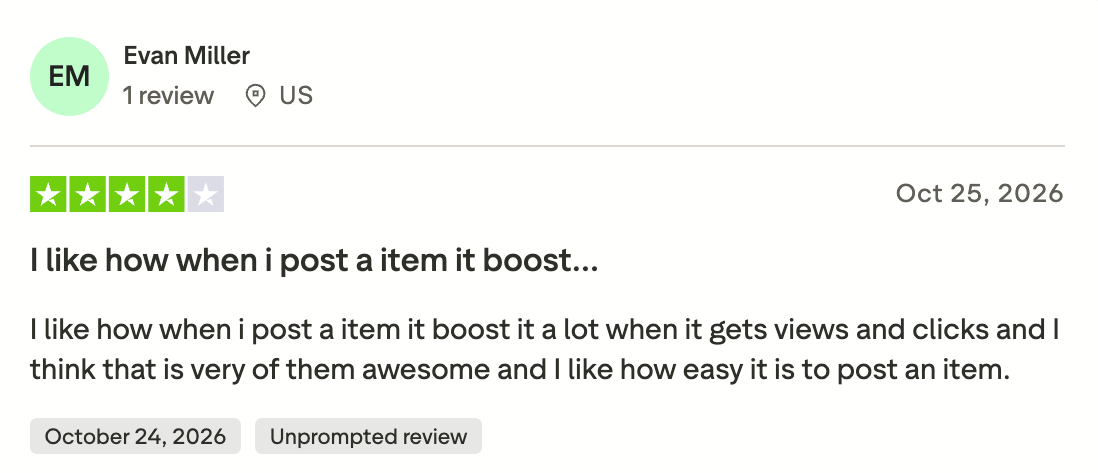
A U.S. seller rated Depop 4 stars. He said posting an item is easy and that Depop pushes listings to more buyers once they start getting views and clicks. (Evan M., Trustpilot, October 24th, 2026)
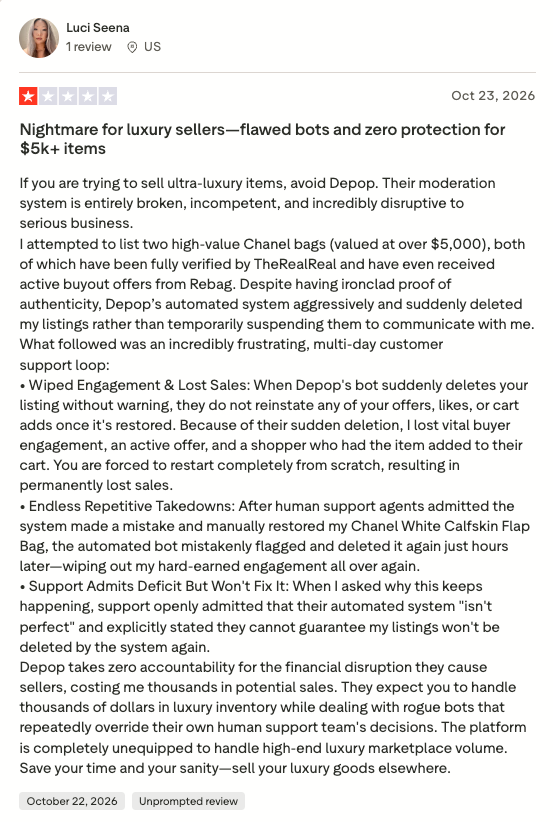
A U.S. luxury seller said Depop’s automated moderation deleted her listings for two Chanel bags. The RealReal had authenticated both bags, and the deletions wiped out an active offer and a buyer’s cart add. (Luci S., Trustpilot, October 22nd, 2026)
Depop fees and payout timing
Standard U.S. fees: No Depop selling fee, plus 3.3% + $0.45 payment processing on the item, shipping, and applicable taxes. On $50 + $6 postage, processing is about $2.30 before tax.
Boosting: For new U.S. listings from March 2026, the fee is 12% on attributed boosted sales. It covers the item price and seller-arranged shipping, excluding taxes, in addition to processing.
Funds release: Earnings clear two business days after delivery or ten business days after the sale, whichever comes first.
Bottom line
Try Depop for pieces you’d describe by era, aesthetic, or streetwear label. Keep boosting off until you know whether the extra fee leaves enough profit.
5. eBay: Best for vintage, menswear, and sneakers
eBay is a global marketplace whose buyers search by exact model and size, such as Levi’s 501 in W32 L30 or a specific Nike Dunk colorway.
Who it’s for: Sellers who will measure each piece and check sold prices before listing.
Key features
- Listing formats: eBay offers auction and fixed-price selling. Choose bidding for pieces with uncertain value, or a fixed price when you have useful sold comparisons.
- Shipping tools: eBay provides carrier labels and a shipping calculator. Compare the actual packed weight and dimensions before setting your delivery charge.
eBay pros
✅ 24 full-size photos: eBay keeps up to 24 photos per listing at high resolution, against Poshmark’s 16, so you can show labels and flaws on vintage.
✅ Overseas buyers: With eBay International Shipping, you send the parcel to a U.S. hub, and eBay handles customs and the international leg.
eBay cons
❌ Postage varies by sale: The label you buy at sale time can cost more or less than the shipping you charged, so profit shifts by a few dollars per order.
❌ Fees on tax and postage: The 13.6% applies to the buyer’s full total, including sales tax and shipping.
What real users say
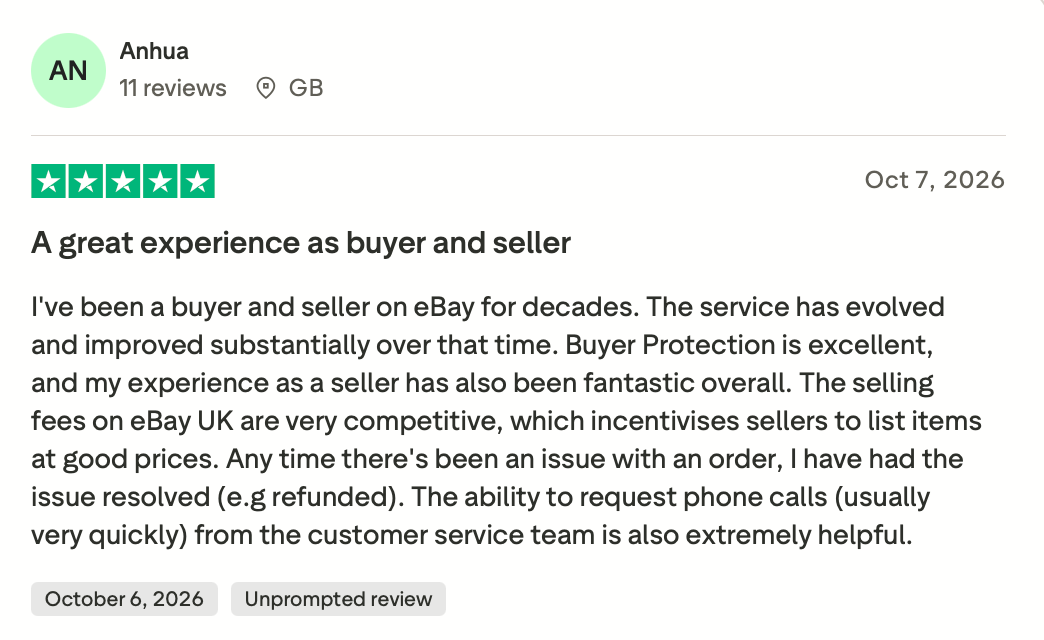
A UK seller with decades on eBay rated it 5 stars. Anhua pointed to competitive eBay UK selling fees, refunds whenever an order went wrong, and fast callbacks from customer service. (Anhua, Trustpilot, October 6th, 2026)
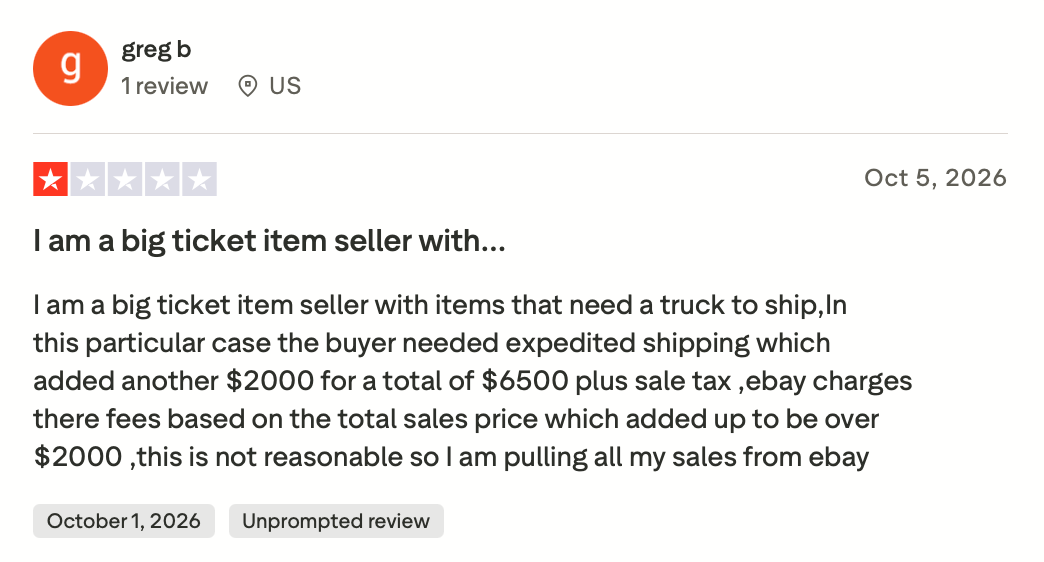
A U.S. seller of truck-freight items said he pulled all his listings. eBay charged over $2,000 in fees on a $6,500 sale because the total included $2,000 of expedited shipping and sales tax. (Greg B., Trustpilot, October 1st, 2026)
eBay fees and payout timing
- Most clothing: The standard rate without a Store subscription is 13.6% of the total sale up to $7,500, plus $0.40 per order above $10 or $0.30 at $10 or less. Category exceptions and Store rates differ.
- Worked example: A $50 item with $6 shipping incurs about $8.02 in standard fees before tax. After paying $6 postage, you keep about $41.98 before other costs.
- Payouts: Standard payouts are initiated within two business days of payment confirmation, subject to holds and your schedule. Bank processing adds time. Eligible express payouts cost $2 and typically arrive within 30 minutes of sending.
Note: From November 2026, eBay is gradually moving eligible U.S. private sellers to eBay balance, where payouts are on-demand by default unless you pick an automatic schedule.
Bottom line
Choose eBay if your stock benefits from precise product details. Before pricing a rare piece, work through our guide to selling vintage items.
6. The RealReal: Best for hands-off designer consignment
The RealReal is a U.S. luxury consignment company. You send designer pieces, and its team authenticates, photographs, prices, and sells them.
Who it’s for: Owners of clothing from labels on The RealReal’s accepted-designer list, such as Gucci, Chanel, and Prada.
Key features
- Pricing handled for you: The RealReal sets the initial asking price, using factors such as brand, condition, and demand. You don’t need to research and price every piece yourself.
- Sales tracking: The My Sales area shows your items, commissions, and payment information.
The RealReal pros
✅ No buyer contact: The RealReal handles questions, shipping, and returns with the buyer.
✅ A designer-focused service: You can check whether your labels qualify before deciding what to send.
The RealReal cons
❌ Small share on cheaper clothing: You typically keep 20% of clothing that sells for under $100, and the rate only reaches 70% for items over $5,000.
❌ The RealReal picks the price: Its team sets the initial asking price, so you don't control what each piece is listed for.
What real users say

A U.S. customer who said she has worked with The RealReal for years rated it 5 stars and called the team professional and accommodating. (Elena S., Trustpilot, October 13th 2026)
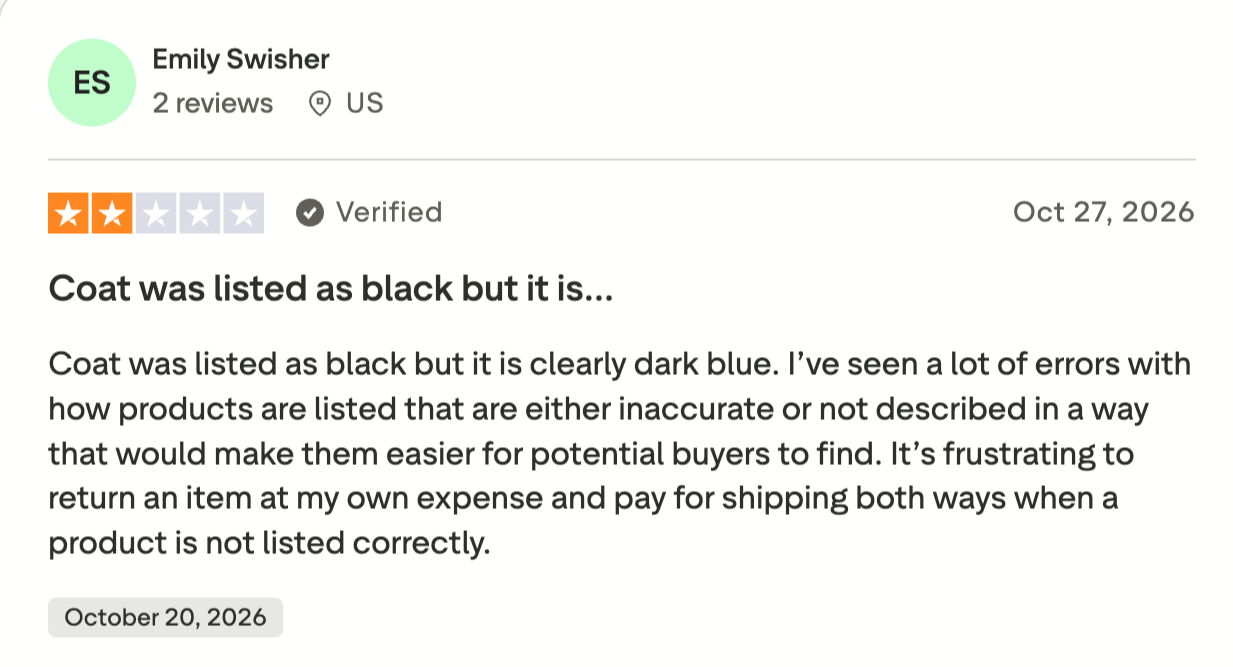
A U.S. buyer rated The RealReal 2 stars after a coat listed as black arrived dark blue. She said she has seen many listing errors on the site, and she had to pay return shipping both ways for an item The RealReal described incorrectly. (Emily S., Trustpilot, October 20th 2026)
The RealReal fees and payout timing
- Commission: Check the current earnings guide for your item and rewards tier. Bonuses apply to eligible items priced at $200 or more. Use the rate for your clothing category when estimating earnings.
- For clothing, The RealReal's earnings guide shows you keep 20% of items that sell for under $100, rising to 70% for items over $5,000. Once your net sales reach $1,500, loyalty bonuses of 1% to 5% apply to items that sell for $200 or more.
- Payment: Commissions are processed on the 15th of the month after the sale, or the following Monday if the 15th falls on a weekend. Direct deposits can take up to 48 hours to reach your bank.
- Eligibility: Consignors need a U.S. address and U.S. bank account. Check accepted designers and any return fees before sending pieces.
Bottom line
Choose The RealReal when you want to hand over the selling work. If controlling the asking price matters more, compare Vestiaire Collective.
7. Vestiaire Collective: Best for designer pieces you price yourself
Vestiaire Collective is a Paris-founded designer resale marketplace where you set your own price and list each piece yourself.
Who it’s for: Sellers of eligible designer clothing, bags, shoes, and accessories.
Key features
Two shipping routes: Eligible sales use authenticated or direct shipping. Authenticated orders go through checks at Vestiaire’s warehouse. Direct orders go to the buyer.
Prepaid labels: Vestiaire supplies prepaid shipping labels in supported selling locations.
Vestiaire Collective pros
✅ Higher share than consignment: You keep $80 of a $100 sale and can cut the price yourself instead of waiting for a markdown.
✅ Fast payouts: Vestiaire issues payouts within 24 hours of a sale completing, and U.S. bank transfers take about two more business days.
Vestiaire Collective cons
❌ A substantial fee: Standard percentage charges add up to 20% for many new U.S. listings.
❌ No listings under $18: The minimum U.S. price rules out low-value designer basics.
What real users say
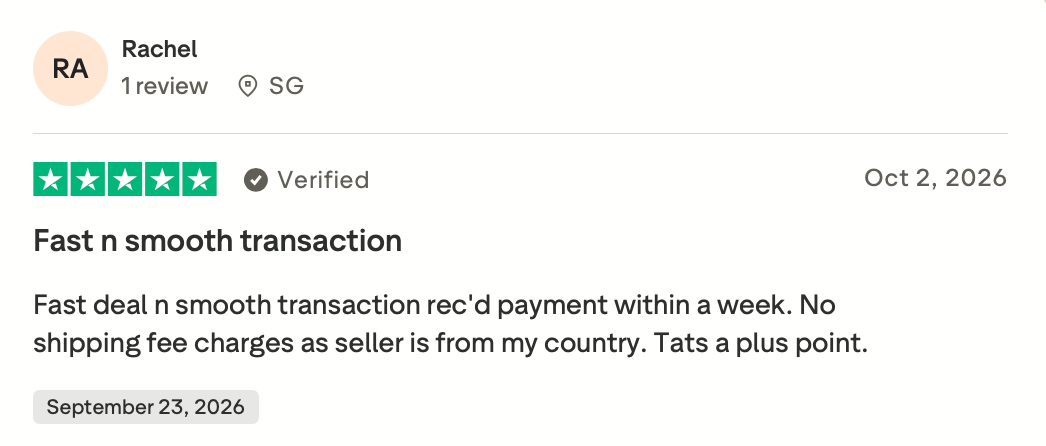
A seller in Singapore reported a fast sale on Vestiaire. Payment arrived within a week, with no shipping charge because the buyer was in the same country. (Rachel, Trustpilot, September 23rd, 2026)
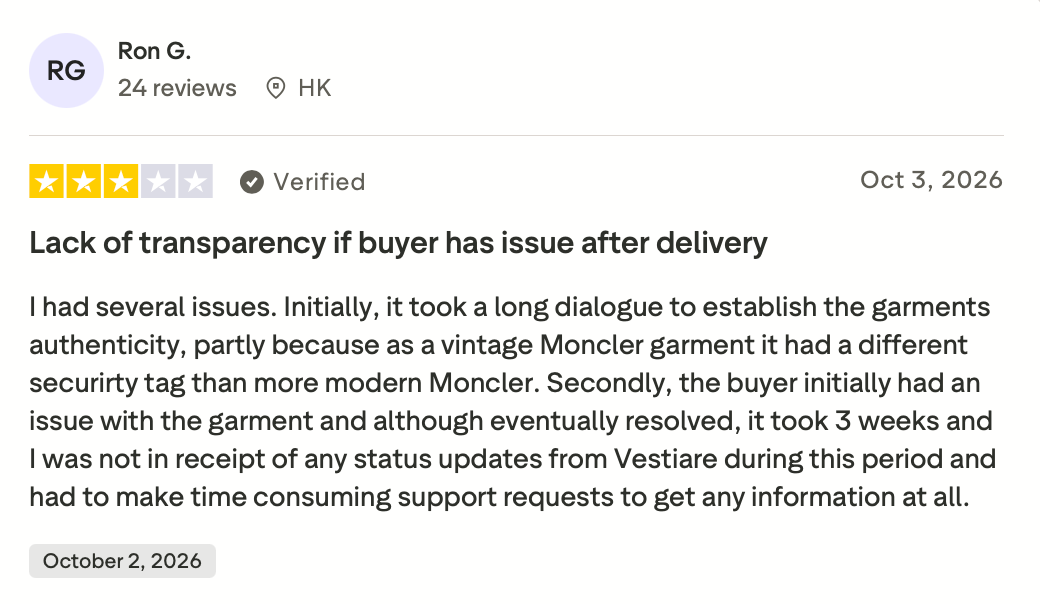
A Hong Kong seller rated Vestiaire 3 stars. Authenticating a vintage Moncler piece took a long exchange, and a buyer’s complaint then took three weeks to resolve with no status updates from Vestiaire. (Ron G., Trustpilot, October 2nd, 2026)
Vestiaire Collective fees and payout timing
U.S. fees for new listings from October 2026 are shown below. Older listings can have different fees, and the minimum USD listing price is $18.
Below $75, the selling fee is $12. From $75 to $15,000, it’s 17%. Above $15,000, it’s $2,500. Processing is 3%, with a $3 minimum. Figures above exclude any other applicable seller costs.
Payouts are issued within 24 hours of sale completion. Authenticated sales usually complete within two business days of warehouse arrival. Direct sales normally complete 72 hours after buyer delivery, or sooner if accepted. U.S. bank transfers then take about two business days.
Bottom line
Choose Vestiaire when you want to price designer pieces yourself. Check the proposed payout on each item instead of assuming every designer label will justify the fees.
8. ThredUp: Best for hands-off closet cleanouts
ThredUp is a U.S. online thrift store. With its Clean Out service, you mail in a bag of clothes, and ThredUp sells the pieces it accepts.
Who it’s for: People clearing women’s and children’s clothing they would otherwise donate.
Key features
Managed selling: ThredUp handles inspection, photography, pricing, and listings for accepted Clean Out items.
Separate self-listing option: Direct Listing launched in open beta in June 2026. You list and ship yourself, with 0% seller fees. It’s a different service from Clean Out.
ThredUp pros
✅ Nothing up front: ThredUp takes its service fee out of your earnings only after items sell.
✅ Some price control: Standard Clean Out prices can be increased by up to 10%, and Premium prices by up to 80%, before an item enters a cart.
ThredUp cons
❌ Some brands earn nothing: Low-resale-value brands can be excluded from payouts unless an item sells for $20 or more.
❌ A wait of two months or more: Processing, the selling window, and the 14-day return window add up to 65–87 days before earnings clear.
What real users say
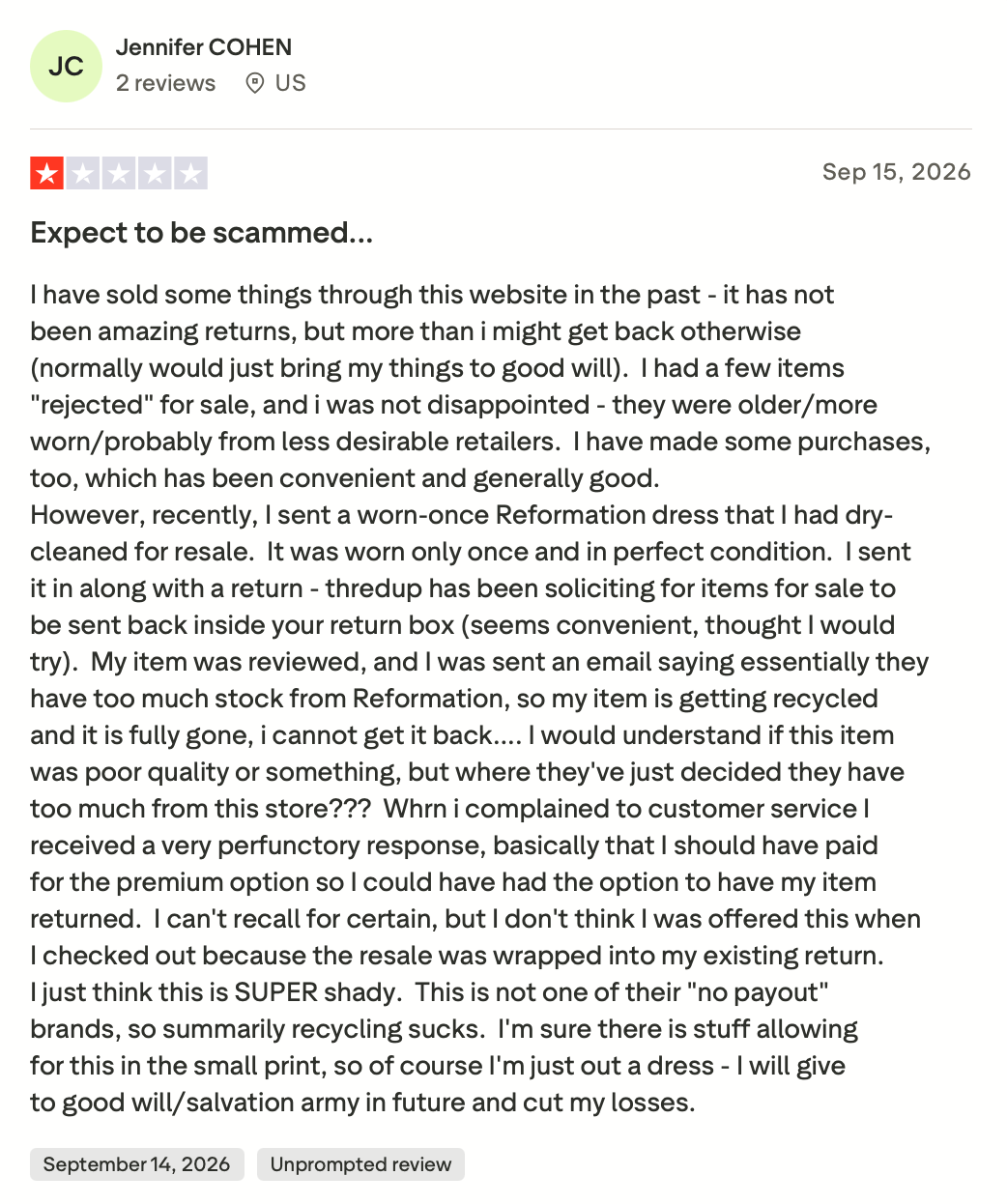
A U.S. seller said past ThredUp payouts beat what she’d get by donating to Goodwill. ThredUp later recycled her worn-once Reformation dress, citing too much Reformation stock, and she couldn’t get it back. (Jennifer C., Trustpilot, September 14th, 2026)
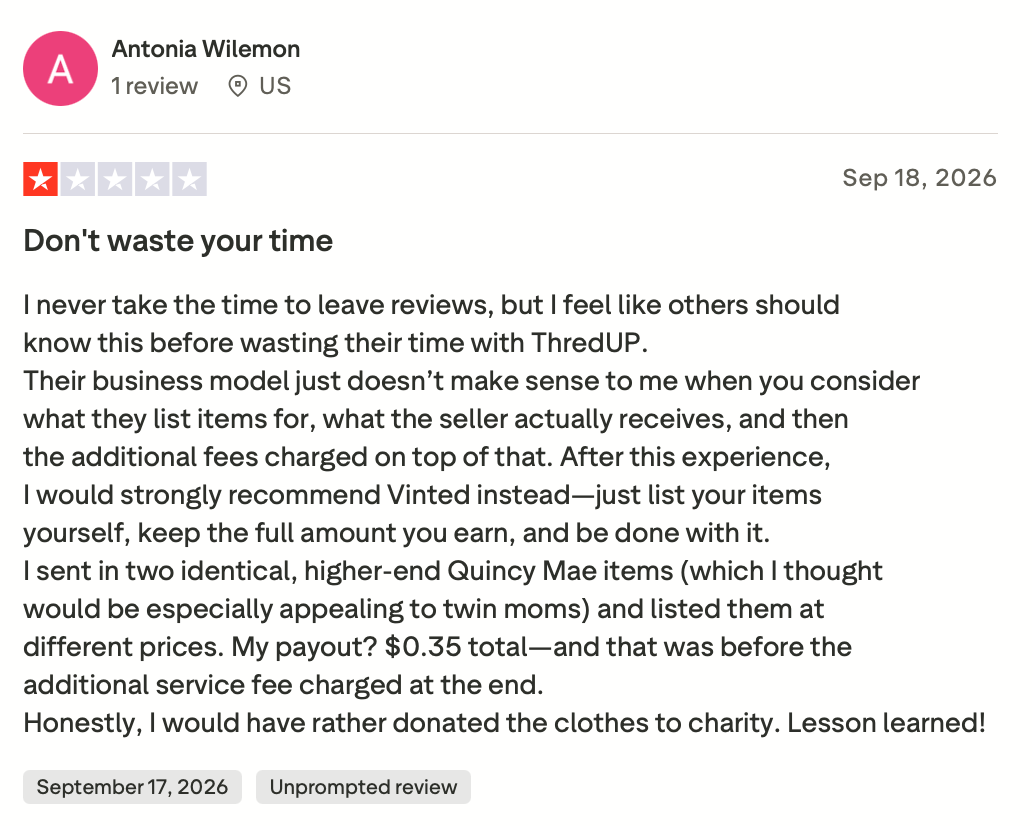
Another U.S. seller sent in two higher-end Quincy Mae items and earned $0.35 in total before ThredUp’s service fee. She now recommends listing clothes on Vinted yourself. (Antonia W., Trustpilot, September 17th, 2026)
ThredUp fees and payout timing
- Service fee: The Clean Out page lists $14.99 for Standard and $34.99 for Premium, deducted from earnings. At the October 21, 2026 check, it advertised a Standard fee waiver for bags returned within 30 days. Check your order’s offer.
- Payout: ThredUp’s earnings guide shows $3 on a $20 sale, $15 on $50, and $60 on $100, before applicable service fees. Eligible $200 sales pay 80%.
- Timing: Standard processing is listed at 21–28 days after arrival, followed by a 30–45-day selling window. Earnings follow the buyer’s 14-day return window. Cash-out adds another step.
Bottom line
Choose Clean Out when the saved work matters more than the payout. For clothes you’re willing to photograph and ship, compare a self-listing option before putting them in the bag.
Should you sell clothes yourself or use consignment?
Start with the likely payout, then decide whether the extra work is worth it. For a $50 item, Poshmark’s standard commission leaves $40. ThredUp’s published Clean Out example pays $15 before service fees. That $25 gap is the amount you’re weighing against your time.
That comparison assumes both services sell the item for $50. They may set or achieve different prices, and the item may remain unsold. Compare realistic sold prices, fees, and effort together.
Which is the best place to sell clothes online for you?
The best place to sell clothes online depends on the pieces you have and the work you’ll actually do. Here’s where I’d start:
Choose Poshmark if you …
Have everyday brands with enough margin for its commission and want straightforward prepaid shipping.
Choose Mercari if you …
Want to sell clothes alongside other household items through the same account.
Choose Vinted if you …
Have low-priced clothing and want to avoid standard seller fees.
Choose Depop if you …
Have vintage, Y2K, or streetwear pieces you enjoy photographing and presenting.
Choose eBay if you …
Have clothing or sneakers that benefit from detailed labels, measurements, and product information.
Choose The RealReal if you …
Want someone else to manage accepted designer pieces and are comfortable with its pricing and commission terms.
Choose Vestiaire Collective if you …
Want to choose the asking price for designer pieces and manage their listings yourself.
Choose ThredUp if you …
Want a managed cleanout of eligible women’s or children’s clothing and accept the payout trade-off.
Skip individual listings if you …
Have worn, low-value clothes whose likely return won’t justify photos, messages, and packing. A local clothing swap, donation, or suitable textile collection may be a better use of your time.
How to sell the same clothes on several sites
You don’t need to choose one site for your entire closet. Try a few suitable pieces on two marketplaces, then compare interest, final sale prices, and the work involved.
Remove duplicate listings as soon as an item sells. Keep the item available to ship, and avoid crosslisting anything you’ve already handed over under a consignment agreement unless that agreement allows it.
On supported marketplaces, Nifty’s auto-delisting can remove linked listings after an eligible sale. Turn it on and check that the listings are linked correctly. It reduces the risk of double sales, but doesn’t make simultaneous purchases impossible.
Sell more with Nifty
Selling clothes on Poshmark, Mercari, Depop, and eBay at the same time multiplies your buyers and your busywork. Nifty, a crosslisting and automation tool, lets you manage and crosslist inventory across multiple marketplaces from one interface, so you don’t have to depend on a single marketplace.
Here’s why more than 30,000 sellers and resellers trust Nifty:
- Customized AI listings: Upload photos and let Nifty generate search-optimized titles, descriptions, and item details. Review the draft, then use custom instructions to shape its writing style.
- Crosslist now: List eligible items across eBay, Etsy, Poshmark, Whatnot, Mercari, and Depop from one interface instead of re-entering the details on each marketplace. Marketplace access and features depend on your connected accounts and plan.
- Bulk crosslisting: Select multiple existing listings in Nifty, choose your target marketplaces, pricing, and shipping, then save the AI-generated results as drafts or publish them.
- Marketplace-specific Pricing Rules: Set a primary marketplace and rules for how prices should change on other marketplaces, so you don’t have to calculate every crosslisted price from scratch.
- Built-in auto-delisting: Enable auto-delisting and Nifty can remove an eligible sold item from your other connected marketplaces, so you don’t risk selling the same item twice.
- Bulk tools = less busywork: Relist selected items in batches, schedule ready-to-publish drafts, and use supported automations to handle recurring selling tasks.
- Analytics and profits, made clear: Track sales, fees, profit, and your top-selling brands and categories. You can also set seller goals and check your progress from Nifty’s home screen.
Start with a 7-day free trial and see how Nifty can help you sell clothes across Poshmark, Mercari, Depop, and eBay. If you’re in Australia or the UK and selling on eBay, Etsy, Whatnot, and/or Depop, Nifty’s now available.
FAQs
1. What is the best place to sell clothes online for free?
Vinted is the best place to sell clothes online for free if you want to avoid standard U.S. seller fees. You list, photograph, and ship the items yourself. Optional promotions can cost extra, and buyers pay shipping and applicable checkout fees.
2. Where can I sell clothes online for cash fast?
You can sell clothes online for fast cash through eBay or Poshmark, but payment isn’t immediate. Available funds may qualify for faster cash-out options. Buyer payment, delivery, account holds, and bank processing all affect when you receive the money.
3. Which site has the lowest fees for selling clothes?
Vinted has the lowest standard seller fees for selling clothes among these marketplaces, at $0. ThredUp Direct Listing also advertises 0% seller fees. Depop charges U.S. sellers 3.3% + $0.45 processing, with optional boosting charged separately.
4. Can I sell the same clothes on multiple sites?
Yes, you can sell the same clothes on multiple sites if their rules allow it and you remove duplicate listings once an item sells. Nifty can auto-delist eligible linked listings on supported marketplaces. Check consignment terms before listing items held by a service.