How to start a reselling business in the UK: 8 steps
.png)
You can start a reselling business in the UK by gathering all that stuff you no longer want, like old clothes and unused electronics, and listing them on marketplaces like eBay or Depop.
But when you actually start sourcing items, you’ll want to follow a system.
I've walked new resellers through this exact starting point, from figuring out what's actually worth listing to knowing when HMRC starts caring about your sales. Here's the 8-step guide to launching a reselling business in the UK and making it profitable.
How to start a reselling business in the UK: 8 steps at a glance
→ Step 1: Decide what you’re going to resell
→ Step 2: Research product demand and resale prices
→ Step 3: Choose where you’ll source inventory
→ Step 4: Calculate whether an item is profitable
→ Step 5: Choose the best marketplaces for products
→ Step 6: Understand UK tax and business requirements
→ Step 7: Create and list your inventory
→ Step 8: Track your sales metrics
Step 1: Decide what you're going to resell
Before you start reselling in the UK, choose one product category. Your choice will affect your storage needs, shipping costs, and risk of returns.
Choose a category you already know about or enjoy. For example, if you love running, you could sell trainers and other athletic gear. If you collect sports cards or other items, selling collectables could be right up your alley.
Starting with a product category you know can make pricing items and answering buyer questions easier. Plus, you’ll probably enjoy selling it more.
Step 2: Research product demand and resale prices
To research product demand, you’ll need to start by going onto platforms like eBay, Depop, or Etsy (if the seller has sold records switched on). Follow these tips:
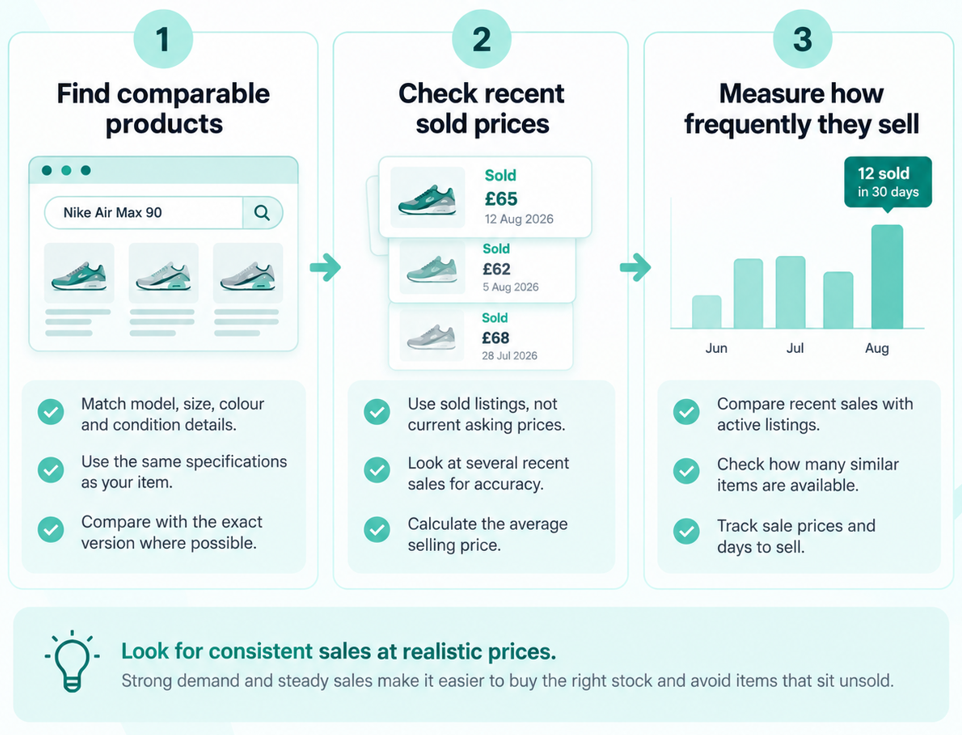
Tip 1: Find comparable products
Comparable products are recent sales that closely match the item you plan to resell. Match the details that affect value, such as model, size, colourway, specification, and condition.
If you want to offer a specific trainer colourway, compare it with sales of that colourway where possible. Basing your price on other models or colourways could lead to inaccurate pricing.
Tip 2: Check recent sold prices
Recent sold prices give you a better indication of what buyers will pay than current asking prices. Current asking prices only tell you how much other sellers want.
Research pricing on eBay by using sold listings or Product Research to check recent sales and pricing patterns. Calculate the average selling prices of several comparable sales rather than basing your buying decision on one unusually high or low result.
Tip 3: Measure how frequently they sell
Sales frequency shows how often comparable items actually sell. Compare recent sales with the number of competing listings to judge whether demand is strong enough to move your stock.
Check how many comparable items are currently available and what other sellers are charging. Lots of competing stock can make an item harder to sell, particularly when supply is high relative to recent sales.
Compare both active listings and recent sales before deciding whether there is enough demand.
Track sale prices and how long each item took to sell. This can show you what to expect when selling similar items.
Step 3: Choose where you'll source inventory
You can source your inventory from places such as charity shops, car boot sales, and even your own home. We wrote a long article about sourcing strategies, but here’s a breakdown of some key places:
- Items you already own: Starting with things around your home means you don’t have to spend money on stock. Try unwanted electronics, clothing, collectables, or household items. This lets you practise listing, pricing, packing, and dealing with buyers before you invest in inventory.
- Charity shops and car boot sales: Local secondhand shopping can help you find individual items to resell. You may also have more room to negotiate prices at car boot sales. Condition matters, so always compare the item’s condition with similar products that have recently sold.
- Retail clearance: Discounted products from retailers can give you another source of new stock. These deals often include seasonal, discontinued, or excess products.
- Wholesalers: These suppliers, such as Wholesale Connections, can give you access to products at trade prices. Depending on the supplier, you may buy individual units, cases, job lots, or entire pallets.
- Liquidation stock: Buying stock from liquidation sellers (such as John Pye Auctions or Wholesale Clearance UK) can give you access to a large amount of goods, clearance items, returns, and stock from business closures. However, the condition can vary widely. Check whether items are graded, tested, listed individually, or sold unchecked.
Step 4: Calculate whether an item is profitable
Before you buy, calculate your estimated profit for an item. Keep the sales numbers from your research nearby. You can use them to estimate how much buyers are currently paying for similar items. You’ll also need to know the platform’s sales fees to calculate if an item can make you money.
For instance, Depop doesn’t take any seller fees, only a transaction fee of 2.9% + £0.30 per sale.
In contrast, eBay’s fees can add up to around 13–15%, depending on your item’s category.
Use this basic formula to calculate estimated profitability:
- Net profit = sale revenue − purchase cost − selling fees − postage − packaging − other direct costs
Then calculate your profit margin by dividing net profit by your sale revenue and multiplying by 100.
For example, if you sell a jumper for £30, paid £10 for it, spend £3.85 on postage and £1 on packaging, your profit before any applicable marketplace fees or other costs is £15.15. If you sell it on Depop, you’ll pay 2.9% + £0.30, which comes out to £0.87 + £0.30 = £1.17. That leaves £13.98 profit after the Depop payment fee (£15.15 − £1.17).
Keep in mind that the final figure depends on the platform you use and whether you sell as a private or business seller, so check the fees that actually apply to your account before buying stock.
Step 5: Choose the best marketplaces for your products
The best marketplace is one that attracts buyers for the products you sell at costs that leave room for profit. Compare selling fees, shipping options, return rules, listing requirements, and seller protections before choosing a platform.
Start with one or two marketplaces that fit your products and are easy to manage. For example, you might sell vintage clothing on Depop and bulky furniture on Facebook Marketplace. Even a marketplace with no seller fees is a poor fit if buyers there rarely purchase your type of product.
Here’s a look at some of the most popular marketplaces in the UK:
Note: Fees depend on account type, category, country, payment method, shipping arrangement, promotions, and applicable taxes.
Step 6: Understand UK tax and business requirements
To understand the UK’s tax and business requirements, you’ll need to know when HMRC (His Majesty’s Revenue and Customs) is likely to consider your reselling activity a trade and when you need to report the income. This department treats trading and selling your own things separately.
Selling your belongings vs trading
Selling unwanted things that you bought for personal use isn’t normally treated as trading. For instance, when you sell old clothes from your wardrobe, HMRC considers it different from buying clothing specifically to resell for profit.
The platform you use doesn’t decide whether you’re trading. HMRC looks at how and why you sell, using a set of guidelines called the “badges of trade.”
HMRC considers several factors when deciding whether you’re trading, including:
- Why you bought the goods
- How often you buy and sell
- How quickly you resell them
- HMRC may also consider whether you change items to make them easier to sell and how organised your selling activity is
No single factor decides whether you’re trading or selling unwanted items. However, regularly buying lots to resell for a profit is a strong sign that you’re trading. Separate rules decide whether you need to report that income to HMRC. One of these is the £1,000 trading allowance.
The £1,000 trading allowance
The trading allowance gives individuals up to £1,000 of tax-free trading income each tax year. If your gross trading income is £1,000 or less, you generally don’t need to tell HMRC.
Gross income is defined as trading income before deducting costs such as stock, marketplace fees, postage, and packaging.
If your gross trading income exceeds £1,000, you generally need to register for Self Assessment and report the income. When working out your taxable profit, you can usually deduct allowable business expenses or use the trading allowance. You can’t use both for the same trading income.
Marketplace reporting rules are separate from the rules that decide whether you owe tax. A marketplace sending your sales information to HMRC doesn’t automatically mean you owe tax or need to file a tax return.
For example, say you earn £1,200 in gross trading income during the tax year. You have gone over the £1,000 trading allowance threshold, even if your expenses leave you with little profit or a loss.
Registration: Sole trader or limited company
In the UK, most resellers operate as either a sole trader or through a limited company. Here’s a look at both.
Sole trader
A sole trader owns and runs a business personally rather than through a separate legal company. There’s no separate legal entity between you and the business, so you're personally responsible for its debts.
Sole traders can start selling without setting up a company. You’ll generally need to register for Self Assessment if your gross trading income goes over £1,000 in a tax year.
If you register as a sole trader, you report your business income and expenses through Self Assessment. You may also need to pay Income Tax and National Insurance on your profits.
You don’t legally need a separate business bank account as a sole trader. However, keeping your business and personal transactions separate can make your records easier to manage.
Limited company
A limited company is legally separate from the people who own it. You must also keep the company’s money separate from your personal money.
Running a limited company comes with more paperwork. This includes keeping company records, preparing annual accounts, filing information with Companies House, and dealing with Corporation Tax.
If you set up a limited company, you can be its director and may also be an employee of the company. You can also run a separate reselling business as a sole trader at the same time. Whether setting up a limited company makes sense depends on factors including profits, tax position, liability, and whether the additional administration is worthwhile.
VAT
The government requires VAT registration if your taxable turnover goes over £90,000 within any 12-month period. The same rule applies if you expect to exceed £90,000 within the next 30 days.
After registering, you may need to charge VAT on the goods you sell. You’ll also need to keep digital VAT records and submit VAT returns using compatible software.
Second-hand resellers may be able to use the VAT Margin Scheme for certain goods. The scheme lets you calculate VAT on the difference between the buying and selling price. However, the full selling price still counts toward the £90,000 VAT registration threshold.
Track your rolling 12-month taxable turnover regularly so you can register on time and reduce the risk of backdated VAT and penalties.
Step 7: Create and list your inventory
Create listings that stand out to buyers on your platform by preparing items for presentation and taking good photos. Follow these steps:
- Inspect and prepare each item: Carefully look for damage, wear, missing parts, and functionality so you can choose the correct condition and disclose issues. Test electronics and other functional products where possible, and photograph any defects you find.
- Take clear product photos: Use clear, well-lit photos of the actual item from several useful angles. Include labels, details, and close-ups of any wear or damage. Photos help buyers assess the item’s appearance and condition. Consider using high-quality photo editing tools to further improve images so they stand out.
- Write an accurate title: Your title helps buyers and marketplace search tools identify what you're selling. Include the most relevant product details, such as brand, model, product type, size, and colour. A title such as “Nike Air Max 90 White UK 9” provides more useful product information than a vague one like “Awesome Trainers, worn twice.”
- Describe condition and defects: If the marketplace has a description box, describe the item's condition accurately and disclose any wear, damage, missing parts, or faults. Use the marketplace's condition categories where available, then add enough detail for buyers to understand what they will receive.
- Set your price: Consult those research notes from step 2 and match characteristics such as model, specification, size, condition, and colour. I always recommend adding 15–20% more to account for negotiation.
- Choose postage and packaging: Plan how you’ll package and send the item before you list it. Weigh and measure the packed item so you can choose the right delivery service and work out the postage cost. Choose packaging that will protect the item from damage during delivery.
Step 8: Track your sales metrics
By tracking sales metrics, you can figure out which items actually make money, how quickly they sell, and how much cash remains tied up in unsold products. Here’s what to track:
- Actual profit per item: Start by working out how much money each sale actually made. Subtract the item’s purchase cost and direct selling costs from its revenue. These costs may include marketplace fees, payment fees, postage, packaging, and promotional fees.
- Profit margin: Use profit margin to compare how profitable items are at different selling prices. Divide your profit by your sales revenue and multiply by 100. A £5 profit on a £10 sale gives you a 50% margin. A £20 profit on a £200 sale gives you a 10% margin.
- Days to sell: Track how many days pass between listing an item and selling it. Stock that takes longer to sell keeps your money tied up for longer. Faster sales free up that money sooner. Compare selling times across products and categories to see which items move faster.
- Sell-through rate: Another useful metric is the percentage of your listed stock that sells during a set period. Divide the number of items sold by the number listed, then multiply by 100. If three out of 10 listed items sell, your sell-through rate is 30%. Compare similar categories and periods because there isn’t a single good rate for every reseller.
- Unsold inventory: Keep a record of stock you bought to resell that hasn’t sold yet. Include each item’s purchase cost, listing date, and current status. Review older stock regularly to decide whether to change the price, relist it, bundle it, or avoid buying similar products.
- Capital tied up in stock: Calculate how much money you have invested in items that are still unsold. Add together the purchase costs of all your unsold stock. A high total means more of your money is unavailable for other purchases. Compare this figure with selling speed, profit, and sell-through rate to see if buying more stock is driving sales.
Sell more with Nifty
After you start a reselling business in the UK, you’ll find that manually writing listings and keeping track of pricing and items will eat into loads of your time. Nifty, a crosslisting and automation tool, solves that by letting you list and manage inventory from eBay, Depop, and other platforms all in one place.
Here's why Nifty's so helpful:
- Customised AI listing: Snap a pic and let Nifty's AI build a complete listing, with SEO-optimised titles and descriptions, and trending hashtags already filled out for you. You can even customise how AI writes your listings to follow your unique style.
- Crosslist now: With a couple of clicks, post your items across Whatnot, eBay, Depop, and Etsy. No copy-paste clutter and no multi-tab hopscotch. (More marketplaces coming soon!)
- Bulk crosslisting: Publish up to 25 listings at once with marketplace-specific pricing rules, shipping presets, and AI-enhanced titles and descriptions. Start in Nifty or import from eBay, then export everywhere in one action.
- Marketplace-specific Pricing Rules: Set your price once on a primary marketplace, and Nifty auto-calculates the rest with percentage or pound adjustments so your take-home stays consistent when you crosslist.
- Auto-delisting? Handled: When you make a sale, Nifty's sales detection auto-delists that item from every marketplace. Say goodbye to double-selling disasters and "sorry, it's already gone" apology messages.
- Bulk tools = no busywork: Share and relist daily in just a few clicks. You can even schedule drafts to go live while you sleep and set automatic discounts that run deeper over time.
- Analytics you can act on: Track sales, fees, top performers, and slow movers in one clean dashboard, so you can actually see what's working and what's just dead space. You can also set and track seller goals directly from your home screen.
Nifty pays for itself in just a few weeks. Start with a 7-day free trial and see how Nifty can help cover your manual listing tasks so you can spend more time sourcing and getting to know shoppers.
FAQs
1. How much money do you need to start a reselling business?
The amount of money you need to start a reselling business depends on what you sell and how you source it. You can start with items you already own to avoid spending money on additional stock. Buying from wholesalers or liquidation suppliers usually requires purchasing inventory upfront. So it’s a good idea to start flipping by visiting charity shops and car boot sales.
2. Is a reselling business profitable in the UK?
Yes, a reselling business can be profitable in the UK. Your profit depends on buying stock below its realistic resale value and keeping marketplace fees, postage, packaging, returns, and other costs low enough to leave a margin. The products you offer also need to sell quickly enough so that too much money doesn’t remain tied up in unsold inventory.
3. What is the best marketplace for reselling in the UK?
The best marketplace for reselling in the UK depends on your product type. eBay suits a broad range of sellers offering everything from collectable items to household goods to clothing. Vinted and Depop are best fits for fashion sellers. You can crosslist your items on different platforms to reach more buyers.


.png)