
How to grow an Etsy shop: 5 strategies for 2026
.png)
When many folks launch an Etsy shop, they get a handful of views, even fewer visits, and maybe one or two sales. The niche is rarely the problem. The real trouble is in their keywords, listing details, and how visible the shop is to Etsy buyers.
Even shops with weak listings can become profitable by rewriting titles and descriptions and using tags correctly. By the end, you'll know how to grow an Etsy shop by improving your listing SEO and keeping your shop active.
How to grow an Etsy shop: At a glance
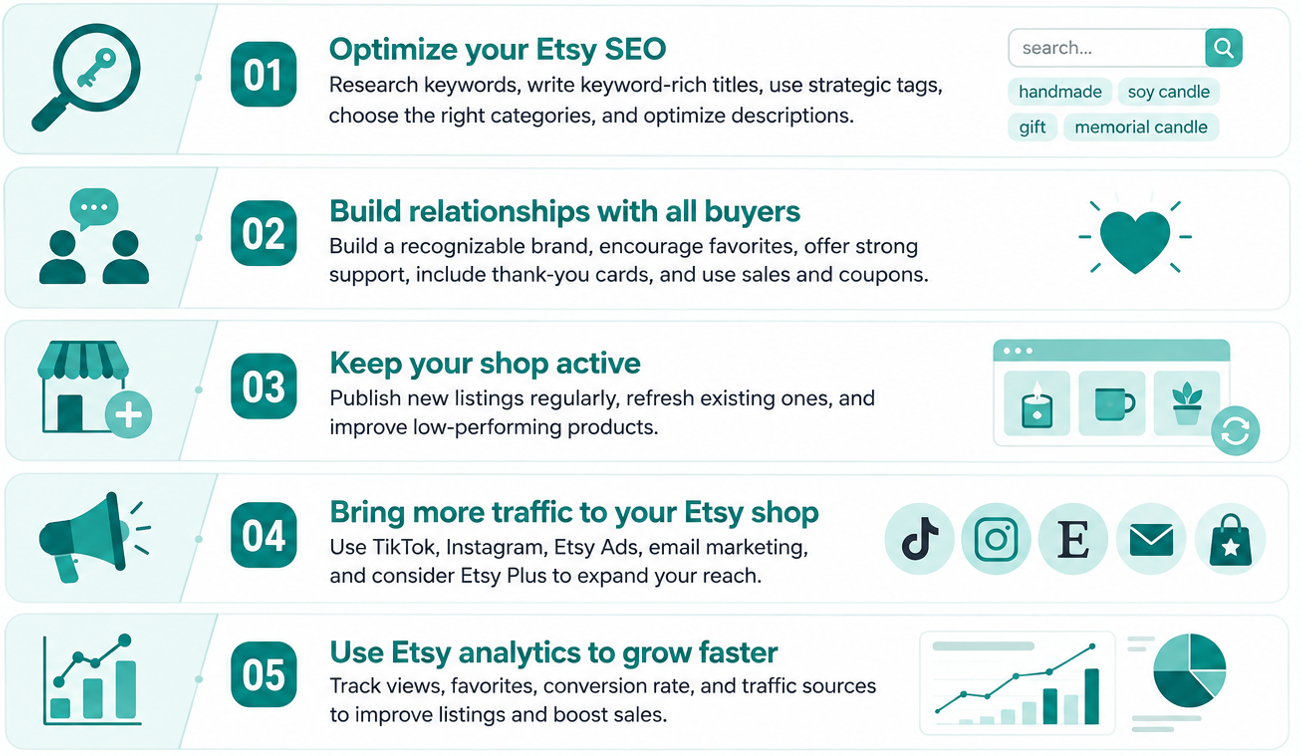
1. Optimize your Etsy SEO
To optimize Etsy SEO, you need to find the right keywords and write informative titles. Follow these 5 steps:
Step 1: Research Etsy keywords
Etsy keyword research helps you identify the words and phrases shoppers type into Etsy's search bar before buying. By researching keywords, you can pull data straight from active searches and use it to build your listings.
Start inside Etsy itself: Type a broad term into the search bar and record the autocomplete suggestions. These suggestions come directly from real buyer queries. Cross-check volume and competition in a tool like eRank or Marmalead.
Analyze the highest-ranking listings for your target keyword. Look for repeated words and phrases in their titles, tags, categories, and descriptions. These words and phrases are the terms Etsy already associates with successful listings.
Our guide to Etsy keyword research breaks down how to find the terms buyers actually search and how to prioritize them.
Step 2: Write keyword-rich titles
Once you’ve found the keywords that match your items, write a title that uses the exact words buyers type into Etsy's search bar. Lead with your strongest keywords so they sit at the very front of the title, where shoppers and the algorithm look first.
Etsy's search algorithm matches buyer searches using the keywords throughout your listing. Repeating your primary keyword naturally in the most important parts of the listing helps Etsy understand what you're selling and improves your chances of appearing in relevant searches.
For example, “Personalized Cutting Board, Custom Wedding Gift, Engraved Wood Board” is more likely to rank than “Beautiful Handmade Board.”
Step 3: Use tags strategically
Etsy lets you add up to 13 tags of up to 20 characters each, so fill these in strategically by using different multi-word keyword phrases instead of repeating the same words.
The platform treats every tag as another way buyers can find your listing. Use your tags to target related searches that don't fit naturally in your title.
Let’s say you’re selling soy candles, so use both “soy candle gift” and “memorial candle” to reach different shoppers.
Step 4: Choose the right categories
By choosing the right category for your items, you help Etsy's system place them correctly in category browsing pages and improve their ranking in search results.
Many shoppers filter by category before searching, so the wrong category can hide your listing from potential buyers.
Pick the most specific category that matches your product instead of the broadest option. For instance, listing an item under “Pendant Necklaces” instead of “Necklaces” helps reach buyers looking for that exact style.
Step 5: Optimize product descriptions
An optimized product description works your primary search terms into the opening lines and answers the questions buyers ask before purchasing.
Etsy's search algorithm now considers the keywords in your description when it ranks listings, alongside your titles, tags, categories, and attributes. A strong description also does the heavy lifting of convincing shoppers to buy.
Start with important details like the material, size, and purpose of the product. If you’re selling cutting boards, use a description like “Handmade walnut cutting board, 12x18 inches, personalized for weddings.” Descriptions like these help both Etsy's search algorithm and potential customers understand exactly what's being sold.
2. Build relationships with all buyers
One-time purchases alone may not help grow your Etsy shop in the long run, so building relationships with each buyer is one of the most valuable Etsy seller tips you can follow. By doing so, you can increase your chances of turning them into loyal, repeat buyers.
Let’s look at how to do this:
- Build a recognizable brand: Use consistent packaging, product quality, visuals, and tone so buyers remember and recognize your shop. Build a logo with consistent brand colors that make it easy for folks to remember who you are.
- Encourage favorites: Etsy Favoriting, done by clicking the heart-shaped button, lets shoppers save listings or shops they want to revisit later. When buyers click this, Etsy notifies them about shops and items they’ve favorited, which can bring them back without requiring paid advertising.
- Offer strong post-purchase support: Respond quickly to questions, concerns, and order issues. Fast, clear communication builds buyer confidence, drives repeat purchases, heads off the misunderstandings behind refunds and bad reviews, and feeds your Etsy Star Seller standing.
- Include a thank-you card: A branded thank-you card invites buyers to return, follow your shop, or sign up for updates. Keep it polite, add your logo, and follow Etsy's rules if you point buyers to social media or other channels.
- Use Etsy sales and coupons: Etsy offers built-in sales and coupon tools that sellers can use to encourage repeat purchases and re-engage interested buyers. These tools include thank-you coupons, targeted offers, and other promotions that can be sent after a purchase or to shoppers who showed interest in a listing.
3. Keep your shop active
Etsy shops benefit from staying active and improving weak listings. Here's how to grow your Etsy shop by keeping it active:
Publish new listings regularly
Publishing new listings means posting products steadily over time rather than all at once. By releasing fresh inventory, you signal to Etsy that your shop is active while giving buyers more opportunities to discover new items.
For example, you might list 3 new cutting boards each week instead of 30 all at once. If you're not sure what to add next, a list of profitable Etsy shop ideas can point you toward products that are already selling.
Refresh existing and low-performing listings
Refreshing a listing means updating the photos, title, description, or tags on an older product when the listing needs improvement. This can help your shop keep its content current and make items easier for shoppers to understand.
Set a recurring time to audit older listings, then update them with better photos and descriptions that match current keyword searches.
You can improve a low-performing product by identifying listings that get views but don’t convert well. Fix this by adding better photos, clearer descriptions, adjusted pricing, or stronger keyword targeting.
4. Bring more traffic to your Etsy shop
Organic search traffic alone may not be enough to drive early Etsy sales, so many sellers use platforms like TikTok, Instagram, and paid ads.
Here’s a look at how each channel can help grow your Etsy shop:
- TikTok: Many sellers use TikTok to introduce products to new audiences through its recommendation feed. Strong short-form videos can reach people even before a shop has a large following. Product demos, packaging clips, and behind-the-scenes videos are common formats for attracting attention.
- Instagram: By using this popular social media app’s features like Reels, Stories, and short updates, you can build familiarity and trust over time. But you need to post consistently and update products when needed.
- Etsy Ads: Etsy’s ads work on a cost-per-click basis, meaning you pay when someone clicks an ad. The tool can help listings get exposure while organic visibility is still developing. A paid campaign can increase impressions and clicks, but results depend on listing quality and product demand.
- Email marketing: Although Etsy allows transactional emails related to an order, marketing emails generally require customer consent. So get your buyers’ permission before sending updates, offers, and product announcements. You can also “sweeten” opt-ins by offering coupons or discounts.
- Etsy Plus: This $10 monthly subscription includes 15 listing credits, $5 in Etsy Ads credit, restock requests, and advanced shop customization tools. If you regularly renew or create listings and use Etsy Ads, you may get more value from the included credits.
5. Use Etsy analytics to grow faster
Etsy analytics helps you review views, favorites, conversion rate, and traffic sources. Review this data regularly to identify which listings need improvement and which products deserve more investment.
Always look at the conversion data after you make a sale. Then consider your overall conversion rate, the percentage of visits that turn into orders.
Etsy says it’s calculated from visits and completed orders and recommends measuring it over longer periods. Measuring these results over short windows can be misleading.
Etsy also notes that conversion can affect search performance, so weak listings drag down both sales and visibility. Use your analytics to spot listings with plenty of views but few sales, then apply the listing fixes from Strategy 3.
Grow your shop on Etsy and other platforms with Nifty
The last piece of how to grow an Etsy shop is refusing to let one marketplace cap your sales. Expanding across platforms multiplies your visibility, but managing separate listings on each one eats the exact time growth requires.
Nifty takes that work off your plate: you can list and manage your items across eBay, Etsy, Poshmark, and more from one place.
Here's why Nifty's so helpful:
- Customized AI listing: Snap a pic and let Nifty's AI build a boss-level listing, with SEO-optimized titles and descriptions, and trending hashtags already filled out for you. You can even customize how AI writes your listings to follow your unique style.
- Crosslist now: With a couple of clicks, post your items across Whatnot, Poshmark, eBay, Mercari, Depop, and Etsy. No copy-paste clutter and no multi-tab hopscotch. (More marketplaces coming soon!)
- Bulk crosslisting: Publish up to 25 listings at once with marketplace-specific pricing rules, shipping presets, and AI-enhanced titles and descriptions. Start in Nifty or import from eBay, then export everywhere in one action.
- Marketplace-specific pricing rules: Save pricing templates for each marketplace and apply them automatically during bulk crosslisting to keep listings consistent without manual edits.
- Automatic delisting? Handled: When you make a sale, Nifty's sales detection auto-delists that item from every marketplace. Say goodbye to double-selling disasters and "sorry, it's already gone" apology messages.
- Bulk tools = no busywork: Share and relist daily in just a few clicks. You can even schedule drafts to go live while you sleep and set automatic discounts that run deeper over time.
- Analytics and profits are real: Track sales, fees, top performers, and slow movers in one clean dashboard, so you can actually see what's working and what's just dead space. You can also set and track seller goals directly from your home screen.
Nifty pays for itself in just a few weeks. Start with a 7-day free trial and see how Nifty can help you turn a single Etsy shop into a multi-platform storefront without adding hours to your week.
(Nifty is now available for sellers in the U.S., Canada, the U.K., and Australia!)
FAQs
1. How long does it take to grow an Etsy shop?
Most Etsy shops take several months of consistent work to grow. Etsy gives new listings a temporary boost. However, long-term growth depends on improving listings, sales, and visibility over time. For many sellers, the first 3 to 6 months are about testing product listings and pricing. The next 6 to 12 months are often when patterns become clearer, and sales are easier to repeat.
2. Does Etsy Plus help grow an Etsy shop?
Etsy Plus can help some sellers grow, but it doesn’t boost rankings on its own. The subscription includes listing credits, Etsy Ads credit, restock requests, and additional shop customization tools. It makes the most sense if you regularly create new listings and already spend money on Etsy Ads. But for newer shops, improving products and SEO usually delivers a better return.
3. How many listings should an Etsy shop have?
There is no minimum number of listings that an Etsy shop should have. However, larger shops generally have more opportunities to appear in search results. Building your catalog consistently tends to work better instead of uploading dozens of products at once. Adding high-quality listings every week gives shoppers more chances to discover your shop.


.png)
.png)
.png)