
What are the Etsy seller account requirements for 2026?
.png)
Etsy seller account requirements include providing a valid email, creating a unique shop name, having a government-issued ID along with a linked bank account, and a credit or debit card to pay fees.
Here’s the breakdown that I’ve used to help new Etsy sellers open their Etsy shops, including types of products you can list and pitfalls to avoid.
Etsy seller account requirements: At a glance
| Requirements | Details |
|---|---|
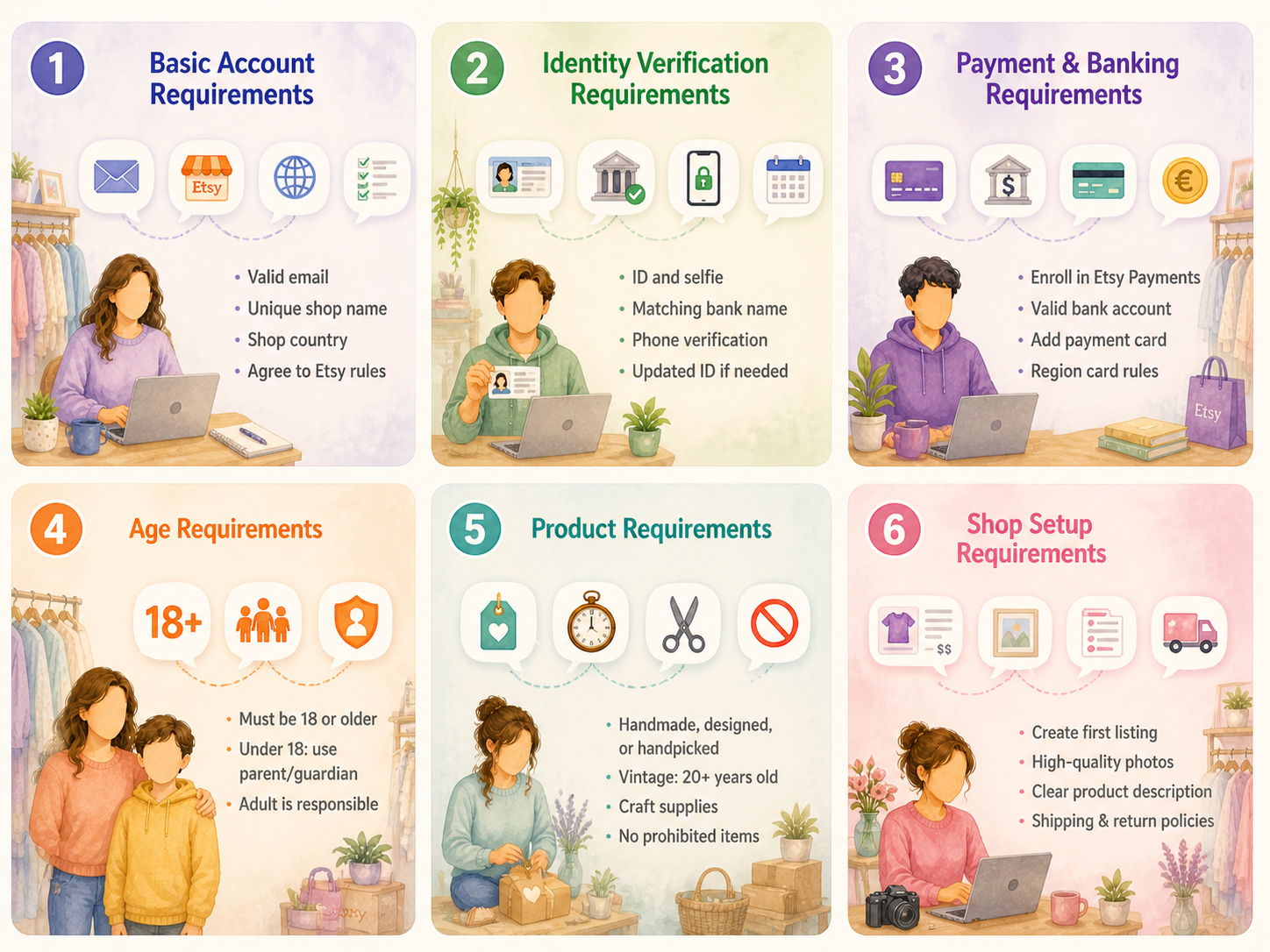
| 1. Basic account | Valid email, unique shop name, shop country selection, agreement to Etsy's Terms of Use and Seller Policies. |
| 2. Identity verification | Government-issued photo ID and selfie; phone number verification; Etsy Payments name must match bank account holder name. |
| 3. Payment & banking | Enroll in Etsy Payments; provide a valid bank account in your legal name; credit, debit, or reloadable prepaid card required for fees. |
| 4. Age | Must be 18+. Under-18 sellers must register under a parent or guardian's name, who takes full legal responsibility. |
| 5. Products | Handmade, vintage (20+ years old), or craft supplies only. Mass-produced "handmade" goods are prohibited and can result in suspension. |
| 6. Shop setup | At least one published listing with photos and description; shipping and return policies; high-quality product photos (min. 2,000px wide). |
To open an Etsy seller account, you need to provide an email, your name, and bank information. You’ll also need to agree to Etsy's rules about what you can and can’t sell. Then, set up your shop’s shipping and return policies.
Here’s an in-depth look at each requirement:
1. Basic account requirements
Etsy’s seller account requirements also include providing a valid email address and choosing a unique shop name. Your shop name must be entirely unique and can’t have been used before as a shop name or username, even by closed shops.
Etsy allows you to change your shop later through the Shop Manager. However, changing it too often can confuse buyers and hurt brand recognition.
You must also select your shop country during setup. Location affects which payment options and setup steps Etsy provides because payment systems vary by region.
The platform also requires you to agree to Etsy’s Terms of Use and Seller Policies. Etsy may use those rules, along with applicable laws and account evidence, to handle disputes or enforce its rules.
2. Identity verification requirements
Etsy requires sellers to provide a bank account along with a government-issued ID, such as a driver’s license or passport. Here’s a closer look:
- Government ID and selfie: Etsy may request a government-issued photo ID and selfie, and support cannot bypass missing verification requirements.
- Matching payout account names: Your Etsy Payments name must match your bank account holder name to avoid payout delays or holds.
- Phone number security checks: Etsy may require phone number verification as an added security step to confirm account ownership and activity.
Note: Etsy may request updated ID information, such as when your passport or driver's license is set to expire.
3. Payment and banking requirements
Under Etsy’s seller account requirements, sellers must enroll in Etsy Payments in every country where the service is available. In many regions without Etsy Payments support, sellers cannot open a shop at all.
All financial details must match your verified identity. If information doesn’t match, Etsy can automatically freeze payouts.
Here’s how to enroll in Etsy Payments:
- Provide Etsy with a valid bank account in your legal name. Payments you receive from Etsy buyers will land in this account.
- Etsy also requires a credit card, debit card, or reloadable prepaid card. This card will cover listing, transaction, and ad fees, as well as unpaid account balances.
As of May 8, 2025, new sellers in Germany, Austria, and the Netherlands must use a credit or debit card to enroll in Etsy Payments.
4. Age requirements
Etsy requires shop owners to be 18 or older. Your account registration has to reflect that.
However, you can have a shop if you’re under 18, but it must be registered in your parent or guardian's name. The adult must be the registered account holder and take full legal responsibility.
The platform doesn’t recognize co-ownership at the account level. If an underage seller opens an account without an adult and it gets flagged, Etsy will close the shop without a grace period for transferring listings or reviews.
5. Product requirements and what you can sell
Etsy permits these product categories: Items that are made, designed, handpicked, or sourced by you; vintage items at least 20 years old; and craft supplies. Mass-produced goods listed as handmade violate Etsy policy and can result in listing removal or account suspension.
Resellers typically offer vintage items and craft supplies on Etsy. If you’re interested in reselling on Etsy, read our guide to Etsy reselling.
Here’s a look at what you can and can’t sell on Etsy:
| You can sell | You can’t sell |
|---|---|
| Handmade jewelry and crafts | Counterfeit designer products |
| Vintage items over 20 years old | Mass-produced “handmade” goods |
| Craft supplies and materials | Weapons and illegal items |
| Digital downloads and printables | Misleading health products |
| Personalized gifts and decor | Copyright-infringing merchandise |
| Handmade clothing and accessories | Alcohol, drugs, or tobacco products |
| Antique home decor | Unsafe or recalled products |
The platform has a prohibited items list that covers a broader range of goods. Etsy often updates the list, so check it from time to time to make sure you’re still following the rules.
Prohibited goods include illegal items, certain wellness products, weapons, and items making specific health claims. You’re responsible for knowing what’s restricted before listing, not after a violation notice arrives.
6. Shop setup requirements
Before launching an Etsy shop, sellers need to upload at least one complete listing with photos and a description. They also need a shipping policy in place. Here’s a look at setup requirements:
- Create your first product listing: Etsy requires at least one published listing before you can complete shop setup and open your store. Read our guide and walk through listing on Etsy for more information.
- Upload high-quality product photos: Etsy lets you upload up to 20 images and recommends the photo size be at least 2,000 pixels wide.
- Write clear product descriptions: Descriptions should explain materials, dimensions, and product use while matching buyer search intent and expectations.
- Add shipping and return policies: You set order processing time and shipping policies. Etsy also gives you the option to choose Etsy Shipping, which simplifies rate calculation and tracking.
Does Etsy require a business license?
Etsy doesn’t require a business license to open or operate a shop. Whether you need a business license depends on your local laws, not Etsy’s signup process. The marketplace doesn’t manage legal obligations like tax registration, sales tax collection, or local permits.
You’re responsible for checking city, state, or country requirements on your own.
If you want to know more about business license requirements, read our guide. It walks you through what determines whether you need a license, types of licenses to consider, and common situations.
Final thoughts: Meeting Etsy seller account requirements
Meeting Etsy’s seller account requirements is usually straightforward: Provide the required documentation, be 18+ (or have a parent or guardian willing to sign for you), sell permitted items, and know your legal obligations.
Most setup problems happen because information doesn’t match across accounts.
Avoid setup problems by using the same name that appears on your bank account, ID, and Etsy account. Always double-check country, account, and payment information during setup, so typos don’t slow down registration. In many cases, entering incorrect information is the biggest obstacle to a fast account setup.
Rocket your Etsy seller account listings with Nifty
Now that you know what Etsy seller account requirements are, the next step is actually building your shop. If you're looking for a tool to manage and grow your Etsy presence alongside other platforms, Nifty, a crosslisting and automation tool, helps you manage your items so you can increase your buyer base without the extra manual work.
Here's why Nifty's so helpful:
- Customized AI listing: Snap a pic and let Nifty's AI build a high-quality listing, with SEO-optimized titles and descriptions, and trending hashtags already filled out for you. You can even customize how AI writes your listings to follow your unique style.
- Crosslist now: With a couple of clicks, post your items across Whatnot, Poshmark, eBay, Mercari, Depop, and Etsy. No copy-paste chaos and no multi-tab hopscotch. (More marketplaces coming soon!)
- Automatic delisting? Handled: When you make a sale, Nifty's sales detection auto-delists that item from every marketplace. Say goodbye to double-selling disasters and "sorry, it's already gone" apology messages.
- Bulk tools = no busywork: Share and relist daily in just a few clicks. You can even schedule drafts to go live while you sleep and set automatic discounts that run deeper over time.
- Analytics and profits are real: Track sales, fees, top performers, and slow movers in one clean dashboard, so you can actually see what's working and what's just dead space. You can also set and track seller goals directly from your home screen.
Nifty pays for itself in just a few weeks. Start with a 7-day free trial and see how Nifty can help you take your Etsy shop from one listing to dozens with minimal manual work.
FAQs
1. What are the requirements to open an Etsy seller account?
The requirements to open an Etsy seller account are having a valid email, a unique shop name, a government-issued ID, a bank account, and a credit or debit card for fees. Double-check your information and make all names match across your ID, bank, and Etsy profile. Mistakes can make the sign-up process longer.
2. How hard is it to get approved as an Etsy seller?
It isn’t very hard to get approved as an Etsy seller as long as you have the correct information and follow Etsy’s rules. Overall, the process is straightforward for most people. The biggest hurdle is mismatched information across your ID, bank account, and Etsy profile. Entering consistent details from the start cuts registration delays significantly.
3. Can minors open an Etsy shop?
No, minors can’t open an Etsy shop on their own. However, they can sell under a parent or guardian’s registered account. The adult takes full legal responsibility. If a minor opens a shop on their own, they face abrupt shop closure and the cancellation of any accumulated listings and reviews.
4. Can you have multiple Etsy seller accounts?
Yes, you can have multiple Etsy seller accounts. But you need to follow Etsy's policies, including maintaining separate, compliant shop setups for each. Managing multiple shops strategically lets sellers segment product lines and reduces cross-niche brand confusion for buyers.
5. Do you need a bank account to sell on Etsy?
Yes, you need a bank account to sell on Etsy. The name on the bank account must match your government-issued identification. You also need a debit, credit, or reloadable prepaid card to pay for Etsy’s platform fees.


.png)
.png)
.png)