How to resell sneakers: 7 steps (2026)
.png)
Every pair of sneakers sitting in a resale closet has a story. Some can turn a $50 profit in a few days, yet others sit for eight months and tie up cash you could've reinvested. I pulled apart what separates the two: Sourcing decisions, pricing research, listing habits, and where you actually sell.
This guide walks you through how to resell sneakers. You’ll learn to pick a niche, research sales data, and choose the best marketplaces for reaching more buyers.
How to resell sneakers: 7 steps at a glance
- Decide what type of sneakers you’ll resell
- Research sneaker demand and resale prices
- Set your maximum selling price
- Source sneakers you can verify
- Prepare your sneakers for listing
- List the sneakers on the right marketplaces
- Track your profit and reinvest carefully
Step 1: Decide what type of sneakers you’ll resell
Profit in sneaker resale depends partly on the type of inventory you buy and how accurately you judge its resale potential. Use these 3 points to help make your decision:
- Sneakers sold at launch: This inventory consists of new pairs sourced through brand apps, retailer launches, raffles, or draws. Limited availability can push resale prices above retail when demand exceeds supply, but you’ll need to source at prices that allow for profitable markups.
- Pre-owned sneakers: This category includes previously worn pairs sourced through thrift stores, consignment shops, marketplaces, or individual sellers. Inspect condition and authenticity indicators before buying. Profit depends on buying below the expected resale value after accounting for condition and selling costs.
- Narrow to 2 or 3 brands, models, or price ranges: By limiting your inventory, you target by criteria such as brand, model line, price range, or condition. A narrower focus helps you build deeper knowledge of the brands, models, pricing, and demand within your chosen niche.
Pro tip: Always learn the risks of your chosen niche. Different sneaker categories can carry different levels of counterfeit risk and price volatility.
Step 2: Research sneaker demand and resale prices
Don’t guess a price: Always check real demand data so you can list your sneakers competitively.
Let’s look at how to research sneaker demand:
Research the exact sneaker
I can’t emphasize enough how much resale prices can vary substantially by size, even within the same model and colorway. Broad comparisons can distort your estimate. Research sales for shoes that match yours as closely as possible. Separate new, unworn pairs from used pairs and compare condition carefully.
Research recent sales data on platforms like eBay and StockX, so you can accurately estimate demand. Review multiple recent transactions and prioritize sales matching your model, colorway, size, and condition. Don’t pay too much attention to active listings, as they show what sellers are currently asking.
Use several closely comparable transactions rather than basing a purchase on one sale.
Assess sales velocity
Sales velocity measures how frequently comparable pairs sell. Check it alongside recent selling prices and the amount of competing inventory available. A high asking price means less when similar pairs rarely sell. But frequent transactions provide strong evidence of active demand.
Use both price and sales activity to judge whether a pair offers enough demand for the amount of money you'll have tied up in it.
Step 3: Set your maximum selling price
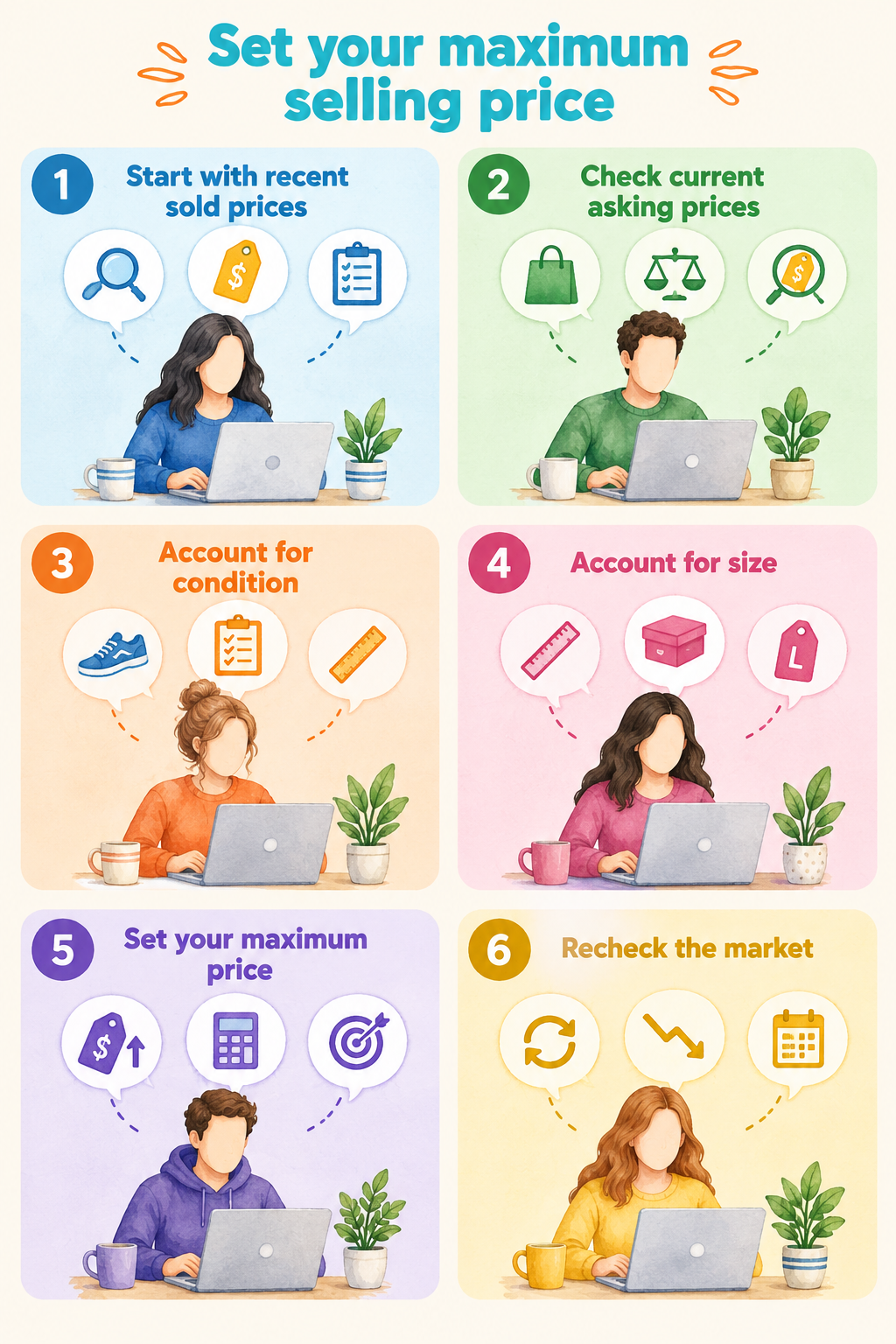
Pricing a pair above what the market supports can leave it sitting unsold while comparable sneakers move. A maximum selling price keeps your asking price grounded in current resale data.
- Start with recent sold prices: Consult your recent sold pricing notes. Match the same model, colorway, size, and condition as closely as possible. If comparable pairs consistently sell around $150, that gives you a starting point for your upper price limit.
- Check current asking prices: Current listings show what competing sellers are asking for similar pairs. Compare them with recent sales to identify prices buyers have paid versus prices sellers are still trying to achieve. A $190 listing means little if comparable pairs repeatedly sell around $150.
- Account for condition: Check wear, creasing, stains, sole condition, original packaging, and included accessories before choosing your price. A cleaner pair may justify pricing toward the upper end of the recent range.
- Account for size: Resale prices can vary by size within the same model and color. Prioritize sales for your exact size when enough data exists rather than relying on the model's overall price. Stronger recent sales in your size may support a higher asking price.
- Set your maximum selling price: Your maximum selling price is the highest asking price you can reasonably support with recent market data and negotiation. Use comparable sales, current listings, condition, and size to establish that ceiling. If you see that most listing prices are at $165, listing above it becomes harder to justify.
- Recheck the market: Sneaker resale prices can change. Recheck recent sales if the pair remains unsold rather than assuming your original ceiling still applies. If comparable sales fall, lower your price to reflect the newer market.
Step 4: Source sneakers you can verify
The wrong pair can hurt your profit before you even list it. Check the seller, condition, and authenticity by following these tips:
Choose reliable sourcing channels
Sourcing channels are retailers, authorized stores, distributors, consignment shops, thrift stores, and individual sellers. Always read reviews to confirm reputation and purchase history before looking at a pair’s condition and price.
Keep documents such as receipts, invoices, and original tags when available because they can support provenance later.
Inspect used sneakers before buying
Inspect pairs for wear, damage, repairs, and replacement components before paying whenever possible. Factor every defect you find into the price you're willing to pay.
Confirm whether each pair includes its original accessories, such as spare laces and hangtags. Missing originals can reduce resale value for some collectible pairs.
Verify authenticity before paying
Check the size tag, logo placement, stitching, materials, sole, and box against photos of an authentic pair of the same model and colorway. Look for fake tells like crooked logos and incorrect fonts. But don’t rely on one detail alone to decide if a pair is real.
Step 5: Prepare your sneakers for listing
Prepare your sneakers for listing by cleaning them thoroughly and taking clear pictures. Let’s look at proper preparation tips:
Clean and prepare the sneakers
Remove dirt, dust, and debris before taking photos. Use cleaning products made for the shoe’s material. The wrong cleaner can stain or damage suede, leather, and other materials.
As you clean, check for stains, scuffs, loose stitching, sole wear, and other damage. Don’t hide these flaws. Keep extra laces, tags, and the original box with the shoes so nothing gets lost.
Photograph the sneakers thoroughly
Take clear photos of both shoes from the front, back, sides, and top. Get close-ups of the soles, toe boxes, heels, insoles, size tags, and logos. If you have the original box or extra accessories, photograph those too.
I suggest you take between 20–30 pictures. Different platforms limit the number of pictures you can upload: eBay up to 24, Whatnot allows an unlimited number, and StockX doesn’t publish a set limit.
If you can, use natural lighting; if not, a warm LED bulb works well. Take close-ups of creases, scratches, stains, worn soles, and other flaws so buyers know exactly what they’re buying.
Consider investing in high-quality photo-editing tools to remove backgrounds and brighten your photos.
Step 6: List the sneakers on the right marketplaces
Choosing a marketplace with weaker demand for a particular pair can make it harder to sell at your target price, while higher fees can reduce your proceeds. Choosing the right platform and listing accurately helps protect the margin you calculated before the sale.
Choose the right marketplace
Several marketplaces make it easy to sell sneakers. Here are some of the most popular options:
- StockX (20M+ lifetime buyers): Best known for new and collectible sneakers, with bids, asks, and market data for pricing research. StockX now also supports used sneakers through StockX Listings.
- GOAT (60M+ members): Strong for new and used sneakers, with authentication processes designed to verify resale products before they reach buyers.
- eBay (136M active buyers): Works well for new, used, rare, and lower-priced sneakers, with the largest reported active-buyer base on this list.
- Poshmark (130M+ registered users): Better for fashion-oriented and pre-owned sneakers, particularly pairs that overlap with clothing and streetwear.
- Grailed (8M+ users): Best for sneakers that overlap with designer fashion, streetwear, archive fashion, and enthusiast markets.
- Whatnot (millions of buyers): Best for sneakers that benefit from live selling, auctions, and direct buyer interaction, with more than 650,000 people joining the platform each week.
Note: Audience figures use each marketplace's most recently reported metric and may change over time. Metrics such as active buyers, registered users, members, and lifetime buyers are not directly comparable.
Create accurate listings
An accurate listing states the correct brand, model, colorway, size, and condition. It doesn’t hide visible defects. Inaccurate or inconsistent details can lead to buyer disputes and may violate marketplace policies.
Include relevant information about box condition, missing accessories, visible wear, and modifications. Describe those details directly rather than relying on vague condition labels.
For example, a listing stating “replaced insoles, original box included” gives buyers clearer information before purchase.
Crosslist across marketplaces
Crosslisting means publishing the same pair across multiple marketplaces to reach more potential buyers. For example, you can sell the same pair of Jordans on eBay, Poshmark, and Whatnot.
Remember to adjust each listing for different platform fees, requirements, and listing formats.
Keep inventory status synchronized across every marketplace you use, and consider using a crosslisting tool or multi-channel listing software to reduce manual actions like copy-pasting and removing an item from all marketplaces when it sells. Some crosslisting tools do this automatically.
Step 7: Track your profit and reinvest carefully
Your profit records show what each pair earns, how quickly it sells, and which inventory deserves more of your money. Follow these tips to track your inventory and earnings:
Record every sale and expense, measure profit
Log every expense and sale by keeping records of sourcing costs and platform fees. Many crosslisting tools have built-in analytics, but you can also create a reseller bookkeeping system. Once tracking becomes routine, revenue and expenses stay linked per pair instead of scattered across emails and app notifications.
Profit and sell-through together show how much a pair earned and how quickly inventory moved. Calculate both because a high margin on a pair that took eight months to sell ties up cash that could have been reinvested sooner.
Track both profit and how quickly each pair sells. Over time, you’ll see which brands, models, sizes, and sourcing methods perform best. For instance, a $30 profit earned in five days may be more attractive than a $50 profit earned in five months.
Reinvest based on your results
Reinvestment means spending your profits on inventory categories your own sales data shows perform consistently. Once reinvestment follows data, you can increase investment into pairs and sourcing methods with consistent margins and sales velocity.
For instance, if you have a sourcing channel producing $40 margins across ten pairs, it provides stronger evidence for future buying decisions than a single $200 profit that has not been repeated.
Use Nifty to manage your sneaker listings
If you’re trying to figure out how to resell sneakers at a high volume across several marketplaces while avoiding repetitive manual tasks, try Nifty. It’s a crosslisting and automation tool that lets you list and manage your sneaker inventory across eBay, Whatnot, Poshmark, and other platforms all in one place.
Here's why Nifty's so helpful:
- Customized AI listing: Snap a pic of your sneakers and let Nifty's AI build a high-quality listing, with SEO-optimized titles and descriptions, and trending hashtags already filled out for you. You can even customize how AI writes your listings to follow your unique style.
- Crosslist now: With a couple of clicks, post your sneakers across Whatnot, Poshmark, eBay, Mercari, Depop, and Etsy. No copy-paste clutter and no multi-tab hopscotch. (More marketplaces coming soon!)
- Bulk crosslisting: Publish up to 25 listings at once with marketplace-specific pricing rules, shipping presets, and AI-enhanced titles and descriptions. Start in Nifty or import from eBay, then export everywhere in one action.
- Marketplace-specific Pricing Rules: SSet your price once on a primary marketplace, and Nifty auto-calculates the rest with percentage or dollar adjustments so your take-home stays consistent when you crosslist.
- Built-in auto-delisting: When a pair sells, Nifty's sales detection auto-delists that sneaker from every marketplace. Say goodbye to double-selling disasters and "sorry, it's already gone" apology messages.
- Bulk tools = no busywork: Share and relist daily in just a few clicks. You can even schedule drafts to go live while you sleep and set automatic discounts that run deeper over time.
- Analytics and profits are real: Track sales, fees, top performers, and slow movers in one clean dashboard, so you can actually see which sneakers are working and which are just taking up shelf space. You can also set and track seller goals directly from your home screen.
Nifty pays for itself in just a few weeks. Start with a 7-day free trial and see how Nifty can help you take everything you've learned about how to resell sneakers and put it to work across every marketplace at once.
Nifty is available in the U.S., Canada, the UK, and Australia.
FAQs
1. What are the best sneakers to resell for beginners?
The best sneakers to resell for beginners are established models such as Air Jordan 4s, Nike Dunks, adidas Sambas, and ASICS Gel-1130s. These models have consistent demand and are popular enough to source. Research the exact colorway, size, condition, and recent sold prices before buying, since demand for the model does not guarantee demand for every version
2. What are the best websites for reselling sneakers?
The best sites for reselling sneakers include StockX, GOAT, eBay, Poshmark, and Grailed. These sites are best because you can sell based on different values and conditions. Always compare fees and audience reach first to avoid wasted listings. Crosslisting across several platforms expands exposure and reduces missed sales opportunities.
3. How much money do you need to start reselling sneakers?
There's no fixed minimum to start reselling sneakers. Many sellers begin with shoes they already own, or they source inexpensive used pairs. Setting a budget you can afford to leave tied up and reinvesting your profits reduces cash-flow risk and avoids overextending on unproven inventory.


.png)