
Nifty vs. Vendoo: Which tool is best for seller workflows? (2026)

When deciding between Nifty vs. Vendoo, many sellers assume both tools offer similar crosslisting and automation features. While they share some core functionality, they take very different approaches to automation, marketplace support, AI tools, analytics, and pricing.
Here's my head-to-head comparison of Nifty and Vendoo, where I evaluate their pricing, marketplace support, automation, AI features, analytics, and overall value. By the end, you'll know which tool is the better fit for your resale business.
Nifty vs. Vendoo: What's the difference?
Nifty is an AI-first, all-in-one tool that automates in the cloud with your computer off, while Vendoo is a cheaper crosslister with wider marketplace coverage that needs your computer on.
Choose Nifty if you want AI-generated listings, true cloud automation, and built-in profit tracking in one plan, and you're ready to scale.
Choose Vendoo if you want the lowest entry price and the widest marketplace reach, and you don't mind keeping your computer on for automation to run.
What is Nifty?
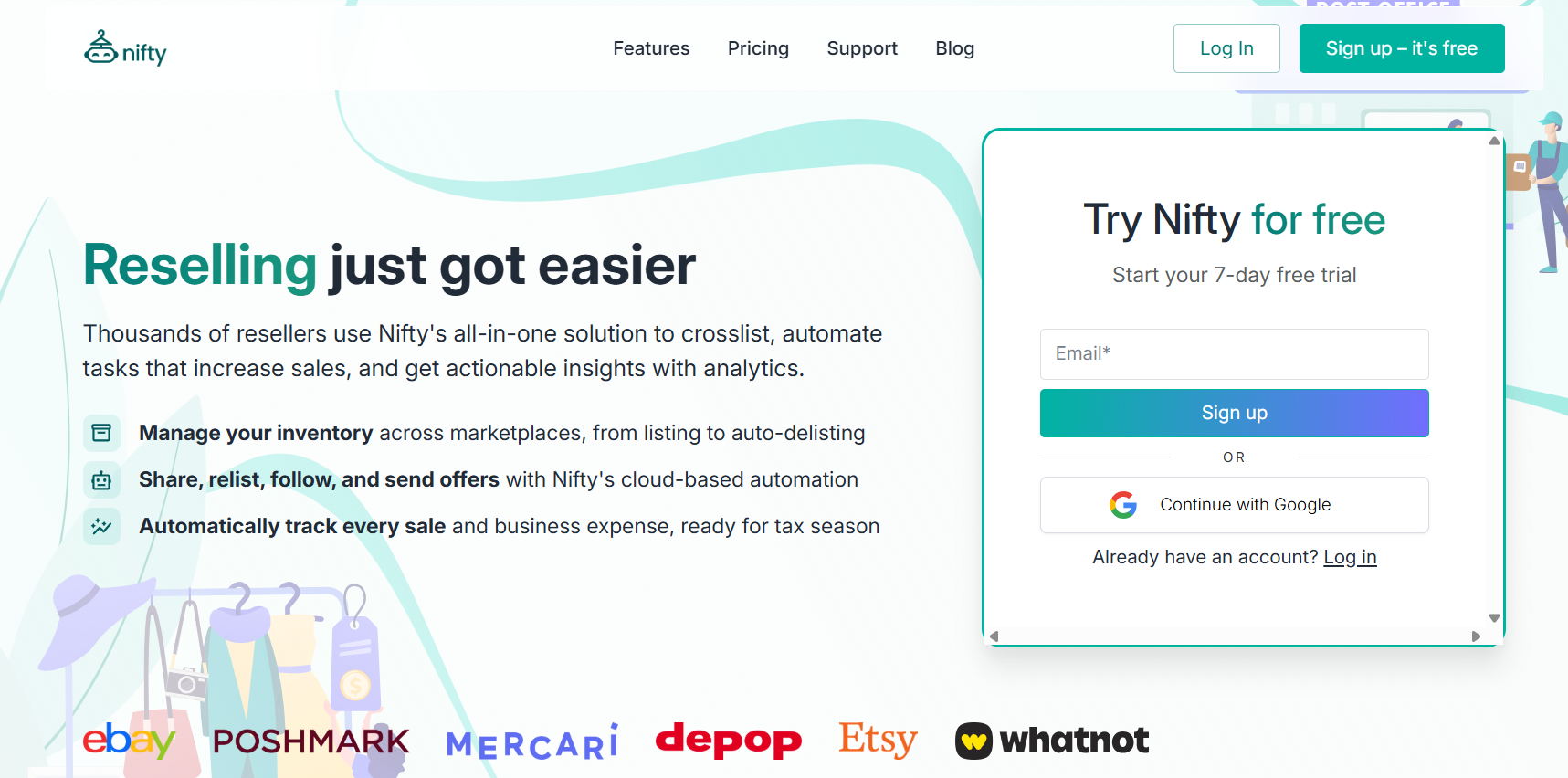
Nifty is a cloud-based crosslisting and automation tool for sellers of all sizes. It integrates with 6 marketplaces and offers photo-editing tools, AI capabilities, and a deep analytics suite.
What is Vendoo?
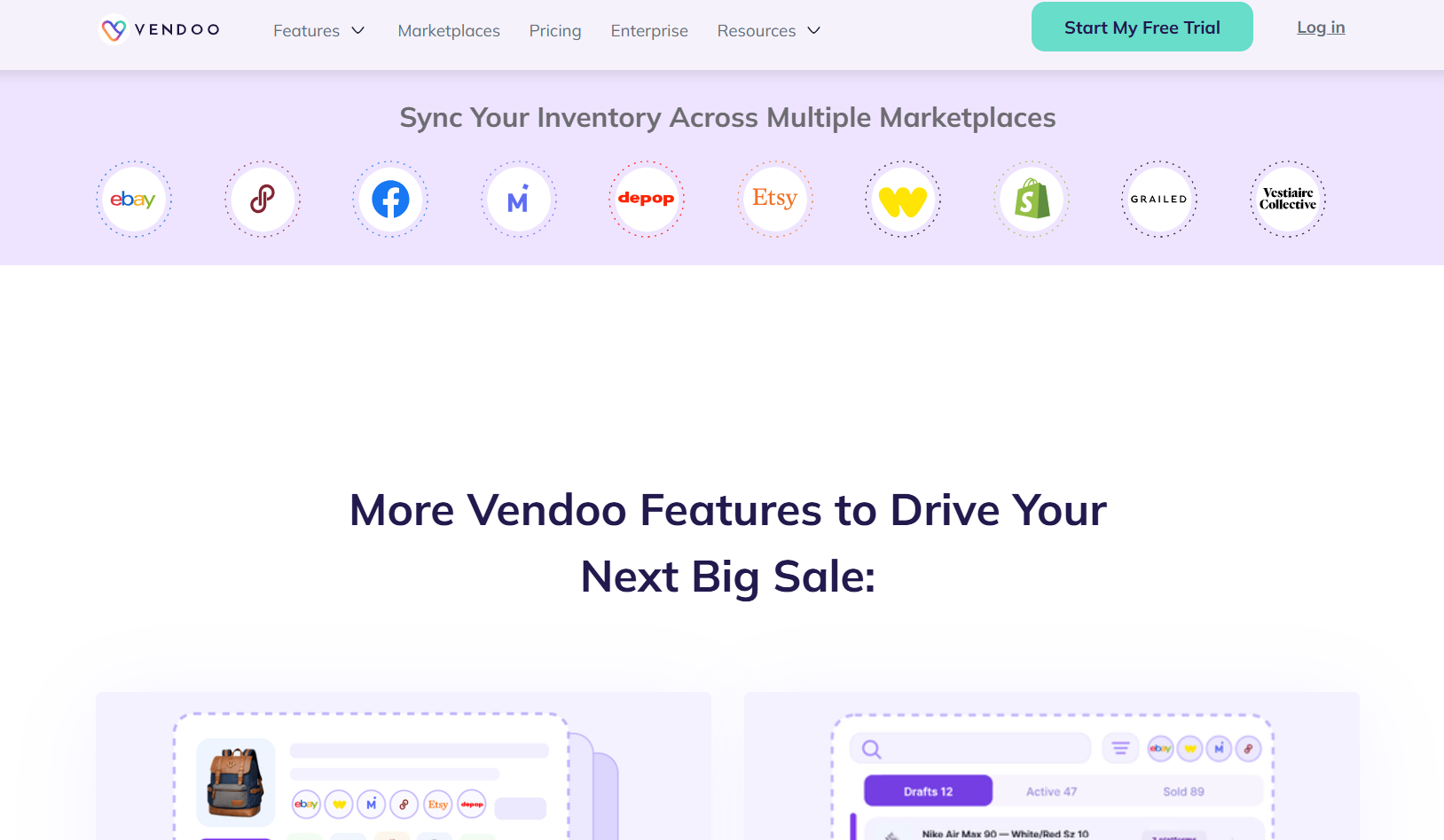
Vendoo is a crosslisting and automation tool that’s suited for beginners. It supports 11 marketplaces and includes automation, inventory tracking, AI-assisted listing tools, and basic sales analytics.
Nifty vs. Vendoo: At a glance
| Tool | Nifty | Vendoo |
|---|---|---|
| Best for | Sellers who want stronger automation, AI listing tools, analytics, and workflow depth | Beginners and budget-conscious sellers who want broader marketplace coverage |
| Marketplace support | Poshmark, eBay, Mercari, Depop, Etsy, and Whatnot (U.S., Canada, U.K., and Australia) | eBay, Poshmark, Mercari, Etsy, Depop, Grailed, Facebook Marketplace, Shopify, Vestiaire Collective, Whatnot, and Vinted |
| Bulk crosslisting | Publish up to 25 listings per batch | Unlimited crosslisting with bulk actions capped at 240 listings |
| Automation | Cloud automation for Poshmark, eBay, Mercari, and Depop, single-marketplace and bundled plans | Computer must stay on for automation to run |
| AI listing tools | Generates titles, descriptions, tags, sizing, and color details with minimal prompting | Generates titles and descriptions but requires more manual prompting |
| Analytics | Tracks orders, profits, margins, trends, and generates profit-and-loss statements | Tracks sales, revenue, and marketplace performance |
| Starting price | $25/month | $14.99/month |
Crosslisting and marketplace support
Crosslisting features let you upload listings directly to your tool’s dashboard, and then publish them across different platforms. These features help you sell more listings and reach a deeper buyer base.
| Feature | Nifty | Vendoo |
|---|---|---|
| Marketplace integrations | Whatnot, Poshmark, eBay, Mercari, Depop, Etsy | eBay, Poshmark, Mercari, Etsy, Depop, Grailed, Facebook Marketplace, Shopify, Vestiaire Collective, Whatnot, Vinted |
| Bulk crosslisting | Crosslist up to 25 items in one action | Crosslist unlimited items, with 240-item bulk action limits |
| Sales syncing and auto-delisting | Automatically detects sales and, with auto-delisting turned on, removes listings everywhere | Auto-delists on Poshmark, eBay, Mercari, Depop, Whatnot, and Etsy when your computer is on with Vendoo open |
| Bulk listing features | Marketplace pricing rules, shipping presets, AI-assisted listing creation | Bulk imports, editing, relisting, multi-quantity listings |
Nifty crosslisting and marketplace support
Nifty's Crosslisting and Bundle plans connect with 6 marketplaces: Poshmark, eBay, Mercari, Depop, Etsy, and Whatnot (added in May 2026).
It's available to sellers in the U.S. and its territories, Canada, the United Kingdom, and Australia, and Nifty says more marketplaces are on the way. You manage every connected listing from one place.
Nifty's crosslisting stands out for its AI. Bulk crosslist up to 25 items at a time, and Nifty fills in every marketplace-specific field (category, brand, size, and item specifics), applies your pricing rules and shipping presets, and writes titles and descriptions automatically.
Start from listings built in Nifty or import your existing inventory, then publish across every connected marketplace.
Vendoo crosslisting and marketplace support
Vendoo connects up to 11 marketplaces, including:
- eBay
- Poshmark
- Mercari
- Etsy
- Depop
- Grailed
- Facebook Marketplace
- Shopify
- Vestiaire Collective
- Whatnot
It supports bulk imports, unlimited crosslisting across connected marketplaces, and multi-quantity listings for tracking inventory without creating duplicate listings. Bulk actions handle up to 240 listings per operation.
Crosslisting winner
Vendoo wins this category on reach and volume. It lists to more marketplaces, including niche and luxury sites like Grailed and Vestiaire Collective that Nifty doesn't cover, and its bulk actions handle up to 240 items at once versus Nifty's 25.
Nifty counters with AI that auto-fills every listing field and cloud-based sales detection that, once you turn on auto-delisting, delists sold items even with your computer off. If per-listing speed and hands-off delisting matter more to you than raw marketplace count, Nifty is still worth a look, but on pure coverage, Vendoo takes it.
Nifty vs. Vendoo: Automation
For this comparison, I considered the automation of repetitive daily tasks: sending offers, relisting, and liking, following, and sharing on Poshmark. Auto-delisting and sales detection aren't in this section, since those count as crosslisting features.
| Automation feature | Nifty | Vendoo |
|---|---|---|
| Cloud-based automation | Yes | No |
| Supported marketplaces | Poshmark, eBay, Mercari, and Depop | Poshmark, eBay, Mercari, Depop, Grailed, and Vestiaire Collective |
| Poshmark automation | Sharing, following, relisting, and offers | Sharing and offers to likers |
| Subscription options | Single-marketplace or bundled automation plans | Automation included with the Pro plan |
Nifty automation
Nifty’s cloud-based automation lets your workflows continue running without leaving a browser open or keeping your computer powered on. Instead of managing separate browser extensions, you control everything from a single dashboard.
You can choose a dedicated eBay or Poshmark Automation Plan. The eBay plan automates recreating listings and sending offers. Nifty’s Poshmark plan adds sharing, following, relisting, and automated offers. Because every feature runs from the same interface, there's no need to install a separate Poshmark bot.
For sellers working across multiple marketplaces, Nifty's Full Automation Plan combines automation for Poshmark, eBay, Mercari, and Depop. It includes all of the eBay and Poshmark automation features, plus automatic relisting and offers on Mercari and Depop from one cloud-based dashboard.
Nifty also offers both automation and crosslisting capabilities as part of its Bundle Plans.
All Crosslisting and Bundle Plans include automatic sales detection across each platform, opt-in auto-delisting after a sale, and scheduled publishing. Since Nifty works in the cloud, it can detect sales and delist even when your machine is off. Nifty also lets you schedule listings to go live at specific times.
Vendoo automation
Vendoo also handles marketplace automation, but your computer must be on. It only offers automation features on its Pro plan. It doesn’t provide individual automation plans.
If your computer is on, you can send automated offers across up to six marketplaces. It also offers sharing tools for Poshmark, Depop, and Grailed.
When items sell, Vendoo helps with sales detection and automatic delisting on every plan for Poshmark, eBay, Mercari, Depop, Whatnot, and Etsy. But your computer must be on, with Vendoo open in a browser tab, for sales detection and automatic delisting to work.
Automation winner
Nifty wins because it offers more ways to buy and use automation. You can choose dedicated eBay or Poshmark automation plans if you only sell on one marketplace, or upgrade to a bundled plan that automates Poshmark, eBay, Mercari, and Depop from a single dashboard.
Vendoo reserves automation for its Pro plan and offers fewer subscription options. It also doesn’t run cloud automation, so you must keep your computer running with Vendoo open in a browser.
AI tools, analytics, and photo-editing
AI tools help you generate listing and description information quickly, while you can rapidly edit and improve photos all within your tool. Analytics provides you with an overview of how well your items sell across various platforms.
| Feature | Nifty | Vendoo |
|---|---|---|
| AI listing tools | Generates titles, descriptions, and optimized tags | Generates titles and descriptions, but requires prompting |
| Analytics | Tracks orders, profits, margins, performance trends, P&L statement | Tracks sales, revenue, and marketplace performance |
| Built-in photo editing | Crops, rotates, filters, brightens, annotates images, background removal | AI background removal with basic cropping and image adjustments |
Nifty AI tools, analytics, and photo editing
Nifty's AI turns product photos into SEO-friendly titles, descriptions, tags, sizing details, and color attributes. You can customize the writing style or add specific instructions, but the AI also works well with no additional input.
Beyond AI listing creation, Nifty offers one of the strongest analytics suites among crosslisting and automation tools. It automatically imports orders, tracks profit margins, and generates charts and reports that highlight top-selling products and where profits are gained or lost.
It also produces a profit and loss statement, making it easier to organize financial records and prepare for tax season.
Crosslisting and Bundle plans include a built-in photo editor with cropping, rotation, filters, brightness controls, annotations, and framing tools. These tools let you refine listing images without leaving Nifty.
An integrated Photoroom connection adds AI background removal. It can also generate a ghost mannequin effect for clothing photos, creating a worn appearance without using a model.
Vendoo AI tools, analytics, and photo editing
Vendoo includes AI listing enhancement on its Growth, Pro, and Enterprise plans that helps refine listing titles and descriptions, plus Photoroom background removal. But you'll still need to write the listing details and set your preferred writing style yourself.
The tool also includes an analytics dashboard that tracks sales, revenue, and marketplace activity from a single interface, making day-to-day bookkeeping easier. However, it doesn't generate profit and loss statements, so you'll probably need a separate bookkeeping tool for taxes.
Vendoo also offers a mobile app for managing listings away from your computer. It supports uploading and organizing listing photos, although it isn't designed to replace a dedicated photo editing tool.
AI, analytics, and photo-editing winner
Nifty wins this category because it offers faster AI-generation, more complete analytics, and better photo-editing tools.
Nifty vs. Vendoo: Pricing
Nifty offers 7 pricing plans, which start at $25/month. Vendoo offers 3 core pricing plans, starting at $14.99/month, plus a custom Enterprise tier.
Both tools give you the option to purchase a yearly subscription, which costs less than buying 12 months of each monthly plan. Other reselling tools price differently, like OneShop, whose flat monthly rate stays fixed regardless of your listing volume.
Nifty pricing
| Plan | Monthly price | Included features |
|---|---|---|
| Poshmark or eBay Automation | $25 | Cloud automation for one marketplace. Includes relisting and automated offers, plus sharing and following on Poshmark. |
| Full Automation | $39.99 | Automation across Poshmark, eBay, Mercari, and Depop. |
| Crosslisting Plus | $39.99 | Supports up to 1,500 active listings and includes 500 Smart Credits for AI features and Photoroom. |
| Crosslisting Pro | $59.99 | Higher listing limits with 1,000 Smart Credits for AI tools. |
| Bundle Plus | $69.99 | Combines Full Automation with Crosslisting Plus, supporting up to 1,500 active listings and 500 Smart Credits. |
| Bundle Pro | $89.99 | Includes Full Automation and Crosslisting Pro with expanded listing capacity and 1,000 Smart Credits. |
Nifty organizes its subscriptions into 3 categories: Automation Plans, Crosslisting Plans, and Bundle Plans. Every plan includes a 7-day free trial.
Choose an Automation or Crosslisting plan if you only need one side of Nifty, or a Bundle plan to combine both for less than buying them separately.
AI Smart Credits reset each month and do not roll over. Nifty also sells additional credit packs of 200 for $5. Each AI listing generation or background removal uses one credit, and purchased credits expire after 90 days.
Vendoo pricing
| Plan | Monthly price | What's included |
|---|---|---|
| Starter | $14.99 | Unlimited listings and crosslisting support for all 11 marketplaces |
| Growth | $29.99 | AI listing enhancement, bulk actions on up to 240 listings, and 300 background removals |
| Pro | $59.99 | Auto-send offers on 6+ marketplaces, marketplace sharing, listing videos, and premium support |
| Enterprise (1,000+ listings) | Contact sales | Custom workflows, team-focused support, and guided onboarding |
Vendoo introduced a new pricing structure in early 2026. It organizes subscriptions into tiers based on selling volume, workflow requirements, and included crosslisting features. Every plan comes with a 14-day free trial.
Vendoo's tiers scale with your selling volume, from casual sellers on Starter up to full-time resellers on Pro, with a custom Enterprise plan for high-volume businesses.
Pricing winner
Vendoo wins on best price, and Nifty wins on best selection. Vendoo's lower entry price makes it the better choice for budget-conscious sellers who only need crosslisting.
However, Nifty offers a wider range of subscription options, including separate Automation, Crosslisting, and Bundle plans, so you can pay only for the features you need.
What real users say
I read through user reviews on Facebook, Trustpilot, and Reddit to see what users had to say about Nifty vs. Vendoo:
Nifty pros
- A user noted that Nifty’s automatic delisting and analytics are very effective for their reselling business. (February 27th, 2026)
- On Facebook, a Nifty user stated that the AI generation feature continues to improve and it creates descriptions, titles, and tags that need minimal editing. (August 5th, 2026)
Nifty cons
- One user said that while they like Nifty for crosslisting, they observed their sales go down when they use automated sharing, offering, and relisting. (February 14th, 2026)
- A Reddit user mentioned that they’ve used Nifty and Vendoo, which were both a bit buggy. (January 26th, 2026)
Vendoo pros
- A seller noted that Vendoo is very easy to learn and use, and the tool has helped their business. (July 31st, 2026)
- An online retailer said that Vendoo makes crosslisting easy, and the auto-delisting feature works well. (July 24th, 2026)
Vendoo cons
- One user said that multiple forms would glitch and some listing details wouldn’t carry over to other marketplaces, resulting in more manual work. (July 13, 2026)
- A Reddit user said they switched from Vendoo to Nifty because Vendoo had problems with automatic delisting, resulting in double sales. (January 24, 2026)
My final verdict: Which should you choose?
Both Nifty and Vendoo are excellent options for online resellers, but they excel in different areas. Here’s how to pick the right one for you:
Choose Nifty if you …
- Need only automation features that let you pay only for the marketplaces you actually need.
- Must track profits with built-in analytics, profit-and-loss reporting, and performance instead of relying on separate bookkeeping or accounting software.
- Want to simplify your workflow by combining crosslisting, automation, AI listing generation, and photo editing in a single tool.
Choose Vendoo if you …
- Are on a budget and need to save money with lower-priced crosslisting plans.
- Sell across more marketplaces, including Facebook Marketplace, Vinted, Shopify, Grailed, and Vestiaire Collective.
- Want to manage listings easily from your phone using Vendoo's mobile app, rather than a mobile-based browser.
Still comparing your options? See how Vendoo measures up against other tools in our Crosslist vs. Vendoo vs. Nifty and SellerAider vs. Vendoo vs. Nifty breakdowns.
Why Nifty is our top Vendoo alternative
When it comes to Nifty vs. Vendoo, both tools can help you crosslist and manage inventory across multiple marketplaces. But if you want flexible automation plans, stronger analytics, and built-in AI tools, Nifty stands out as the better long-term choice.
Here’s why:
- Now available in more countries: Nifty supports sellers in the U.S. and its territories, Canada, the United Kingdom, and Australia, making it a strong option for resellers outside the States too.
- Customized AI listing: Snap a photo and let Nifty generate SEO-friendly titles, descriptions, tags, sizing details, and color attributes in seconds. You can also customize the AI's writing style to match your brand.
- Crosslist in minutes: Publish listings to eBay, Etsy, Poshmark, Mercari, Depop, and Whatnot from one interface. Skip the copy-and-paste routine and manage everything in one place. (More marketplaces are coming soon.)
- Bulk crosslisting: Publish up to 25 listings at once with marketplace-specific pricing rules, shipping presets, and AI-enhanced titles and descriptions. Start in Nifty or import from eBay, then publish everywhere with a single action.
- Marketplace-specific pricing rules: Create pricing templates for each marketplace and apply them automatically during bulk crosslisting to keep pricing consistent across every platform.
- Automatic delisting: Nifty detects when an item sells and, once you turn on auto-delisting, automatically removes it from your other marketplaces, helping prevent overselling and canceled orders.
- Bulk automation tools: Share, relist, schedule drafts, and automate offers from one cloud-based tool without relying on browser extensions or keeping your computer running.
- Analytics that help you grow: Track sales, profits, fees, best-selling products, slow-moving inventory, and business performance from one dashboard. You can even generate profit and loss reports and set sales goals directly from your home screen.
Unlike Vendoo, Nifty gives you more options for combining automation, AI listing generation, analytics, and inventory management. Start your 7-day free trial and see why so many sellers choose Nifty over Vendoo.
FAQs
1. Which tool has better AI, Nifty or Vendoo?
Nifty has better AI than Vendoo. That’s because Nifty can generate titles, descriptions, tags, sizing, and color attributes with minimal prompting required. Vendoo needs manual prompting for style and details, so Nifty cuts manual listing work and speeds up publishing.
2. Does Nifty support automatic delisting on every marketplace?
Yes, once you turn it on, Nifty supports automatic delisting on Poshmark, eBay, Mercari, Depop, Etsy, and Whatnot, removing sold items across connected marketplaces after it detects the sale (within 15 minutes). This feature reduces overselling risk and helps sellers avoid canceled orders from duplicate sales.
3. Is Vendoo cloud-based?
Not fully. Vendoo's crosslisting runs from its web app, but sale detection, auto-delisting, and automation only work while your computer is on, Vendoo is open in a browser tab, and your marketplaces are connected. Nifty handles these in the cloud, so it keeps running after you close your device.


.png)

.png)