How to start an online clothing store in the UK (2026)

Most people who want to start an online clothing store in the UK already have a starting point: a wardrobe full of things they no longer wear, or a knack for spotting good pieces in charity shops. But which marketplace should you use, and how should you price your stock?
I’ve helped sellers launch online clothing stores across Vinted, Depop, eBay, and Etsy following my 11-step process. By the end, you'll know what to sell, where to find it, how to price it for profit, and which tax deadlines to add to your calendar before your first sale.
How to start an online clothing store in the UK: TL;DR
- Step 1: Choose what type of clothing you want to sell
- Step 2: Choose your clothing business model
- Step 3: Research what clothing actually sells
- Step 4: Find clothing to sell
- Step 5: Register your clothing business in the UK (if necessary)
- Step 6: Choose where to sell your clothes online
- Step 7: Price your clothing for profit
- Step 8: Create clothing listings that help items sell
- Step 9: Set up a packaging system
- Step 10: Market your online clothing store
- Step 11: Track what sells and reinvest carefully
Step 1: Choose what type of clothing you want to sell
Start with the clothing type you’re already familiar with, such as vintage clothing, sportswear, or trainers. Here’s a breakdown of some popular clothing categories:
- Vintage and Y2K clothing: Vintage clothing is usually at least 20 years old, while Y2K covers styles from the late 1990s and early 2000s. Rare and popular pieces can sell for higher prices. Sellers often find stock through vintage wholesalers, kilo sales, charity shops, and markets.
- Designer and premium brands: Pre-owned luxury brands such as Burberry can sell for more than high-street clothing. You also need to check that items are genuine before buying them.
- Sportswear and trainers: Branded sportswear from Nike, Adidas, and similar brands can sell throughout the year. The model, size, and condition all affect the selling price. For trainers, check the soles carefully for signs of wear before buying stock.
- Children's clothing: This category covers pre-loved clothing from newborn sizes through to older children's clothes. Lower-priced pieces can also sell well in bundles grouped by age or size.
- Occasionwear: Wedding guest dresses, suits, and prom outfits let buyers find event clothing for less than the original retail price. Brand, condition, and current styles can also affect the selling price.
- High-street pre-loved clothing: Second-hand Zara, Mango, Arket, and similar brands often sell for less than designer or collectable clothing. But buyers usually expect lower prices, so you may need to sell more items to make money.
Step 2: Choose your clothing business model
An online clothing store can follow one of four kinds of business models, each with its own cash needs, stock risk, and margin structure. Here’s a look at each:
If you’re not sure which business model to pick, follow my quick guide:
- Choose reselling if you’re starting with a small budget, e.g., under £500. Selling in small, diverse batches can help reveal what products are in high demand.
- Choose wholesale if you already know of a category that has high demand. Bulk pricing usually widens margins but requires more money upfront.
- Choose private label if you can fund factory minimums, since you control design and pricing.
- Choose print-on-demand if you create original artwork that you can put on clothing.
Step 3: Research what clothing actually sells
Search eBay UK sold listings to see what similar items have recently sold for. Compare the brand, model, size, and condition as closely as possible.
Use these selling prices to estimate the most you can afford to pay for stock.
Check how many similar items are currently listed for sale. Keep in mind that it can still be difficult to earn money from popular categories if lots of sellers offer the same products. Compare recent sales with active listings to see which items may take longer to sell.
Estimate your profit, which is the sale price minus your stock cost, marketplace fees, packaging, and any postage you pay. It’s a good idea to know these costs before buying stock so you can anticipate cash flow. You can also determine whether certain garments are worth it.
Step 4: Find clothing to sell
Each source comes with different prices, stock levels, and sorting needs. The best mix depends on what you know you can sell. Start with small amounts of local stock, then buy more once you see steady sales.
- Charity shops: Donated clothing changes often, so plan regular trips and rotate between shops. Keeping a regular schedule can help you learn which shops usually have the best stock for your category.
- Car boot sales: Households clearing out their wardrobes often sell clothing at low prices. Many sellers are open to offers, especially when you buy several items. Arrive early for the widest choice, or visit later when sellers may accept lower prices.
- House clearances: Large clothing lots usually become available when people move, downsize, or clear a property. These can be great opportunities to get plenty of stock in one purchase. But allow time to sort everything and find pieces in sellable condition.
- Facebook Marketplace: Local sellers often list wardrobe clear-outs, clothing bundles, and job lots for collection. Use saved searches to find specific brands or types of clothing. Check every bundle carefully because photos may not show stains, damage, or heavy wear.
- UK wholesalers: Buying from a wholesaler gives you access to second-hand and vintage clothing in larger amounts. Wholesalers may sell by the piece, bundle, kilo, sack, or bale. Start with smaller orders until you know which categories work best.
- Clearance stock: Retailers and suppliers may sell new overstock and end-of-line clothing at lower prices. Check recent selling prices and available sizes before buying several pieces. Unsold clearance stock can quickly tie up money if demand is weak.
Step 5: Register your clothing business in the UK (if needed)
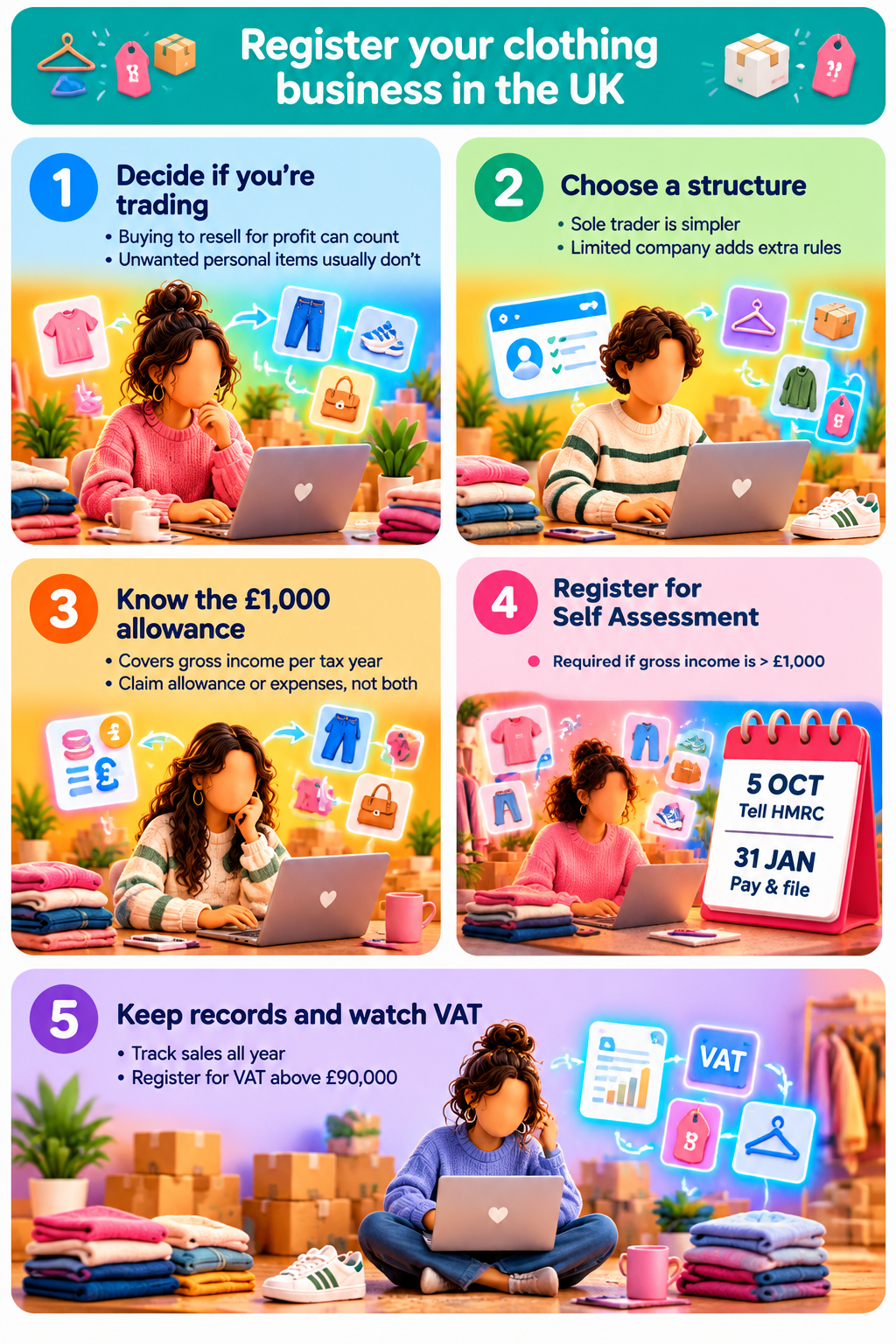
Before you register your clothing business in the UK, work out whether you’ll resell for profit or just sell unwanted personal possessions. Follow these steps:
1. Decide whether you’re trading
The UK government taxes trading income. But selling unwanted personal belongings usually isn't treated as trading.
Buying or making clothing to sell for profit can count as trading. Selling your own unwanted clothes usually doesn't. Once you start buying stock to resell, keep records of your purchases, sales, and costs.
For example, regularly buying charity shop clothes to resell on Vinted for a profit could count as trading.
2. Choose a business structure
The more straightforward option for many small clothing businesses is to start as a sole trader. You run the business yourself and report your trading income to HMRC when required.
A limited company is legally separate from you and comes with extra accounting and Companies House rules. Many new clothing resellers start as sole traders because the setup and reporting requirements are simpler.
3. Understand the £1,000 trading allowance
The trading allowance covers up to £1,000 of gross trading income each tax year. Gross income means the money you receive before taking off costs such as stock, fees, or postage.
If your gross trading income goes above £1,000, different tax rules apply. You can generally claim allowable business expenses or the £1,000 trading allowance when working out your taxable profit. You usually cannot claim both against the same income.
4. Register for Self Assessment when required
You usually need to register for Self Assessment if your gross trading income goes above £1,000 in a tax year. Self Assessment is HMRC's system for collecting Income Tax that isn't automatically deducted. As a sole trader, you report your trading income and allowable expenses on your tax return. HMRC uses this information to calculate how much tax you owe.
Note: The government plans to raise this reporting threshold to £3,000, but hasn’t confirmed a start date, so the £1,000 rule still applies.
New filers normally need to tell HMRC by 5 October after the end of the tax year in which their gross trading income first goes over £1,000.
For instance, if you start trading in May 2026 and need to complete Self Assessment, you would normally notify HMRC by 5 October 2027. Your online tax return and any tax due would then generally be due by 31 January 2028.
Missing these deadlines can lead to penalties or interest. Add both dates to your calendar.
5. Keep records and monitor VAT
Keep track of total sales with a bookkeeping system throughout the year so you know when you pass the £1,000 trading allowance. These records can help you work out your profit and complete your tax return.
Marketplaces like eBay and Vinted share seller data with HMRC once you make 30 or more sales or earn over about £1,700 in a calendar year. This isn’t a new tax, but it means HMRC can see your sales.
You should also keep track of your taxable turnover for VAT. You generally need to register once it passes £90,000 over a rolling 12-month period. You must also register if you expect your taxable turnover in the next 30 days alone to go over £90,000.
Step 6: Choose where to sell your clothes online
Choose the channels that suit your stock. Vinted charges sellers no fees, while Depop attracts buyers looking for vintage and trendy pieces. Here are some top reselling marketplaces:
Note: If you’re buying stock to resell, Vinted requires a Vinted Pro account, which UK sole traders can open. Pro sellers must accept returns within 14 days of delivery.
Step 7: Price your clothing for profit
To price your clothing for profit, start with the expected selling price from your Step 3 research. Take away your stock cost, selling fees, packaging, and any postage you pay to see your profit on each item.
Then decide the lowest offer you can accept and still make a worthwhile profit. If buyers are likely to make offers, leave some room to negotiate. Keep your starting price close to what similar items have recently sold for.
Step 8: Create clothing listings that help items sell
Create clothing listings that give buyers enough information to judge each item and help your stock sell. Here are 7 listing elements that you should consider:
- Clear front, back, and detail photos: Photograph the entire garment from the front and back, then add close-ups of labels, important details, and flaws. Use clear, well-lit images and enough angles to show its condition accurately.
Consider using a high-quality photo-editing tool to crop, brighten, or remove cluttered backgrounds, without changing the item’s true colour or hiding flaws. - Brand and product type: Include the brand and specific garment type in your title and description. Use terms buyers are likely to search for, such as “Ralph Lauren cable-knit jumper.” Avoid generic descriptions like “navy knit,” as these don’t give much information.
- Size and measurements: List the tagged size alongside useful garment measurements. Record measurements such as pit-to-pit, length, waist, and inside leg where relevant.
- Colour and material: Describe the colour accurately and copy fibre content from the care label where available. Details such as “forest green, 100% lambswool” give buyers more information and can support marketplace filters and item specifics.
- Accurate condition: Choose the marketplace condition category that best matches the garment and describe visible wear clearly. Overstating condition can lead to disappointed buyers, disputes, or returns.
- Flaws or alterations: Disclose marks, holes, repairs, tailoring, and other changes that affect the garment. Photograph flaws and provide updated measurements when alterations have changed the fit.
- Searchable product title: Build the title around specific terms buyers are likely to search for, including the brand, garment type, and important product details. “Barbour Beaufort wax jacket olive 40” communicates more useful search information than promotional wording such as “stunning vintage must-have.”
Step 9: Set up a packaging system
Vinted, Depop, and eBay UK offer postage options that can create shipping labels for you. Stock up on mailing bags, boxes, tape, and other packing supplies that fit and protect each item.
Create a system for packaging and posting each item of clothing that sells. For instance, keep all your supplies in one packing area. Set regular posting days to stay within each marketplace’s dispatch deadline. For example, Vinted gives you 5 business days to send an item.
Don’t forget to average out your costs for packaging materials so you can deduct them from your gross sales per order.
Before sending the parcel, check that it meets the delivery company's size and weight limits. Keep your proof of postage or tracking details in case there is a delivery problem.
Step 10: Market your online clothing store
Marketing your clothing store means promoting it so the right buyers find your stock.
Start with tools such as offers and bundle discounts (where the marketplace allows them) to encourage sales. You can also use Instagram or TikTok to share interesting pieces and bring more people to your listings.
Once you have your own website or social following, you can build an email list from people who sign up there. Then send newsletters that link to your listings on each marketplace. Don’t use buyer contact details from a marketplace sale for marketing, because sites like eBay don’t allow it.
Step 11: Track what sells and reinvest carefully
Use the same bookkeeping system we talked about in Step 5 to track what you paid, what each item sold for, fees, postage, packaging, profit, and time to sell.
After you make more sales, look for brands and clothing types that sell quickly and make enough profit. Use this information to decide what stock to buy again.
Increase your spending slowly as you learn what sells. Buying too much stock early can leave your money tied up in unsold clothes. Only spend large amounts of money on stock if you’ve done your research and are fairly certain you can move it at a profit.
Nifty can help increase your online store sales
If you're working out how to start an online clothing store in the UK, listing time becomes the bottleneck sooner than most expect: Every garment needs photos, measurements, a searchable title, and a price. But Nifty, an automation and crosslisting tool, can reduce manual tasks and automate tasks across marketplaces.
Here's why Nifty's so helpful for a new clothing reseller:
- Customised AI listings: Upload photos of a garment and let Nifty generate search-optimised titles, descriptions, and item details that cover the brand, size, colour, and material buyers search for. Review each draft, and use custom instructions to shape the AI’s writing style.
- Crosslist now: List eligible items across eBay, Etsy, Depop, and Whatnot from one interface, with no re-entering details on each marketplace. Marketplace access and features depend on your connected accounts and plan.
- Bulk crosslisting: Select multiple existing listings in Nifty, choose your target marketplaces, pricing, and shipping, then save the AI-generated results as drafts or publish them. That means a charity shop haul can go live in one sitting.
- Marketplace-specific Pricing Rules: Set a primary marketplace and rules for how prices in pounds should change on other marketplaces, so fee differences get built in. A £40 eBay price adjusts automatically for Depop when you crosslist, with no calculator required.
- Built-in auto-delisting: Enable auto-delisting and Nifty can remove an eligible sold item from your other connected marketplaces, helping reduce the risk of selling the same one-off vintage piece twice.
- Bulk tools = less busywork: Relist selected items in batches, schedule ready-to-publish drafts, and use supported automations to handle recurring selling tasks while you're out sourcing.
- Analytics and profits, made clear: Track sales, fees, profit, and your top-selling brands and categories, so you know what to source again. You can also set seller goals and check your progress from Nifty's home screen.
Nifty pays for itself in just a few weeks. Start with a 7-day free trial and see how Nifty can help you turn your first sourcing haul into listings on major marketplaces, with profit tracked from the very first sale.
FAQs
1. Can you start an online clothing store in the UK without money?
Yes, you can start an online clothing store in the UK with little or no money. Begin by selling unwanted clothing you already own through marketplaces such as Vinted, Depop, or eBay UK. As sales generate cash, you can reinvest the proceeds into stock from charity shops, car boot sales, or other low-cost sources.
2. How do you start an online clothing store from home in the UK?
Start an online clothing store from home in the UK by choosing what clothing you want to sell. Then, decide how you will source it, research demand, and select a sales channel. You can start from home using marketplaces such as Vinted, Depop, or eBay UK before paying for a standalone ecommerce website.
3. Do you need to register a clothing business from home in the UK?
No, you don’t always need to register a clothing business from home in the UK. Selling your own unwanted clothes usually doesn’t count as trading. If you buy or make clothes to sell for profit and your gross trading income goes over £1,000 in a tax year, you must register for Self Assessment with HMRC by 5 October after that tax year ends.