How to make money on Vinted: 7 steps
.png)
Some beginner Vinted sellers struggle to make money because they source without a plan and don’t price competitively. Consistent sellers research comparable listings and track which items are worth sourcing again.
I've helped sellers track margins across hundreds of Vinted listings, from designer boots to everyday hoodies. Here's my process for pricing items using comparable listings and sold data from other marketplaces. By the end, you’ll know how to make money on Vinted.
How to make money on Vinted: At a glance
→ 1. Start with items you already own
→ 2. Research what your items are worth
→ 3. Create listings buyers can evaluate
→ 4. Source inventory you can confidently resell
→ 5. Use offers and bundles without killing your margin
→ 6. Ship sold items reliably
→ 7. Track what actually makes you money
Follow these steps in order. My strategy starts with low-risk moves, such as selling items you already own before spending money on new inventory, then gradually scales up as you learn what works. Each step builds on the last, so work through them in sequence for the best results.
Step 1: Start with items you already own
Go through your closet and gather unused clothes, shoes, and accessories. This helps you avoid spending money on additional stock and allows you to focus on learning how listing on Vinted works.
As you sift through items, only pick those in good enough condition to justify the time spent photographing, listing, and packing them. For instance, those like-new boots you wore once back in 2024 have potential on Vinted. But that sun-bleached Quiksilver tee that accompanied you through your 8-month Southeast Asia trek is better off at a textile recycling point than in a listing.
Step 2: Research what your items are worth
Search for active listings similar to your item and compare their asking prices and condition. Vinted doesn’t provide a searchable database of sold listings, so use current comparable listings as a pricing reference rather than relying on completed-sale prices. Follow these pointers:
Check comparable listings and asking prices
Comparable listings are active Vinted listings for the same item or a very close match. Start by finding items with a similar brand, product type, size, style, and condition. Compare the asking prices of your closest matches and ignore those with differences in condition, size, style, age, and other characteristics that could explain why one seller asks more than another.
Check sold prices on other platforms
Use eBay's sold and completed listings to find similar items that have sold and record their selling prices, condition, size, and other relevant details in a spreadsheet. You can also check marketplaces such as Poshmark or Depop for additional data, but eBay provides the clearest sold-listing data for price comparisons.
If you have an eBay seller account, the free Product research tool in Seller Hub shows the real figure, including accepted offers, across three years of data.
Estimate a realistic listing price
When using sold prices from other marketplaces, check how each platform's fees affect the comparison. Don't automatically subtract a fixed percentage from an eBay sold price: eBay seller fees vary by category and other factors. But Vinted doesn't charge sellers a selling fee. That gives you room to price an item lower on Vinted while still keeping similar proceeds.
Remember, buyers see an all-in price: Vinted adds a Buyer Protection fee of roughly 5% + $0.70 in the U.S., or 3–8% + £0.30–£0.80 in the UK, on top of your asking price.
Buyers expect to negotiate, so leave room. From my own tracking: knock 10–15% off comparable prices for a small flaw, 20–30% for one you must photograph. That's your target. Add 10–20% and list at that.
Say comparable hoodies ask $22 and yours has cuff fraying. Target $16, list at $18. Then set your minimum acceptable price: the lowest you'll take once costs are covered.
Step 3: Create listings buyers can evaluate
Your listings’ photos, titles, and descriptions help buyers decide whether they’ll buy your items. Here’s how to create listings that increase your chances of making a sale:
Use clear photos
Listing photos are the images buyers use to judge condition before purchase. Vinted allows up to 20 photos. I always recommend you use the maximum number so you can display multiple angles, flaws, tags, and how the item hangs. Vinted suggests using a hanger, mannequin, or flat lay and advises against showing your face.
Make sure your cover photo, the first picture buyers see, is clear and very well done. It will appear side by side with other similar items. The more your photo stands out, the higher the chances that someone will click on (and hopefully buy) your item.
Use natural lighting if you can; if you can’t, get continuous white LED lights with softboxes or diffusers, set to around 5500K to mimic natural daylight. What you can't do is edit your way to a better photo: Vinted's Catalog Rules require pictures to represent the item as it is. Vinted’s rules also mean no flash and no filters. Light the item properly instead; that's where the gains are.
Write a descriptive title
Your listing’s title is the text buyers will see under the cover photo. Vinted titles generally follow the same formula: Brand name first, followed by size and condition, with the price shown underneath.
Use the structured fields to explain exactly what's for sale. The fields exist because vague titles get buried in search and ignored in browsing. Fill in the category, brand, size, color, condition, and material accurately so Vinted’s system can correctly apply search filters for buyers.
For example, "Zara wool coat, size 10, measurements included" outperforms "nice coat, good condition," and turns a passive scroll into a matched sale.
Describe the condition accurately
Use the description to give buyers useful details about the item. Mention its condition, how much wear it has had, and any flaws they should know about.
Avoid fluffy phrases like “highly elegant.” One person’s elegant is another person’s dated. Stick to specific, descriptive wording, such as “vintage burgundy camel-hair jacket, new with tags.”
Don't add hashtags or name any brand other than the one you selected in the brand field. Vinted hides or removes listings that mention unrelated brands.
Step 4: Source inventory you can confidently resell
Check your account type first. Vinted limits standard accounts to private use, and its rules classify buying items to resell at a profit as commercial activity, which could result in hidden listings or a ban.
Reselling needs a Vinted Pro account, which requires a registered business and gives buyers a 14-day right of return. It's available in the UK, Ireland and most of Western Europe, but not the U.S. One rule binds everyone, Pro included: No new stock bought specifically to resell, so second-hand sourcing is the only route that works.
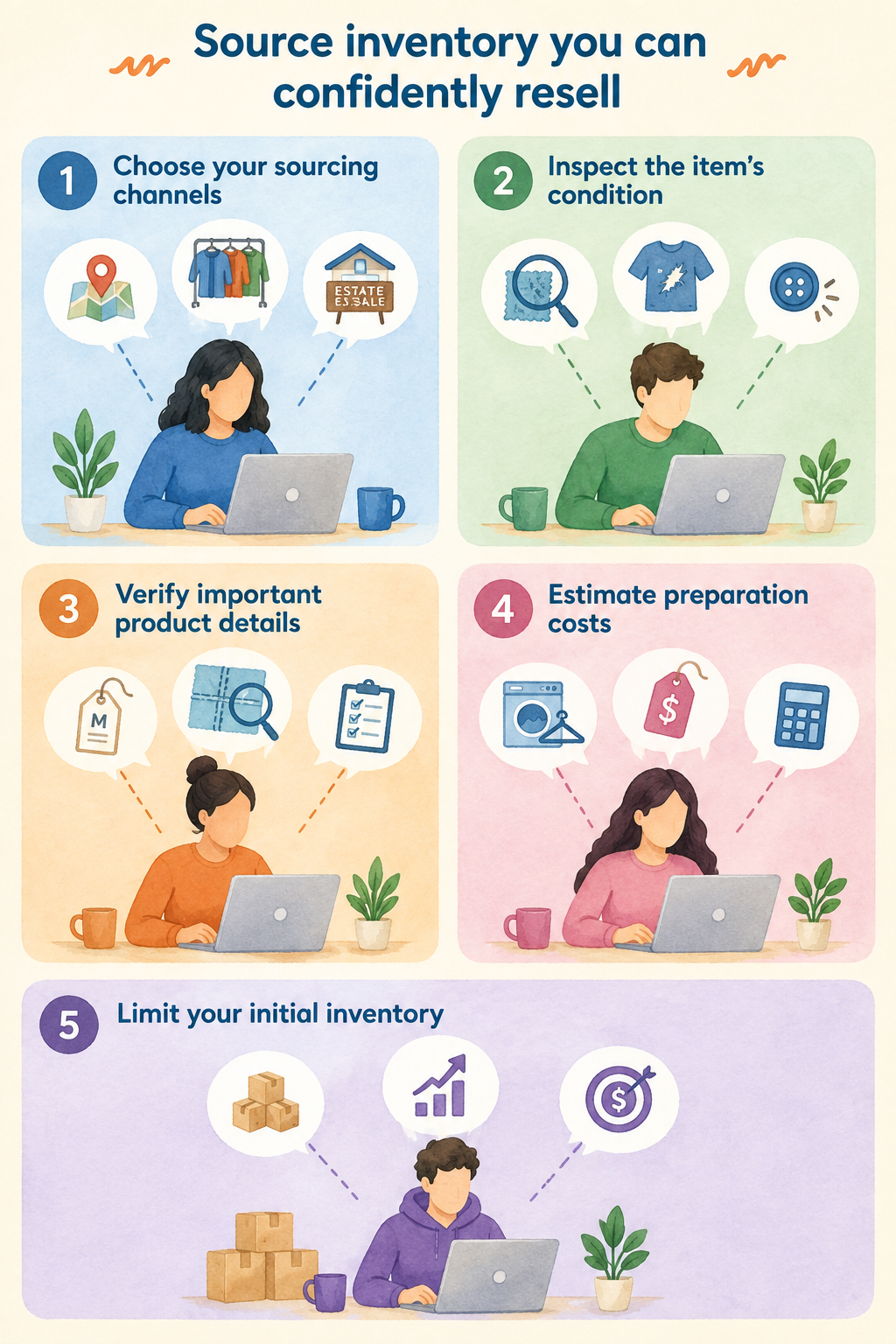
Once you’ve experimented with listing items you already own, you can start sourcing using my system:
- Choose your sourcing channels: Sourcing channels are the places, such as thrift stores and estate sales, you return to when looking for inventory. Regular channels make it easier to develop a consistent buying routine and compare opportunities over time. Read our article about how to successfully source.
- Inspect the item's condition: Before purchasing an item, inspect its wear, stains, holes, missing buttons, and other defects that affect value. Pass on items that are in poor condition, such as torn clothing that you can’t fix.
- Verify important product details: Check labels, brand-specific identifiers, construction, and other relevant details before buying branded goods. These checks can help identify authenticity concerns, although no single detail proves an item is genuine.
For eligible designer listings, Vinted's Item Verification service uses its in-house experts to check authenticity. Buyers pay the £10/item fee, so it's worth knowing about when you list higher-value pieces. It's available in the UK and most European markets, though not in the U.S.
- Estimate preparation costs: Preparation costs are expenses such as cleaning and minor repairs needed before an item is ready to sell. Add these expenses to your acquisition cost when calculating potential profit. A $10 dry-cleaning bill, for example, increases the total cost of preparing a coat for resale by $10.
- Limit your initial inventory: Start with a manageable amount of inventory while you learn which items attract buyers and sell consistently. Buying too much too early can leave cash tied up in slow-moving stock. Increase your purchasing gradually as you learn what sells and how quickly.
Step 5: Use offers and bundles without killing your margin
Here’s the difference between offers and bundles on Vinted: Offers let buyers negotiate an item's price. Bundles allow them to purchase multiple items from the same seller in one transaction.
Use your minimum acceptable price as the cutoff for deciding whether an offer or bundle is worth it. For bundles, add together the minimum acceptable prices of all included items and evaluate the offer against that total.
For example, if a buyer offers $11 on an item with a $16 minimum, you’ll need to counter at $16 or higher. Always counter or decline offers below your minimum acceptable price.
Step 6: Ship sold items reliably
A sale is complete when the buyer receives the item, and the transaction closes on Vinted. Follow these tips to reduce shipping problems:
- Confirm the order: An order is ready to process once it appears as confirmed in Vinted and you receive the shipping instructions. Follow the order details shown in the app. Never accept payments outside the platform. Pack and send the order only after Vinted has confirmed it.
- Meet the shipping deadline: Vinted normally gives sellers 5 business days to ship an item once it sells. If you miss the deadline, Vinted cancels the order, refunds the buyer, and adds automatic negative feedback to your profile. Plan your drop-off early enough to stay within that window.
If you’re running late, press the ⓘ in your buyer chat and request 3 or 5 extra business days. The buyer can accept or decline the request.
- Check the item before packing: Compare the item against its listing photos and description one last time. Look for stains, damage, missing parts, or anything else you may have missed. If you spot an issue that makes the listing inaccurate, tell the buyer before shipping and consider offering a discount.
- Package the item securely: Use packaging that protects the item during transit and follows the chosen carrier's requirements. Add appropriate cushioning for fragile items and protect clothing or other vulnerable goods from damage. Taking photos of the item and parcel before shipping and recording the packing process can also help if a dispute occurs.
- Keep your shipping records: Don’t throw out any proof-of-shipping documents until Vinted marks the transaction complete. Depending on the shipping method, this can include your drop-off receipt, shipping label, tracking details, or carrier confirmation. These records can help prove that you sent the parcel if a delivery problem arises.
Tracking can take 48 hours to appear. If yours hasn't updated after drop-off, press "I confirm I've sent the order" so Vinted doesn't cancel it.
Step 7: Track what actually makes you money
By tracking what sells, you can create a repeatable process to evaluate potential inventory before spending money. Here’s how to do it:
- Record every item's total cost: Create a bookkeeping spreadsheet with one row per item and record the purchase price plus cleaning, repairs, packaging, promotion, and any other costs you paid. This gives you the real amount invested in each item before comparing it with the eventual sale price.
- Record the final selling price: Enter the final item price you accepted when an item sells, excluding buyer-paid shipping and Buyer Protection charges. Comparing this with your original asking price can show whether certain brands or categories repeatedly require larger discounts to sell.
- Calculate your profit per item: Subtract all costs from your sale proceeds. Track the resulting profit so a high selling price doesn't disguise a weak return. A $50 sale means little if you spent $42 sourcing and preparing the item.
- Track how long items take to sell: Record the listing date and sale date for every item. An item earning $20 in five days may be more attractive than one earning $25 after six months because your invested cash becomes available sooner and can be used again.
- Review your results before buying more stock: Group completed sales by brand, category, size, purchase price, or other useful characteristics and look for repeated patterns. If your records show Nike sneakers repeatedly selling faster and at stronger margins than unbranded jackets, use that evidence when deciding what to source next.
Sell more items with Nifty
Now that you know how to make money on Vinted, you can earn even more by expanding into other marketplaces. That's where Nifty, a crosslisting and automation tool, comes in. Nifty lets you list and manage inventory across eBay, Etsy, Poshmark, and other marketplaces, all in one place.
Here’s why Nifty’s so helpful:
- Customized AI listing: Snap a pic and let Nifty’s AI build a high-quality listing, with SEO-optimized titles and descriptions, and trending hashtags already filled out for you. You can even customize how AI writes your listings to follow your unique style.
- Crosslist now: With a couple of clicks, post your items across Whatnot, Poshmark, eBay, Mercari, Depop, and Etsy. No copy-paste clutter and no multi-tab hopscotch. (More marketplaces coming soon!)
- Bulk crosslisting: Publish up to 25 listings at once with marketplace-specific pricing rules, shipping presets, and AI-enhanced titles and descriptions. Start in Nifty or import from eBay, then export everywhere in one action.
- Marketplace-specific Pricing Rules: Set your price once on a primary marketplace, and Nifty auto-calculates the rest with percentage or dollar adjustments so your take-home stays consistent when you crosslist.
- Auto-delisting: When you make a sale, Nifty’s sales detection auto-delists that item from every marketplace. Say goodbye to double-selling disasters and “sorry, it’s already gone” apology messages.
- Bulk tools = no busywork: Share and relist daily in just a few clicks. You can even schedule drafts to go live while you sleep and set automatic discounts that run deeper over time.
- Analytics you can act on: Track sales, fees, top performers, and slow movers in one clean dashboard, so you can actually see what’s working and what’s just dead space. You can also set and track seller goals directly from your home screen.
Nifty pays for itself in just a few weeks. Start with a 7-day free trial and see how Nifty can help you take the sourcing and pricing skills you built on Vinted and put them to work across other marketplaces.
FAQs
1. What should you sell on Vinted to make money?
You should sell clothes, sneakers, and accessories on Vinted because they sell fastest. Vinted allows almost anything, from home goods to electronics. Focusing on fashion categories is the most lucrative because many buyers still view Vinted as a fashion and accessories marketplace.
2. How can you make money on Vinted quickly?
You can make money quickly on Vinted by starting with items you already own, since there’s no upfront inventory cost. Research comparable listings on Vinted, then check sold prices on platforms like eBay to see what buyers actually pay, since Vinted doesn’t provide the same sold-listing data.
Use clear, well-lit photos to make your listings stand out and help items sell faster, shortening the time between listing and getting paid.
3. Can you make money on Vinted without selling items?
No, you can’t make money on Vinted without selling items. Vinted's model centers on selling items directly to buyers, so income depends on completed sales. The platform doesn’t allow you to sell services.
4. Is it worth selling on Vinted in the UK?
Yes, it is worth selling on Vinted in the UK. Vinted charges no seller fee, letting UK sellers price competitively while keeping more proceeds. This structure improves margins compared to platforms with per-sale fees, avoiding unnecessary profit loss.


.png)