NWOT meaning and how it affects your listings (2026)

NWOT means new without tags: An item that’s never been worn or used but no longer has its original retail hangtags or price tags. You’ll see it across secondhand clothing listings, and it has one firm limit: the item can't have been worn or used.
I compared how Poshmark, eBay, Mercari, and Depop each define new and like-new condition, and they don’t handle untagged items the same way. By the end, you’ll know how NWOT differs from NWT, which items qualify and which don’t, and what other reseller acronyms mean.
What’s the difference between NWT and NWOT?
The difference is the tags: NWT items still have their price tags or hangtags attached, whereas NWOT items don't. Both mean the item is new and never used.
“Tags” doesn’t mean the labels sewn inside the clothes, like the brand, size, fabric, or care labels. An NWOT shirt still has those sewn-in labels. If any are missing, say so in your listing. Buyers use them to check size, fabric, and whether the item is real.
What qualifies as NWOT?
NWOT describes new, unused items that no longer have their original retail tags. Here are the rules of thumb:
Items that may qualify as NWOT
An NWOT garment or accessory must be new and unused, even though its original retail tags are missing. This means no one has ever worn or used the item, not even once. A quick try-on at home that leaves no signs of wear is the most it can have had.
Store returns may qualify if they’re actually unused and meet marketplace requirements.
Examples include a shirt bought but never worn with its price tag removed, shoes briefly tried on indoors without signs of wear, and an unused gift without retail tags.
Items that should not be described as NWOT
Previously worn or used items don't qualify as NWOT, even if they look new. Items that don’t have tags but have been used one or two times could qualify as “excellent used condition” (EUC).
Visible wear or damage can affect the appropriate condition category. Carefully inspect each item and disclose any flaws before listing.
Examples include clothing worn outside, garments with pilling or stretched fabric from use, shoes with worn soles, and items washed after being worn. Unused items with manufacturing defects may require a separate condition category, depending on the marketplace.
How do resellers use NWOT on resale marketplaces?
Resellers use NWOT across major resale marketplaces by writing the term into their titles and descriptions differently. Here’s how it works:
- Poshmark: NWOT is seller shorthand in titles and descriptions. There's no NWOT option, but Poshmark's Like New condition covers "new without tags or like new." Sellers select Like New for unused items without retail tags, add NWOT to the title or description to set them apart from lightly worn pieces, and include photos showing their condition.
- eBay: New without tags is an official clothing condition for unworn items without original tags or packaging and with no flaws. Unworn clothing with defects belongs under New with imperfections. Condition options vary by category.
- Mercari: Sellers can write NWOT in descriptions and select Like New as the official condition. Mercari includes unused items without tags under this grade, provided they have no noticeable damage or wear.
- Depop: Sellers can add NWOT to the description and select “Like new,” since Depop's “Brand new” is for items that still have their original tags. An untagged dress worn once should not be advertised as NWOT because it has already been used.
How to list an NWOT item accurately
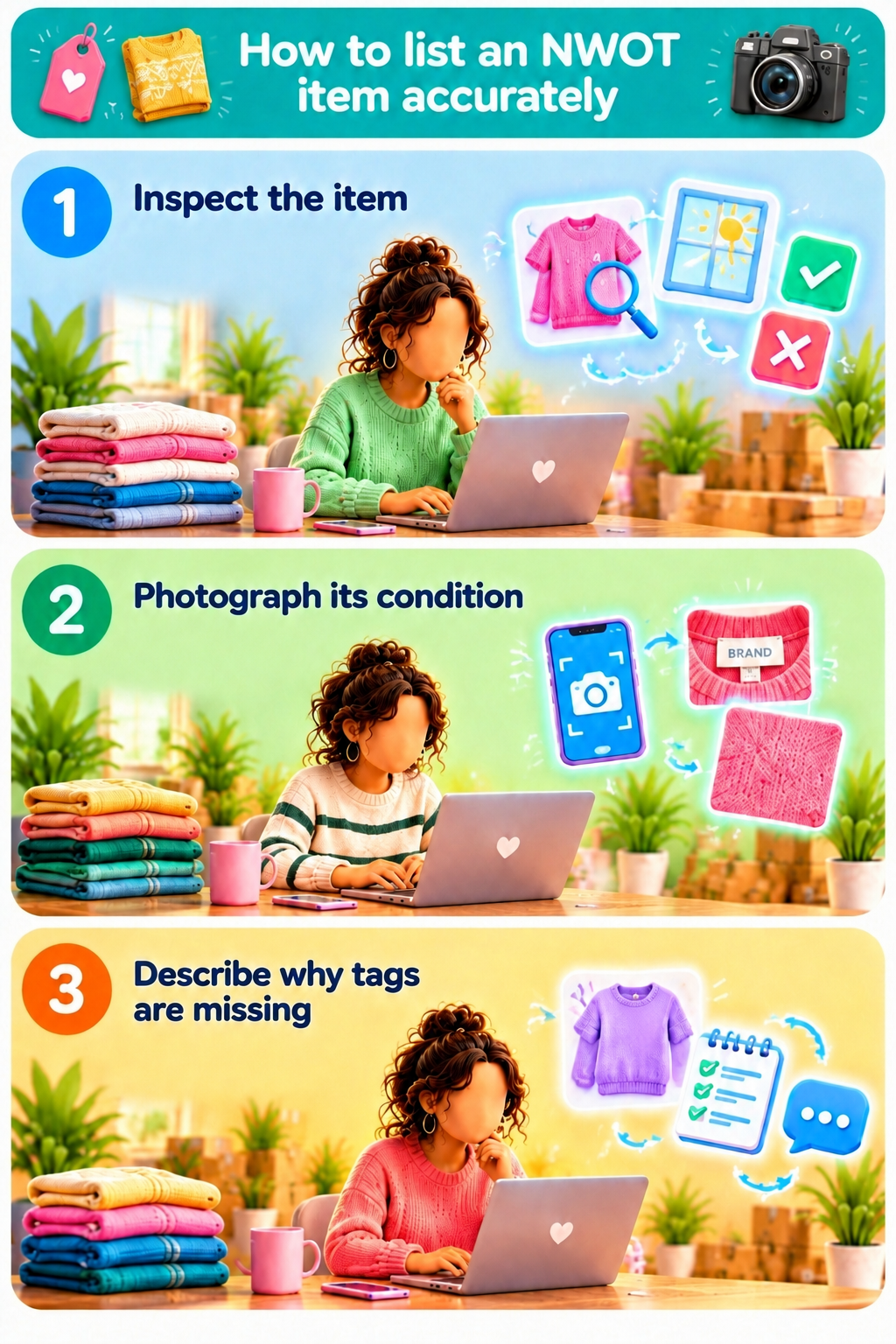
List an NWOT item accurately by showing buyers that it's new and unused, even though its store tags are missing. Follow these 3 steps to describe its condition and set a fair price:
- Inspect the item: Check the item in natural light for wear, damage, stains, changes, or missing parts. Items that show signs of use usually don't qualify as NWOT, but a quick try-on that left no trace still counts as unworn. Check underarms, collars, cuffs, and hems for signs of wear.
- Photograph its condition: Take clear photos of the entire item, brand and size labels, fabric, and areas that often show wear. If a close-up turns up a flaw, the item isn't NWOT anymore, so pick the marketplace's condition for flawed items instead. Read our guide to taking spectacular photographs for Poshmark. The principles apply to all marketplaces, too.
- Describe why tags are missing: Tell buyers the item is unused and that its original store tags are missing. Mention any signs of handling. Explain why the tags are missing if you know.
Other resale condition acronyms to know
Here’s a look at some other popular resale condition acronyms, used across many reseller marketplaces:
Important: HTF isn't a condition grade. You’ll most likely see it with certain collectibles and rare vintage items.
Sell more on multiple marketplaces with Nifty
Now that you know the meaning of NWOT, it’s time to start selling your items. I suggest selling NWOT items on multiple marketplaces to reach more buyers. Nifty, a crosslisting and automation tool, simplifies multi-marketplace selling across Poshmark, Depop, eBay, and others.
Here’s why Nifty’s so helpful:
- Customized AI listings: Upload photos and let Nifty generate search-optimized titles, descriptions, and item details. Use custom instructions so every NWOT draft states the item is unused, explains how the tags came off, and mentions the sewn-in brand and size labels. Review each draft before publishing.
- Crosslist now: List eligible NWOT items across eBay, Etsy, Poshmark, Whatnot, Mercari, and Depop from one interface instead of re-entering the details on each marketplace. Confirm that each listing’s condition category matches that marketplace’s official definitions. Marketplace access and features depend on your connected accounts and plan.
- Bulk crosslisting: Select multiple existing listings in Nifty, choose your target marketplaces, pricing, and shipping, then save the AI-generated results as drafts or publish them. It’s a fast way to move a batch of unworn gifts or untagged store returns.
- Marketplace-specific pricing rules: Set a primary marketplace and Nifty works out every other marketplace's price from the rule you set, so you don't recalculate each crosslisted price by hand. When you add an item, Nifty can also suggest a price from recent comparable sales.
- Built-in auto-delisting: Enable auto-delisting and Nifty can remove an eligible sold item from your other connected marketplaces, helping reduce the risk of selling the same one-of-a-kind NWOT piece twice.
- Bulk tools = less busywork: Relist selected items in batches, schedule ready-to-publish drafts, and use supported automations to handle recurring selling tasks, so untagged inventory doesn’t sit stale.
- Analytics and profits, made clear: Track sales, fees, profit, and your top-selling brands and categories to see which never-worn inventory is worth sourcing again. You can also set seller goals and check your progress from Nifty’s home screen.
Nifty pays for itself in just a few weeks, and we’re also available for Australian and UK sellers on Depop, eBay, Etsy, and Whatnot. Start with a 7-day free trial and see how Nifty can help you turn untagged, never-worn items into accurate, buyer-ready listings on every connected marketplace.
FAQs
1. What does NWOT mean in selling?
NWOT means “new without tags.” Use it to describe an item that is new and unused but no longer has its original retail hangtags or price tags. The abbreviation communicates the seller’s claimed condition. Buyers should still review the photos, sewn-in labels, and description for signs of wear before purchasing.
2. What does NWOT mean in slang?
In slang, NWOT keeps the same meaning: New Without Tags. You’ll see it in resale listings, social media posts, and online threads about secondhand shopping, where it describes unused items missing their retail tags. It’s a common shorthand among resellers and thrift shoppers.
3. Is NWOT the same as “like new”?
Not exactly. NWOT means the item has never been used, whereas “like new” can also cover items that have been worn briefly and show little to no visible wear. Poshmark and Mercari both file unused, untagged items under Like New, so on those marketplaces you'd pick Like New and add NWOT to the listing.