
HTF meaning: When should resellers use Hard to Find in 2026?
.png)
You’ve probably seen the label “HTF,” or hard to find, many times. Some sellers misuse the label on items that buyers can easily find from several other sellers.
I've sourced and resold hundreds of items across eBay, Mercari, Poshmark, and Depop, so I know when to use HTF and when to skip it.
This guide explains what HTF signals, when it's genuinely earned, and how to use it in your own listings without torching your credibility.
What does HTF mean in different contexts?
In contexts beyond reselling, HTF can stand for higher (or high) time frame, Happy Tree Friends, and a potty-mouth text response. Here’s a look at the more common meanings:
What does HTF mean in reselling?
HTF means hard to find, a term sellers use for items that are difficult to source or rarely available.
However, an HTF item isn't always valuable because buyers still need to want it. For example, you might have a limited-edition clay mug from 1935 that you've listed on eBay. If no one views the listing or shows interest, being hard to find doesn't make the mug valuable.
Before using the HTF label, do more research: Check sold listings on sites like eBay or Depop to see what buyers have actually paid and whether items like yours actually sell. Researching the best items to resell can also help you compare demand before sourcing or setting a price.
Why are some items HTF?
Some common examples of HTF items in reselling are discontinued products, limited releases, and vintage items. Here’s why these goods are so hard to find:
- Discontinued products: Brands sometimes stop making a product even though people still want to buy it. As time goes by, the product can become harder to find.
- Limited releases: Some companies make certain products in small quantities or for a short time. Once the items sell out, buyers may have to search resale marketplaces unless the brand releases more.
- Older or vintage items: Some products can become harder to find as fewer examples remain over time. Certain models, designs, or versions may be especially scarce because production ended years ago, or the original business that produced them no longer exists.
- Uncommon sizes, colors, or variants: Some versions of a product are harder to find than others. For example, a shoe may be widely available in common sizes but difficult to find in size 15. Some brand-new or NWT items can also be HTF because few unused versions are still available.
- Region-specific products: Brands sometimes sell products only in certain countries or markets. Buyers elsewhere may have to search international stores, importers, or resale marketplaces to find them.
- Collectibles with limited current inventory: Production may have ended years ago, leaving only a small number of certain collectibles for sale. Condition and the number of owners willing to sell can also affect availability. Check active listings and recent sales across several marketplaces before paying extra for an item labeled HTF.
What does HTF mean on eBay?
HTF means hard to find on eBay. The platform doesn’t use HTF as an official condition, category, or item detail. It is simply a term that you can choose to use.
You can add it to titles or descriptions when you think an item is difficult to find. For example, your listing might say, “Vintage Pyrex Butterprint Bowls HTF Complete Set.” This tells you the seller believes similar sets are hard to find.
I can’t stress this enough: Check active and sold listings before using the HTF label. The term alone doesn’t prove your item is rare, popular, or valuable. If buyers can easily find the same item elsewhere, calling it HTF could hurt your credibility and reputation.
How to use HTF in an online listing
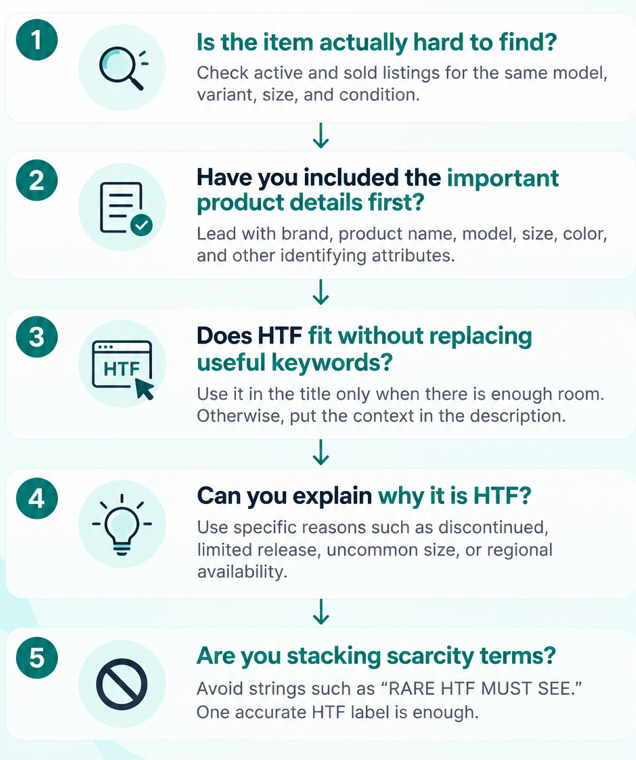
Use HTF when you have a good reason to believe the item is actually hard to find by checking current listings and recent sales. Follow these steps:
Step 1: Check whether the item is actually hard to find
Search sites like eBay, Poshmark, or Depop for active and sold listings for the same item before calling yours HTF. Compare the model, size, color, condition, and other details that could affect how easy it is to find. Use a spreadsheet to record this information for easy reference.
For example, say you're researching a watch. Search for its exact reference number because another version of the same watch may be much easier to find.
Step 2: Prioritize searchable product details
Put details such as the brand, product name, model, size, and color in your titles first. These terms help buyers find your item through searches and filters.
For example, “Nike Air Max 1 Patta Waves Size 10.5 HTF” tells buyers exactly what the item is before adding the HTF label.
Step 3: Add HTF where it makes sense
eBay gives you limited space in a title, so don't let HTF push out useful product details. Add it to the title when you have room. If you don’t have room in the title, use the term HTF in the description.
Step 4: Explain why the item is difficult to find
In the description, tell buyers why you're calling the item HTF. Sharing these details helps show buyers why you consider the item hard to find. For instance, you could say a model was discontinued in 2019 when you have a reliable source for that date.
Step 5: Don't stuff the listing with scarcity terms
Avoid stuffing your title with multiple abbreviations that mean the same thing. This doesn’t give buyers any new information. Plus, they take up space you could use for the product name, model, size, or other details buyers search for.
One HTF label is enough when the item is actually hard to find.
When should you not use HTF?
Avoid using HTF when your item is old but easy to buy, or when products are widely available. These situations can help you determine when not to use HTF:
- The item is old but easy to buy: Age or discontinued status doesn't automatically make an item hard to find. Older products can remain widely available through old stock and resale marketplaces. For instance, a 10-year-old product available from several sellers may be better described by its age, model, condition, or history.
- Limited products are widely available for resale: Even if an item was produced in limited quantities, that doesn't mean it's hard to find today. A product originally released in small numbers may still have plenty of resale inventory when it doesn’t have much demand.
- You're using HTF to get more views: Don't assume adding HTF will push your listing higher in search results. Use it to describe genuine limited availability, not as a way to attract extra views. eBay listing software can help you review sales volume, sell-through rates, and current availability.
Other common reseller abbreviations
Whether you’re sourcing items or selling them, you’ll most likely run into common abbreviations like NWT and NWOT. Here’s a definition of each acronym and its meaning:
Sell more HTF items with Nifty
Now that you know HTF means hard to find, the next question is how to actually move those items once you've priced and listed them correctly. That's where Nifty, a crosslisting and automation tool, comes in. Nifty helps you list and manage your HTF finds across eBay, Etsy, Poshmark, and other platforms all in one place, saving you tons of time.
Here's why Nifty's so helpful:
- Customized AI listing: Snap a pic and let Nifty's AI build a high-quality listing, with SEO-optimized titles and descriptions, and relevant hashtags already filled out for you. You can even customize how AI writes your listings to follow your unique style.
- Crosslist now: With a couple of clicks, post your items across Whatnot, Poshmark, eBay, Mercari, Depop, and Etsy. No copy-paste clutter and no multi-tab hopscotch. (More marketplaces coming soon!)
- Bulk crosslisting: Publish up to 25 listings at once with marketplace-specific pricing rules, shipping presets, and AI-improved titles and descriptions. Start in Nifty or import from eBay, then export everywhere in one action.
- Marketplace-specific Pricing Rules: Set your price once on a primary marketplace, and Nifty auto-calculates the rest with percentage or dollar adjustments so your take-home stays consistent when you crosslist.
- Built-in auto-delisting: When you make a sale, Nifty's sales detection auto-delists that item from every marketplace. Say goodbye to double-selling disasters and "sorry, it's already gone" apology messages, which matter even more when a buyer was chasing a genuinely scarce find.
- Bulk tools = no busywork: Share and relist daily in just a few clicks. You can even schedule drafts to go live while you sleep and set automatic discounts that run deeper over time.
- Analytics you can act on: Track sales, fees, top performers, and slow movers in one clean dashboard, so you can actually see which HTF items are commanding a premium and which ones are just dead space. You can also set and track seller goals directly from your home screen.
Nifty pays for itself in just a few weeks, so start with a 7-day free trial and see how Nifty can help you get your hard-to-find inventory sold faster, at the right price. And if you're in the UK or Australia, Nifty is now available for eBay, Etsy, Whatnot, and Depop sellers.
FAQs
1. Does HTF mean an item is rare?
No, HTF doesn’t necessarily mean an item is rare. HTF describes how hard something is to find right now, while “rare” means genuinely limited supply. An item can be temporarily HTF without being truly scarce. Always verify sold listings before pricing to avoid overpricing and lost sales.
2. Does HTF make an item more valuable?
No, HTF doesn’t make an item more valuable. Value depends on real buyer demand, so checking sold/completed listing prices before setting your price reduces the risk of overpricing and slow-moving inventory.
3. What does HTF mean on marketplace listings?
HTF means “hard to find” on marketplace listings. The term is informal shorthand sellers use to flag limited availability. It's not an official platform status or proof of rarity, so pairing it with searchable details helps buyers find items faster and cuts confusion.
4. Does putting HTF in a listing help it sell?
No, putting HTF in a listing doesn’t necessarily help it sell. HTF signals scarcity to shoppers who recognize it, but price, condition, photos, and accurate titles matter more. Prioritizing searchable keywords over scarcity terms improves visibility and avoids missed searches.


.png)
.png)