
How to increase sales on Vinted: 10 ways (2026)
.png)
You can increase sales on Vinted by improving your listing photos, pricing items competitively, and listing regularly. But Vinted closets with few sales often have the same problem: A handful of items sell, while the rest sit for months without a single offer.
After helping many resellers improve their Vinted performance, I’ve summarized the changes that make the biggest difference. By the end, you’ll know how to increase sales on Vinted, from improving weak listings to deciding when an Item Bump is worth it.
How to increase sales on Vinted: 10 tips at a glance
- Improve your listing photos
- Write listings buyers can actually find
- Price items for the Vinted market
- Send offers to interested buyers
- Use bundle discounts to increase order size
- List new items regularly
- Reassess listings that aren't getting engagement
- Build buyer trust
- Time listings around seasonal demand
- Use paid visibility selectively
1. Improve your listing photos
Vinted listing photos should show buyers exactly what an item looks like, including its condition, color, details, and any flaws. Vinted recommends clear photos taken in daylight and requires sellers to use their own photos rather than stock or advertising images.
- Use a clear first photo: The first photo should give buyers a clear view of the entire item. Vinted's catalog rules state that the first image must clearly show the whole item, so keep it unobstructed and use a simple background that makes it easy to see.
- Photograph items in good lighting with accurate colors: Good lighting helps buyers see an item's actual color, texture, and condition. Take photos in daylight and avoid flash and filters to help prevent the item from looking different. Choose a well-lit location and check that the photos accurately represent what you are selling.
- Include multiple angles and close-ups: Multiple photos give buyers a more complete view of an item than a single image can provide. Show the front and back, then add additional images of tags, condition, or distinctive features. For a jacket, that could include close-ups of the zipper, cuffs, pockets, lining, and stitching.
- Show labels, logos, materials, and sizing information: Close-up photos can document information that buyers can’t easily see in the main listing image. Pictures of labels, logos, care labels, and stitching can help buyers evaluate an item’s material, size, or authenticity. Make sure text on tags is readable.
- Photograph visible flaws: Flaw photos document stains, holes, tears, scratches, pilling, fading, and other signs of wear before a buyer makes a purchase. Shoot each relevant flaw clearly and mention it in the description. For example, include a close-up of a snag on a sleeve and identify its location so the buyer knows about it before ordering.
2. Write listings buyers can actually find
Vinted uses listing information to determine which items come up in buyer searches and recommendations. Follow these 3 pointers:
Step 1: Write a descriptive title
A descriptive title tells buyers what the item is and includes specific details that distinguish it from similar listings. Vinted recommends including information such as the brand, color, item type, or distinctive features while avoiding vague words such as “nice,” “pretty,” or "good.”
If you’re selling jeans, don’t write, “cool late 90s Levi’s.” This title tells buyers nothing. Use a title like, “vintage men’s Levi's 501 blue straight-leg jeans 32 x 32” to provide more useful identifying information.
Step 2: Complete the item details accurately
Item details, such as category, brand, size, color, and condition, help categorize your listing. Accurate details also help buyers narrow their searches. Some buyers use filters to find listings that match precisely what they’re looking for. The more accurately you describe your item, the more likely it is to appear in relevant filtered searches.
Select the fields that best describe the item and choose up to 3 applicable materials where available. For example, correctly listing a wool coat's category, brand, size, color, material, and condition helps it match relevant searches and filters.
Step 3: Add a useful description
A useful description provides more information about your item that buyers can’t find in the listing fields. A detailed, accurate description can include additional materials, alterations, missing parts, any flaws, or unique descriptions about the item.
Descriptions also factor into how Vinted evaluates an item's relevance to a search query.
For example, noting that you custom-tailored a leather jacket at the waist and fitted it with new brass zippers gives buyers a clearer picture of its condition, character, and history.
3. Price items for the Vinted market
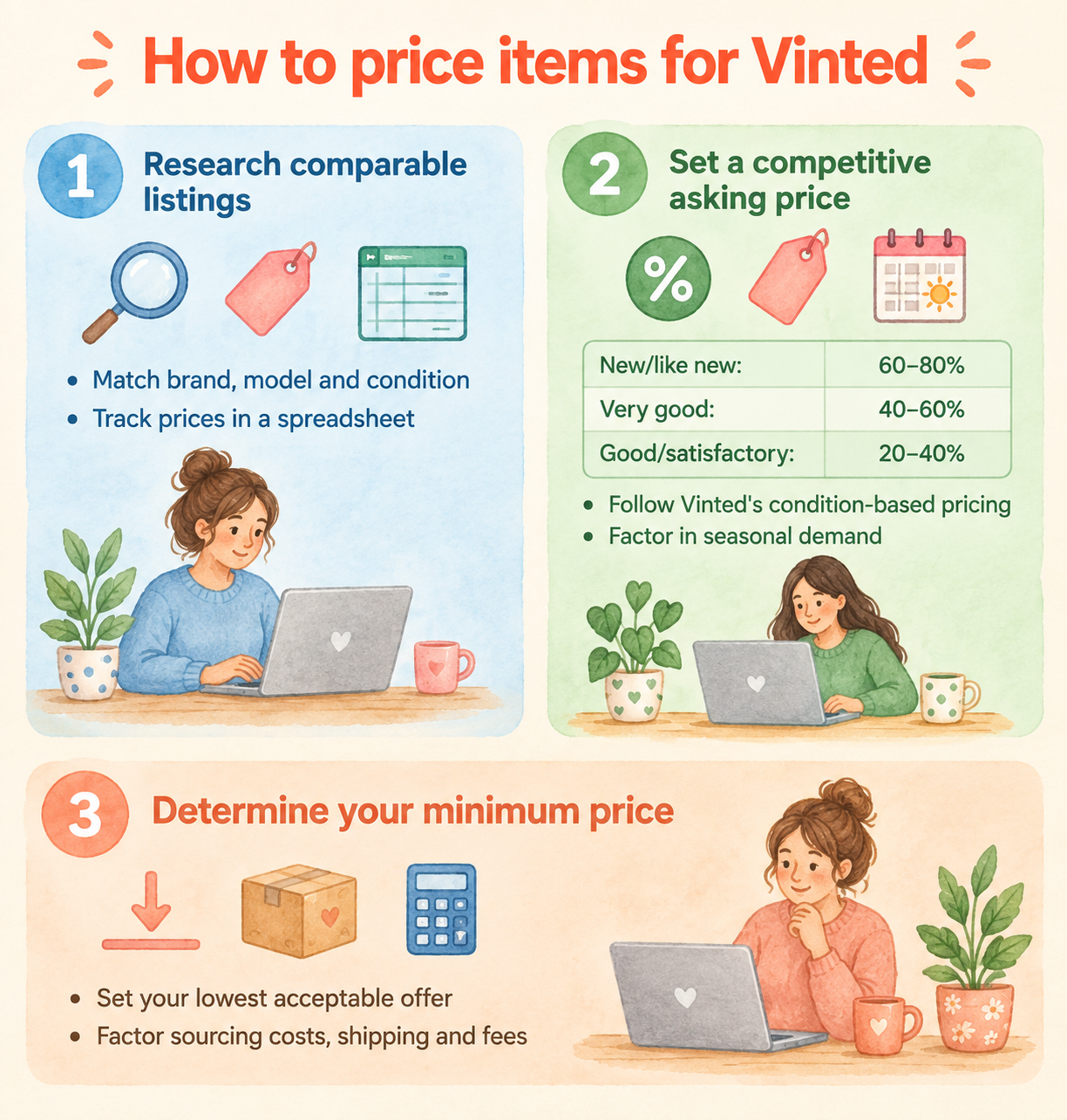
Before you list an item, always check similar ones and compare their condition and listing prices so you know Vinted’s current market pricing for your item. Here’s what you need to do:
Step 1: Research comparable listings
Comparable listings are items similar to yours that are already for sale. Look for the same brand, model, condition, and other key features to get a better idea of what buyers may pay. You can then adjust your price or negotiate through offers.
Compare several listings instead of relying on a single unusually high or low price. Put on your market analyst hat and record pricing, date taken, and any important information (such as condition or exact match) in a spreadsheet so you can track historical trends.
Step 2: Set a competitive asking price
Competitive pricing reflects both your item's condition and how similar products are currently priced on Vinted. The platform recommends 60–80% of retail for new or like-new items, 40–60% for items in very good condition, and 20–40% for items in good or satisfactory condition.
You should also consider seasonality. For instance, a North Face down jacket will likely have more demand in September than in May.
Step 3: Determine your minimum acceptable price
A minimum acceptable price is the lowest amount you’re willing to accept. Vinted allows buyers to make offers, while sellers can accept, decline, or counter them. Set your own floor by considering sourcing costs, shipping (if applicable), and any other relevant fees.
Here’s an example of how to determine your minimum pricing for the North Face Nuptse down jacket:
Current retail price: $380
Target resale range: $228–$304 (60–80% of retail)
Listing price: $275
Sourcing cost: $90
Packaging and shipping: $15
Minimum acceptable price: $200
Profit at minimum price: $95
4. Send offers to interested buyers
Vinted allows sellers to send an offer to someone who favorites an item or asks about it. When buyers “favorite,” they save the item so they can return to it later, so it indicates interest but doesn’t guarantee a purchase. Making offers shows buyers you’re serious about selling.
In most cases, buyers will ask for a lower price. Choose a discount that still keeps the sale worthwhile for you, and avoid reducing the price below the minimum you are willing to accept. Keep in mind that even when a buyer accepts a proposed price, the item isn’t sold until the buyer completes the purchase and payment is accepted.
5. Use bundle discounts to increase order size
A bundle discount is a discount you give to a buyer who purchases multiple items in one order. Bundling usually makes shipping prices more attractive to the buyer, can help you clear out slow-moving inventory, and might even increase the total order value.
For example, offering a $5 discount across 3 tees gives the buyer a better combined price.
But always remember to set a minimum acceptable total before offering a bundle discount so the reduction doesn’t damage your profit margin.
6. List new items regularly
To list regularly, create a schedule for adding new items throughout the week. Don’t upload everything at once and then leave your account inactive. Vinted recommends uploading items regularly to help gain followers, and followers can receive notifications when you list something new.
Newer listings may appear higher in Vinted buyer feeds. For instance, consider spacing 10 items across 2 weeks to help create multiple opportunities for shoppers to see your new stuff. However, posting frequently doesn’t automatically boost the ranking of your older or unrelated listings. Choose a schedule that matches the inventory you can realistically maintain.
7. Reassess listings that aren't getting engagement
Reassess listings that aren’t getting engagement by changing prices, photos, item details, or descriptions. Let’s look at some low-engagement scenarios and what you can do to help:
If your listing gets few views
Few views can mean there’s a problem with the parts of your listing buyers see first in search results or feeds. Review your title, category, size, condition, and price. Compare these details with competitors.
Check the first photo as well so buyers can immediately see what you are selling. If the photos look bad or are unclear, change them.
For example, correcting a light jacket placed in the winter coat category gives Vinted more accurate information about where the item belongs. Plus, buyers searching for light jackets are more likely to find it.
If your listing gets views but few favorites
Views with few favorites show that shoppers have enough interest to click on the listing, but they often don’t save it. Review factors a buyer can evaluate from the listing, such as the photo collection, condition, and description.
Compare your asking price with similar items currently listed on Vinted and make sure the photos accurately represent the item. If your light jacket is priced above comparable listings in similar condition, for example, you could reassess whether the difference is justified.
If your listing gets favorites but no sale
Favorites indicate that buyers have enough interest to save your item. I always recommend that sellers make offers with limited-time discounts for favorited listings. For instance, you can offer a buyer 10% off for the next 12 hours, or build a bundle that pairs a small item (such as a beanie) with a jacket.
Also consider reassessing your listing price against comparable items. If the market indicates lower prices, you’ll probably need to make some adjustments to meet that demand.
8. Build buyer trust
Building buyer trust means you follow processes and provide good service. Let’s look at how you can do this:
- Have a complete and verified seller profile: Your Vinted profile can include a profile photo, description, location, verification information, and feedback from other members. Vinted also provides account-verification options, including phone-number verification. A full profile gives prospective buyers more context about the person selling the item.
- Respond clearly to legitimate buyer questions: Buyers can contact you via Vinted messaging to ask for additional information about an item. Answer relevant questions with specific information when you can. For example, if someone asks for a jacket's shoulder width, respond with the precise answer they’re looking for.
- Ship completed orders reliably: If you use prepaid shipping, you must send sold items within 5 business days. Follow the shipping instructions provided for the order, package the item appropriately, and hand it to the designated carrier before the deadline.
- Build positive transaction history: Vinted displays feedback about previous transactions on profiles. The platform may also generate automatic feedback in certain circumstances. Completing transactions on time and providing good service gives buyers a reason for positive reviews.
9. Time listings around seasonal demand
Seasonal timing helps you reach buyers when they’re most likely to purchase certain items. Demand for some categories can change throughout the year. Winter coats, for example, may attract different levels of interest as colder weather approaches. Warm-weather and occasion-specific clothing can have their own periods of relevance.
Review seasonal inventory as the appropriate time of year approaches and reassess its price, photos, and listing details before deciding that an unsold item needs a permanent price reduction.
10. Use paid visibility selectively
Paid promotion via Item Bump can offer additional visibility on Vinted, so it makes the most sense when greater exposure could help an otherwise solid listing reach more buyers. Here’s when to use this feature:
Choose which items are worth promoting
A listing worth promoting should have accurate information, strong photos, a reasonable price, and enough potential proceeds to justify the additional cost. Vinted charges for Bumps based on the item's price and the promotion duration, with the applicable fee shown before purchase.
Consider the cost alongside what you expect to earn from the item before paying for Item Bump. For example, spending several dollars to promote a higher-priced listing with more room to absorb the fee may be the right move.
Fix the listing before paying for visibility
Review the listing before purchasing a Bump. Make sure the price is aligned with market demand, your photos are clear, and your description, title, and other information are all accurate.
Measure whether promotion increases visibility and contributes to sales
Vinted lets you track views and interactions for a bumped item. Use those results to evaluate whether the additional exposure was useful. Compare the promotion cost with the revenue earned from the item instead of looking only at additional views.
A sale doesn’t automatically make a promotion profitable because your acquisition cost and other expenses still matter. If repeated Bumps add visibility without producing worthwhile results, reassess the listing or stop paying to promote it.
Sell more with Nifty
Now that you know how to increase sales on Vinted itself, you can consider listing on other marketplaces to reach more buyers. Every item sitting in your closet could also be live on eBay, Poshmark, Depop, and Etsy, among others. That's where Nifty comes in. You'll be able to list and manage your items in one place.
Here's why Nifty's so helpful:
- Customized AI listing: Snap a pic and let Nifty's AI build a high-quality listing, with SEO-optimized titles and descriptions, and trending hashtags already filled out for you. You can even customize how AI writes your listings to follow your unique style.
- Crosslist now: With a couple of clicks, post your items across Whatnot, Poshmark, eBay, Mercari, Depop, and Etsy. No copy-paste clutter and no multi-tab hopscotch. (More marketplaces coming soon!)
- Lightweight Facebook Marketplace integration: Select multiple inventory items and export a CSV formatted for quick Facebook Marketplace uploads.
- Bulk crosslisting: Publish up to 25 listings at once with marketplace-specific pricing rules, shipping presets, and AI-enhanced titles and descriptions. Start in Nifty or import from eBay, then export everywhere in one action.
- Marketplace-specific Pricing Rules: Save pricing templates for each marketplace and apply them automatically during bulk crosslisting to keep listings consistent without manual edits.
- Automatic delisting? Handled: When you make a sale, Nifty's sales detection auto-delists that item from every marketplace. Say goodbye to double-selling disasters and "sorry, it's already gone" apology messages.
- Bulk tools = no busywork: Share and relist daily in just a few clicks. You can even schedule drafts to go live while you sleep and set automatic discounts that run deeper over time.
- Analytics and profits are real: Track sales, fees, top performers, and slow movers in one clean dashboard, so you can actually see what's working and what's just dead space. You can also set and track seller goals directly from your home screen.
And if you're outside the U.S., Nifty is also available in the UK and Australia for Whatnot, Etsy, eBay, and Depop.
Nifty pays for itself in just a few weeks. Start with a 7-day free trial and see how Nifty helps you earn more revenue with less manual work.
FAQs
1. How do you get more views on Vinted without bumping?
Get more views on Vinted without bumping by optimizing titles, categories, brands, sizes, and colors. These actions help search and filters find your listing. Always lead with a strong cover photo and list new items a few times weekly. Regular listings help drive organic discovery and avoid paying for visibility you could earn for free.
2. Is it worth bumping items on Vinted?
Yes, it is worth bumping items on Vinted, but you should bump selectively. Bumping only helps if the item is already priced right with strong photos and details. Fix weak listings first, then measure views, favorites, and sales against the fee to avoid wasting money on promotion.
3. Why am I getting views on Vinted but no sales?
You are getting views but no sales because you most likely have issues with your asking price or listing details. Views mean buyers are finding you, so the issue sits later in the funnel: The price is too high, your photos are bad, your description isn’t enough, or you have bad reviews. Compare your price to similar listings and quickly answer buyer questions. Consider making discounted offers to some viewers.


.png)
.png)