How to sell on Depop (2026): A complete guide
.png)
I’ve sold Nike gear on Depop for about 5 years, averaging about 80 new listings per month. To sell on Depop successfully, you’ll need to set up a niche profile, list items with great photos and keyword-rich descriptions, price competitively based on research and costs, and ship promptly to build good reviews.
Here’s my breakdown of how to sell on Depop, plus a few tips to help you get started.
What you need to know before selling on Depop
Depop tends to favor listings from sellers who understand its social-media-style interface and trend-driven culture. The platform appeals most to Gen Z and young Millennials looking for Y2K fashion, vintage finds, and top brands such as Lululemon, Nike, Adidas, among others. Over 56 million folks worldwide are registered Depop users.
Here’s what these Depop details mean: Trend-led fashion and accessories geared toward younger shoppers often perform best on Depop. Yet, some Depop buyers also demand designer, niche, and non-trend items. Understanding social-style listing skills, such as strong visuals, tags, and engagement, can improve your results.
| Action | Description | How it helps |
|---|---|---|
| Picking a niche | Define items you sell and your shop’s style | Attract specific buyers |
| Taking excellent photos | Use consistent lighting, angles, backgrounds | Increase visitors to your store |
| Description writing | Add brand, measurements, material, flaws | Improve search relevance and buyer trust |
| Pricing | Research comps and calculate costs | Protect margins and speed up sales |
Tips from Depop reselling experts
Follow these tips from Depop experts to help you understand what's working now and avoid outdated strategies:
- Learn from official sources and active sellers: Before optimizing your listings, build your foundation by tapping into Depop's current best practices and real seller experiences.
- Follow @howtodepop on Depop: This official account shares up-to-date guidance on pricing, photos, trends, and how the algorithm actually works, straight from the platform team.
- Watch recent Depop YouTube content: Prioritize videos from the past year with active engagement, especially creator breakdowns and official uploads that reflect current strategies. Skip outdated content unless it's still generating fresh discussion.
- Browse r/Depop for real-time insights: Reddit threads reveal what's working now, pricing tactics, trending items, and honest reviews of features like boosts. It's where active sellers share practical, unfiltered advice.
- Verify before you trust: If something sounds like old advice (outdated hashtag tricks, for example), it probably is. Depop's policies and features evolve quickly, so always confirm information is current before applying it to your shop.
How to set up your Depop account for sales
Getting your Depop account right from the start lets you hit the ground running and avoid rebuilding trust and visibility later. Follow these tips:
Creating your profile the right way
- Pick your niche early: Depop’s algorithm focuses on relevance, listing quality, and seller performance. A clear niche helps buyers quickly understand your shop and can support better engagement.
- Choose a unique username: Your username should reflect your niche and stick in buyers' minds. Pair it with a bio that states exactly what you sell and your typical shipping timeframe.
- Connect Depop Payments: Depop Payments charge processing fees, but Depop Payments often has slightly lower card processing rates in markets like the U.S.
- Enable international shipping: Many Depop buyers live outside of the U.S., so selecting international shipping expands your buyer reach.
- Upload a profile photo: Using a profile photo or logo helps your shop look more active and trustworthy, and can encourage more buyers to click through to your listings.
How to take scroll-stopping photos
Once you've dialed in your profile, it's time to upload your listings. Depop is very visual, so buyers will notice photos first. Title and item details, such as brand, style, and size, appear beneath each thumbnail.
To get the best results, focus on aesthetically pleasing, well-taken photos that inspire buyers to click on your items. Here’s how to get them right:
Get the gear you actually need
Luckily, you don’t need to invest thousands of dollars in a DSLR or studio lights to compete on Depop. These basic tools will get you there:
- A smartphone camera: Many successful Depop sellers shoot with their phone. Just wipe the lens with a microfiber before every session to avoid blurry or smudged images.
- A cheap tripod: A basic phone stand or tripod costs $10–$25 and keeps your angles consistent. Hands-free shooting also lets you model items yourself without awkward arm stretches or mirror glare ruining your shots.
- Light from the Sun: Natural daylight is one of the best and easiest lighting options for most sellers, and often works well enough that you don’t need expensive ring lights or softboxes to start. Shoot near a window during the day to get even, flattering light that shows true colors and fabric texture.
- Pick a clean backdrop: A white poster board or plain wall removes visual noise and keeps the focus on your item. Cluttered, distracting backgrounds can pull attention away from your item and make listings look less professional.
Use these 3 photography styles
Depop buyers make judgments in just a few seconds based on how your items appear. Mix these 3 photography styles across your 8 photo slots:
Style 1: Model shots
Wearing or modeling the item shows how it drapes, fits, and moves on a real body. Crop your head out if you want privacy while still giving buyers a sense of scale and proportion.
Style 2: Flat lay
Arrange your item flat on a clean surface and shoot from directly overhead. This style works best for jewelry, hats, bags, and folded clothing, where fit matters less than detail. Just remember to pay attention to wrinkles and keep the garment visible.
Style 3: Hanging display
Hang the item on a plain wall or door and snap a quick photo. Use this method when you’re listing dozens of items daily and don't have time to model or stage everything.
Final thoughts on photos: Consistency is everything
A typical Depop buyer may scroll through hundreds of listings in an hour. To stand out, aim for a cohesive visual identity that showcases professionalism.
Present all your items at a similar scale in the frame so nothing looks out of place. And, photograph every flaw honestly with close-up shots to prevent returns and angry messages. You can add annotations to each picture if you invest in quality photo-editing software.
How to write descriptions that convert buyers
Depop’s algorithm ranks listings based on how relevant your listing details are to a buyer’s search. The platform allows up to 1,000 characters for a description, with 5 hashtags included.
I recommend writing your description line by line in the box to clearly organize item information:
Line 1: Brand + item type + style/color + size
Open your description with the brand name, the item's actual name, its style or color, and the size. The first 4-5 words are the most important for Depop's search algorithm. For example, buyers searching "Nike hoodie black medium" need to see those exact words in your first line. Avoid filler phrases like “super cute” or “perfect for”. Let your photography do the describing.
Line 2: Exact measurements (pit-to-pit, length, waist, depending on garment)
Sizing varies wildly across brands, but measurements prevent returns and build trust. Include pit-to-pit width, total length, and waist or inseam, depending on the garment type. Buyers who know their measurements will scroll past your listing if you don't provide them, and those who don't will message you asking for them.
Line 3: Material, care instructions, hashtags
List the fabric content and any care instructions buyers need to know. Disclose any flaws, stains, or wear, and photograph these imperfections in vivid detail. Honesty builds buyer trust and can lay the foundation for repeat purchases.
End with up to 5 hashtags relevant to your niche. Use focused tags like #gorpcore, #cottagecore, #vintageNike, #barbiecore, or #careerchic rather than generic ones like #fashion or #aesthetic. This will help your listing rank in trending searches.
Fill in the Drop-down boxes: Info and enhance your listing
Select your item’s category (t-shirt, hoodie, etc.), brand, and condition, such as brand new, excellent used condition, or good, so buyers know what they're getting. You can also fill out color, source, age, and style to provide rich descriptions.
Use an AI listing creation tool like Nifty
Don’t want to manually list each item? Get a crosslisting and automation tool like Nifty that writes descriptions for you. Upload your item’s photos to Nifty’s dashboard, and its AI will generate complete listings, with hashtags, and optimized for Depop’s search engine. All you have to do is give one a quick once-over, and you’ll save hours.
How to price for profit
Pricing too high risks your items sitting unsold and could reflect poorly on your reputation as a seller. On the other hand, pricing too low can shrink your profit margins and train buyers to expect cheap items.
Follow these steps to optimize your pricing:
Step 1: Research sold listings for sourcing targets
Before you start selling, do your homework and search Depop for items similar to yours. Pay attention to whether the items are in shoppers’ bags and whether any buyers have sent offers.
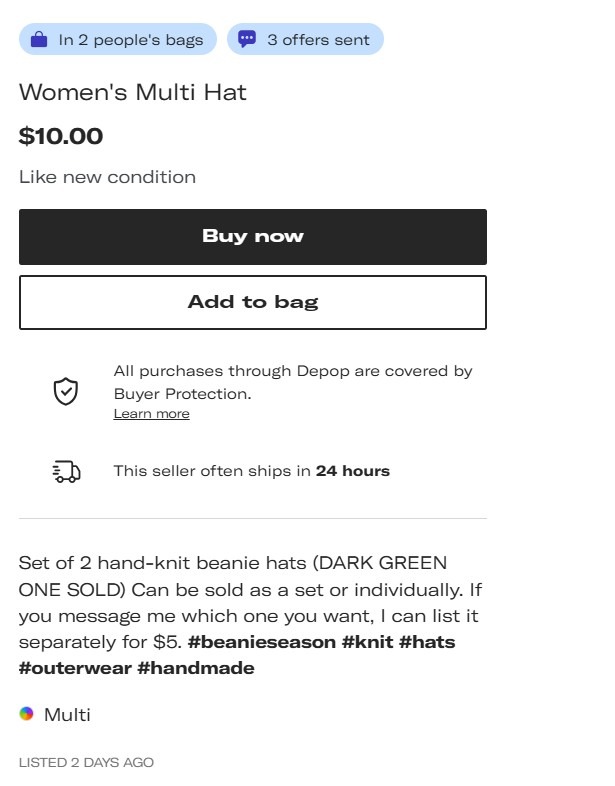
Learn when these items were first listed by looking at the “listed XX days ago” line below the description.
Use this data before you source to know which items buyers demand, and how much they’re potentially worth.
Step 2: Calculate your true costs
Your cost of goods includes what you paid for the item, packaging materials, shipping supplies, and the time you spend listing and communicating with buyers. In the U.S., you pay no Depop commission, only payment processing fees of 3.3% + $0.45 per sale. Divide your total costs by 0.967 and add $0.45 to find your break-even point before you start making a profit.
As of mid-2024 in the U.S., buyers pay a marketplace fee, typically up to 5% of the purchase price + $1. Higher prices mean higher buyer fees, so keep this in mind when setting your listing price to remain competitive.
Step 3: Add markup and negotiation buffer
Add a 100–200% markup plus 20–30% to generate actual profit and buffer for buyer offers, respectively. For instance, a $5 thrift-store shirt should list between $12 and $20 after you factor in all costs and leave room to negotiate.
Tips to make sales fast
Here are a few Depop selling tips that can help you move inventory more quickly:
- Bundle free shipping into the price: Free shipping creates buyer excitement and makes the transaction feel more straightforward and more generous. Calculate your actual shipping cost, add it to your item price, and market the shipping as free.
- Use the sale feature strategically: Depop’s discount tools and ‘sale’ tags can help interested buyers discover your items and may appear in various in‑app or email communications.
- Accept reasonable offers quickly: Set a minimum acceptable price, then respond promptly to fair offers, often in the 5–20% below-asking range. Accepting these offers helps keep stock moving without eroding your margins and gives buyers a smooth experience that can lead to better reviews and greater loyalty.
How to handle shipping
Shipping costs and speed directly impact whether buyers complete purchases and leave positive reviews. Here are the two shipping options that Depop allows:
- Ship with Depop (prepaid labels): Buyers pay for Depop’s USPS-integrated labels, which automatically calculate shipping by weight tier. After purchase, you’ll receive a label or QR code that you stick on the package.
- Self-shipping: If you’re comfortable comparing rates and handling your own labels, buying postage directly from USPS, UPS, FedEx, or similar services can lower costs. Be careful when adding this to the listing price so you don’t damage your margins.
We wrote a breakdown of Depop shipping policies and prices, which you can find here.
5 steps for better shipping
Once an item sells, you’ll want to start the shipping process as soon as possible. Follow these steps:
Step 1: Print labels
Instead of printing paper labels and taping them onto the packaging, invest in a thermal label printer. It prints fast and produces clean, scannable labels that look professional.
Step 2: Choose packaging wisely
Bulk poly mailers are usually low-cost and work well for most soft clothing. Boxes are better for structured, heavy, or fragile items. Avoid excessive padding that wastes money and too little protection that risks damage.
Step 3: Package items professionally
Fold all garment items neatly and consider a slight branded touch, like adding branding labels. Don’t repeatedly message buyers in ways that might feel pushy. Instead, include handwritten thank-you notes that invite honest reviews.
Step 4: Weigh accurately
Don’t guess a package’s weight. Use a digital scale to avoid carrier charge corrections and surcharges, which can be substantial and quickly erode your margins.
Step 5: Ship promptly and communicate
Aim to ship within 1–3 days, even though Depop’s formal allowance is within 10 days of purchase. Faster shipping tends to drive better feedback and repeat purchases. Share tracking and an estimated delivery window so buyers feel informed and are less likely to ask where their order is.
How to get your listings seen by more buyers
Posting regularly and staying engaged with the platform helps push your listings higher in search results, keeping your shop visible to new buyers. Here’s how to keep your listings competitive:
- Focus on relevance and quality: Depop’s algorithm prioritizes how well your listings match buyer searches (titles, descriptions, brand, category, color), plus engagement and seller performance. Focus on building listings that meet buyer demand.
- List consistently, not necessarily daily: A steady outflow of new, well-optimized listings helps keep your shop active and increases your chances of appearing in search and feeds.
- Time your listings strategically, not reactively: Seasonal timing affects search visibility. Post sweaters in summer or swimsuits in winter to catch rising demand before competition peaks. Getting ahead of the curve helps you build presence while the market is less saturated.
- Follow retail lead times: Check what local clothing stores are doing. You’ll notice that they stock merchandise well before customers need it. Apply this same principle to your Depop shop by listing seasonal items months in advance of peak usage.
- Refresh smart, not spammy: When an item stalls, either relist it from scratch or make meaningful edits by providing better photos, clearer titles, and improved keywords or pricing.
- Respond promptly and helpfully: Fast, clear replies to buyer questions help close sales and support good reviews and engagement.
- Engage authentically and grow your inventory: Interact genuinely with your niche and build a page that’s large enough to browse. Need sourcing tips for new inventory? Check out our sourcing guide.
- Understand how to boost Depop listings: Depop's Boost Shop automates promotion across your shop or individual listings, increasing your chances of selling by 25%. New sellers should consider using automatic shop boosting to test items and monitor what gets traction. However, don't boost weak listings; fix titles, photos, and pricing first.
Tips that turn browsers into repeat customers
Building a base of repeat buyers paves the way for long-term profit. Follow these tips to gain a steady stream of repeat customers:
- Offer free seasonal gift wrapping: Include tissue paper and ribbon, especially during the holiday season when buyers shop for others. This small investment makes your packages feel special and memorable.
- Bundle items with combined shipping: Encourage buyers to purchase multiple items by offering combined shipping discounts that reduce their total cost. Promote bundles in your bio and listing descriptions.
- Discount multi-item purchases: Offer 10–15% off to buyers who purchase 2 or more items from your shop. Highlight this deal clearly in your shop policies, so browsers know they can save by buying more.
- Time sales strategically: Run sales during Depop promotional events, holiday shopping seasons, and peak browsing times like weekends. The platform sends notifications to users who saved your items, creating urgency and driving traffic back to your shop when buyers are most ready to spend money.
- Set boundaries on offers: Enable the "Make Offer" button to invite negotiation, but use Depop's auto-decline feature to automatically reject lowball offers. Set your minimum acceptable price to filter out time-wasters while still giving serious buyers room to negotiate.
Common mistakes that kill your sales
Success on Depop also requires that you know what to avoid. Here are some errors new Depop sellers make that slow progress:
- Mixing photo styles and backgrounds: Using different lighting, angles, and backgrounds across your listings makes your shop look unprofessional. Stick to one consistent style and background for every listing so your feed looks cohesive and intentional.
- Underpricing without calculating shipping: Always calculate your actual costs before setting prices, including materials, time, and platform fees.
- Bulk listing instead of daily: Uploading twenty items on Monday and nothing the rest of the week tanks your visibility by Thursday.
- Wasting your first five words: Opening descriptions with "Cute vintage top!" or "Great condition jeans!" wastes precious text. Just use brand names, item types, and sizes. Lead with "Levi's 501 Black Jeans 32x30" to capture the algorithm and buyer attention.
Sell more on Depop with Nifty
Now that you know how to sell on Depop, scale your selling operation and crosslist your Depop products to other platforms. And if you use Nifty, managing all these listings on different marketplaces is a breeze. Nifty’s a crosslisting and automation tool that schedules relisting, manages items, and more.
Here's why over 10,000 sellers use Nifty:
- AI listing: Snap a pic and let Nifty's AI build a high-quality listing, with SEO-optimized titles and descriptions, trending hashtags, and every dropdown already filled out for you.
- Crosslist now: With a couple of clicks, post your items across Depop, Whatnot, Poshmark, eBay, Mercari, and Etsy. (More marketplaces coming soon!) No copy-paste, no multi-tab, it's all in the background.
- Automatic delisting, handled: When you make a sale, Nifty's sales detection auto-delists that item from every marketplace. Say goodbye to double-selling disasters and "sorry, it's already gone" apology messages.
- Bulk tools = no busywork: Share and relist daily with just a few clicks. Update or discount dozens of items at once. You can even schedule drafts to go live while you sleep.
- Analytics and profits are real: Track sales, fees, top performers, and slow movers in one clean dashboard, so you can actually see what's working and what's not.
Nifty pays for itself after just a few weeks. Try a 7-day free trial now.
FAQs
1. What sells best on Depop in 2026?
Vintage Y2K fashion, streetwear from brands like Nike and Adidas, and unique accessories sell fastest on Depop. Gen Z and young Millennial buyers demand thrifted finds, trending styles, and one-of-a-kind pieces. Designer items and rare collectibles also perform well if priced competitively. Focus on items with strong visual appeal and cultural relevance.
2. How should I price my items on Depop?
Price your items on Depop by calculating your total costs (item, packaging, any shipping you cover, and a value for your time), then adding between 120% and 230% to cover costs and discounts. Cross‑check against sold listings in your niche so your price sits within a realistic range.
3. How do I get more views on my Depop listings?
Get more views on Depop by listing new items daily to keep your shop active. Periodically improve older or poorly-performing listings with better photos, clearer titles, and stronger keywords to bump them. Respond to buyer messages as quickly as is practical, since fast, helpful replies support conversions and good reviews.