
Nifty vs. Crosslist: How to pick the best tool (2026)

When comparing Nifty vs. Crosslist, both tools cover the basics of crosslisting and reseller automation, but their features differ in several important areas.
Nifty stands out for its cloud-based automation, AI features, and built-in analytics. Crosslist offers wider marketplace support and a lower starting price for crosslisting, making it a practical option for sellers on a budget who want to list across more marketplaces.
I’ll break down Nifty and Crosslist’s pricing, supported marketplaces, automation tools, AI features, and analytics so you can decide which tool fits your resale business.
Nifty vs. Crosslist: What’s the difference?
Nifty is cloud-based crosslisting software with built-in automation, AI listing tools, photo editing, inventory management, and sales analytics.
Crosslist is a crosslisting and automation tool that supports 11 marketplaces, with universal listing tools, background autoposting, bulk editing, and optional AI features.
Choose Nifty if you want built-in AI tools, bulk crosslisting, cloud-based automation, and detailed seller analytics.
Choose Crosslist if you prioritize wider marketplace coverage and want to crosslist across up to 11 platforms.
Nifty vs. Crosslist: At a glance
| Category | Nifty | Crosslist |
|---|---|---|
| Best for | Automation, AI tools, analytics, and multichannel selling | Broad marketplace coverage and straightforward crosslisting |
| Crosslisting and marketplace support | 6 marketplaces | 11 marketplaces, including Vinted, Grailed, Shopify, and WooCommerce |
| Automation | Cloud automation across four major resale marketplaces | Background autoposting and one-click relisting; requires computer to remain on |
| Inventory management and auto-delisting | Tracks inventory and, with auto-delisting turned on, delists sold items automatically | Sales detection on all plans; auto-delisting on Gold and Diamond plans |
| AI listing tools + photo editing | AI listing creation with SEO and built-in photo editing | AI listing creation, suggested pricing, background removal, and photo editing |
| Analytics | Tracks sales, profits, margins, and marketplace trends | Revenue, profits, margins, and marketplace trends |
| Starting price | $25/month | $29.99/month |
| Overall advantage | Strong automation, AI tools, and seller analytics | Wider marketplace support and lower-cost multichannel crosslisting |
What is Nifty?
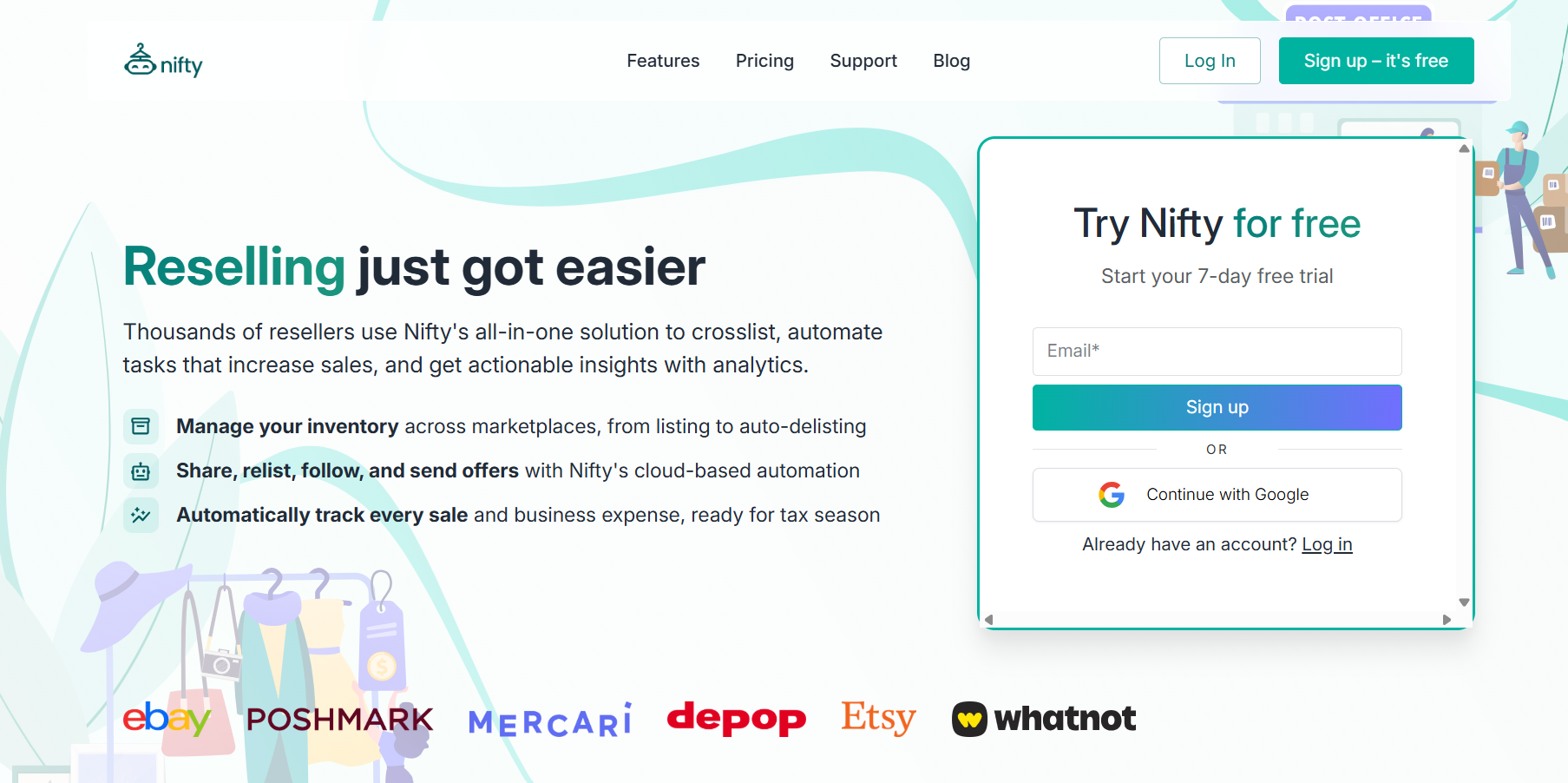
Nifty is cloud-based software that helps resellers list, configure, and manage inventory across 6 marketplaces. Sellers also get automation features, image-editing tools, and detailed sales reporting.
What is Crosslist?
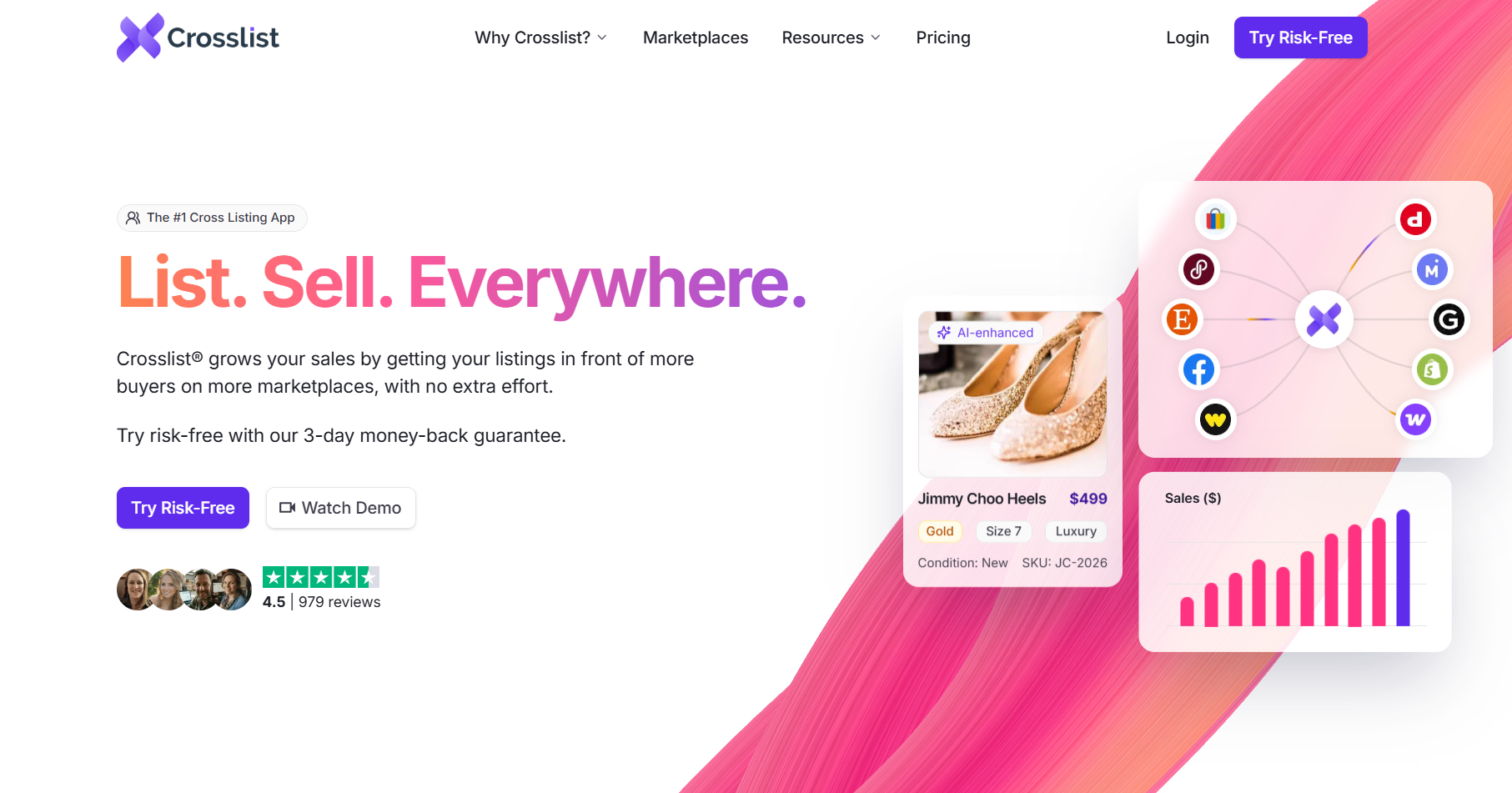
Crosslist helps resellers crosslist and manage inventory across 11 marketplaces. It offers background autoposting, bulk editing, listing templates, and CSV tools on select plans. An optional AI add-on creates listings from photos, edits product images, and suggests pricing.
Nifty vs. Crosslist: Pricing
Both Nifty and Crosslist offer several pricing options that suit sellers of all sizes, from folks just getting started to seasoned vets with 1,000+ new monthly listings. Let's look at the pricing plans.
Nifty pricing
| Plan | Monthly price | Included features |
|---|---|---|
| Poshmark or eBay Automation | $25 | Automates one marketplace through the cloud, including relisting and offers. Poshmark users also get automated sharing and following. |
| Full Automation | $39.99 | Runs automated selling tasks across Poshmark, eBay, Mercari, and Depop. |
| Crosslisting Plus | $39.99 | Covers 1,500 active listings and provides 500 Smart Credits for AI tools and Photoroom. |
| Crosslisting Pro | $59.99 | Raises listing capacity to over 1,500 items and provides 1,000 Smart Credits for AI features. |
| Bundle Plus | $69.99 | Pairs Full Automation with Crosslisting Plus, covering 1,500 active listings and 500 Smart Credits. |
| Bundle Pro | $89.99 | Pairs Full Automation with Crosslisting Pro, adding more listing capacity and 1,000 Smart Credits. |
Nifty splits its subscriptions into 3 groups: Automation, Crosslisting, and Bundles. Each option comes with a 7-day free trial.
Sellers who mainly use Poshmark or eBay can start with a single-marketplace Automation Plan for $25/month. It includes Nifty’s main automation features for one selected marketplace.
Full Automation costs $39.99/month and covers Poshmark, eBay, Mercari, and Depop. The plan includes Poshmark sharing, relisting, following, and automated offers, plus automation for eBay, Mercari, and Depop.
Crosslisting plans begin at $39.99/month with Crosslisting Plus, which is designed for sellers who manage listings across several marketplaces.
Crosslisting Pro costs $59.99/month and raises the closet limit to above 1,500 items while providing 1,000 AI Smart Credits per month. Both Crosslisting plans include bulk editing and automatic sales detection, so sold items can be removed from other connected marketplaces once you turn on auto-delisting.
Bundle Plus costs $69.99/month, while Bundle Pro costs $89.99/month. These plans target higher-volume sellers by combining automation, crosslisting, AI features, and bulk editing in one subscription.
AI Smart Credits refresh monthly and do not carry over. Nifty also offers 200-credit packs for $5. One credit covers either an AI-generated listing or a background removal, while purchased credits expire after 90 days.
Crosslist pricing
| Plan | Monthly price | Included features |
|---|---|---|
| Bronze | $29.99 | Adds up to 200 new listings per month. Add 200 AI credits for $4.99/month. |
| Silver | $34.99 | Adds up to 500 new listings per month. Add 500 AI credits for $4.99/month. |
| Gold | $39.99 | Adds up to 1,000 new listings per month. Add 1,000 AI credits for $4.99/month. |
| Diamond | $44.99 | Includes unlimited listings. Add 2,000 AI credits for $4.99/month. |
Crosslist has 4 subscription tiers priced from $29.99 to $44.99 per month. Quarterly billing cuts the subscription price by 10%, while annual billing gives you 2 months free compared with paying monthly. The optional AI add-on costs a flat $4.99 per month regardless of your plan or billing cycle.
All four plans include the same main features, including support for 11+ marketplaces, bulk editing, and manual delisting. The primary difference between tiers is the number of listings each plan supports.
Instead of a free trial, Crosslist provides a 3-day money-back guarantee. This period is shorter than the 7- or 14-day trials available from many other multi-channel listing tools. Crosslist also requires credit card details before you can start using the software.
The refund policy comes with specific conditions. You must create fewer than 20 listings and request a refund from support within 72 hours of purchasing your plan. Annual subscription refunds also carry a $9.99 processing fee.
Pricing winner
Nifty wins on pricing because its entry plan starts at $25/month, compared with Crosslist’s $29.99/month starting price. It includes AI credits baked into select plans, while Crosslist charges an extra $4.99/month for its AI add-on.
Plus, Nifty offers a 7-day free trial. Crosslist requires payment details upfront and provides a 3-day money-back guarantee with usage restrictions. If you dislike your Crosslist experience, you’ll need to take the time to reach out to its team to request a refund.
Nifty vs. Crosslist: Crosslisting and marketplace support
| Feature | Nifty | Crosslist |
|---|---|---|
| Marketplace support | Connects with Whatnot, Poshmark, eBay, Mercari, Depop, and Etsy | eBay, Poshmark, Vinted, Facebook Marketplace, Depop, Mercari, Grailed, Shopify, Etsy, Whatnot, WooCommerce |
| Bulk crosslisting | Publishes up to 25 listings per action | Bulk publishes listings across multiple marketplaces |
| Bulk listing tools | Pricing rules, shipping presets, and AI listing creation | Templates, price adjustments, shipping profiles, bulk editing |
Nifty crosslisting
Nifty’s Crosslisting and Bundle Plans connect with 6 marketplaces, including:
- Whatnot
- Poshmark
- eBay
- Mercari
- Depop
- Etsy
The Nifty team added Whatnot support in May 2026. Nifty has more marketplace integrations planned.
Standard plans support up to 1,500 active listings, while Crosslisting Pro and Bundle Pro raise those limits for larger inventories. Nifty lets you manage connected listings from one command center.
Bulk publishing lets you post up to 25 listings at once. Nifty can apply marketplace-specific pricing rules, shipping presets, and AI-generated titles and descriptions during the process.
If you’re primarily an eBay seller looking to crosslist, you can create listings directly in Nifty or import inventory from eBay before publishing across connected marketplaces.
Crosslist crosslisting
Crosslist supports listings across the following 11 marketplaces:
- eBay
- Poshmark
- Vinted
- Facebook Marketplace
- Depop
- Mercari
- Grailed
- Shopify
- Etsy
- Whatnot
- WooCommerce
Crosslist uses one universal listing form to create a listing and publish it across multiple marketplaces. Sellers can also save reusable templates that pre-fill common listing information.
The template system has some limits, though. For instance, when I tried Crosslist, I wasn’t able to create custom fields, which added time to my listing process for items that need extra listing details.
The universal form also supports marketplace-specific settings, so sellers can configure relevant details for each selected sales channel before publishing.
Crosslisting winner
Crosslist wins for marketplace coverage because it connects to 11 marketplaces, compared with Nifty’s 6. It also covers platforms Nifty lacks, including Vinted, Grailed, Shopify, and WooCommerce.
But if you prioritize bulk listing over marketplace coverage, Nifty has the edge. It offers better bulk publishing, letting you post up to 25 listings at once with pricing rules, shipping presets, and AI-generated listing details.
Nifty vs. Crosslist: Automation
| Automation feature | Nifty | Crosslist |
|---|---|---|
| Cloud automation | Runs in the cloud without keeping devices on | Limited; autoposting and most autodelisting require your computer running |
| Marketplace coverage | Automates Poshmark, eBay, Mercari, and Depop | Multichannel autoposting and one-click relisting |
| Poshmark tools | Automates sharing, following, relisting, and offers | One-click delisting and relisting; no sharing, following, or offer automation |
| Sales detection | All crosslisting and bundle plans | All plans; auto-delisting only on Gold and Diamond plans |
| Plan options | Choose individual marketplace or bundled automation plans | Some automation included with all plans |
Automation is a tool's ability to send offers, refresh listings, and like, follow, and share on Poshmark without user intervention (besides scheduling when the automation happens).
Nifty automation
Nifty runs automation in the cloud, so tasks can keep running without an open browser or powered-on computer. You manage these actions from one dashboard instead of relying on separate browser extensions. The tool allows you to schedule when automations will take place.
Sellers can choose a dedicated eBay Automation or Poshmark Automation Plan. The eBay option handles relisting and automated offers. The Poshmark plan adds sharing, following, relisting, and offer sending, so you don’t need a separate Poshmark bot.
For multichannel sellers, Nifty’s Full Automation Plan covers Poshmark, eBay, Mercari, and Depop. It combines the eBay and Poshmark features with relisting and offer automation for Mercari and Depop, all from one cloud-based dashboard.
Nifty offers sales detection and opt-in auto-delisting on its bundle and crosslisting plans.
Crosslisting and Bundle Plans add separate inventory features, including automatic sales detection, auto-delisting, and scheduled publishing. Because these tools also run in the cloud, sold items can be detected and, with auto-delisting turned on, removed from other marketplaces even when your computer is off. Sellers can also schedule listings to publish at chosen times.
Crosslist automation
Crosslist automates several repetitive selling tasks. Its autoposting publishes listings to your selected marketplaces in the background, and one-click delisting and relisting helps keep stale listings fresh. Crosslist also supports marketplace-specific listing settings and lets sellers adjust prices or markups by marketplace.
Crosslist doesn't automate Poshmark sharing, following, or offers. Autoposting can continue in the background while you do other work, but your computer must remain running until the process finishes.
The tool detects sales on every plan, but auto-delisting is only available on the Gold and Diamond Plans.
Crosslist's current documentation describes immediate and queued background posting. But it doesn’t mention any features for scheduling listings to publish at specific future times.
Automation winner
Nifty offers broader automation across four marketplaces and runs tasks entirely in the cloud. Unlike Crosslist, it doesn’t require your computer to stay on. It also supports scheduled automation, relisting, offers, sharing, following, and scheduled publishing.
Nifty vs. Crosslist: AI tools, photo editing, and analytics
| Feature | Nifty | Crosslist |
|---|---|---|
| AI listing creation | Generates titles, descriptions, tags, sizing, color details | Generates titles, descriptions, tags, attributes, and suggested prices |
| Photo editing | Crops, rotates, adjusts brightness, filters, frames images | Built-in editing plus AI-generated and AI-edited product photos |
| Background editing | Photoroom removes backgrounds, creates ghost mannequin effects | Unlimited AI-powered background removal |
| Sales analytics | Tracks sales, margins, inventory, profits, and losses | Tracks revenue, fees, expenses, margins, sales trends |
| Analytics access | Available with Crosslisting and Bundle subscription plans | Available only with Gold and Diamond subscription plans |
AI tools speed up listing creation by generating titles, descriptions, and product details. Built-in photo editing tools let you crop and spruce up listing images without switching software, while analytics shows how your inventory performs across marketplaces.
Nifty AI tools, photo editing, and analytics
Nifty’s AI creates SEO-focused titles, descriptions, tags, sizing information, and color details from product photos. You can give it extra instructions or choose a writing style, though it can generate listings without additional prompts.
Crosslisting and Bundle plans come with built-in photo editing tools for cropping, rotating, adjusting brightness, applying filters, adding annotations, and framing images.
The tool also integrates with Photoroom for image editing. You can remove backgrounds or apply a ghost mannequin effect to clothing photos without photographing items on a model.
Nifty also provides detailed sales analytics for tracking performance across marketplaces. It imports orders, calculates profit margins, and creates charts and reports showing top-selling inventory and sources of profits or losses.
The analytics tools can also generate profit and loss statements, giving you organized financial data for bookkeeping and tax preparation. Nifty provides analytics on its crosslisting and bundle plans.
Crosslist AI tools, photo editing, and analytics
Crosslist offers an optional $4.99/month AI add-on with every subscription tier. Its AI can generate titles, descriptions, categories, tags, product attributes, and suggested prices from uploaded photos. You can also customize your descriptions to match a specific tone and set your preferred description length. It also fills missing fields in existing listings.
The tool has AI background removal and photo editing. Its editor includes cropping, filters, fine-tuning, and image adjustments that help prepare product photos for marketplace listings.
Just like with Nifty, Crosslist’s analytics suite brings sales data from connected marketplaces into one dashboard. You can track revenue, fees, expenses, estimated profit, profit margins, and sales trends. But sales analytics is available on the Gold and Diamond plans only.
AI tools, photo editing, and analytics winner
Nifty wins by a narrow margin for its combined listing, photo, and analytics toolkit. Plus, AI features come baked into Nifty’s Crosslisting and Bundle plans, and you don’t need to worry about purchasing an extra add-on. Both tools can use AI to generate detailed listings from photos, while Crosslist also offers AI pricing and photo-generation tools.
Nifty also stands out for its Photoroom integration and more detailed financial reporting, including profit and loss statements.
Nifty vs. Crosslist: What users say
I searched Reddit, Facebook, and Trustpilot, looking for pros and cons about Nifty and Crosslist. Here’s what I found:
Nifty pros
- A Nifty user shared that the AI listing tool keeps improving and produces titles, descriptions, and tags that require little editing. (August 5th, 2026)
- Another Nifty seller said that the tool helped diversify their sales while AI automation doubled listing output, which they said justified the premium plan’s cost. (May 11th, 2026)
Nifty cons
- One user reported that although they like Nifty for crosslisting, they see fewer sales when using its automated sharing, offer, and relisting features. (February 14th, 2026)
- A user complained that Nifty generated incorrect clothing sizes, which created more manual work. (August 11th, 2026)
Crosslist pros
- A reviewer credited Crosslist’s AI listing tools with speeding up their workflow and helping them nearly triple their sales. (June 23rd, 2026)
- A seller who has used Crosslist for 3 years said they’ve been very satisfied with the tool and called its recently added delisting update fantastic. (May 31st, 2026)
Crosslist cons
- One user didn’t like Crosslist’s delisting limitations and switched to Nifty. (August 11th, 2026)
- A reviewer said that Crosslist reversed a refund because of their account usage and support interaction, and that they lost account access without receiving the refund. (June 23rd, 2026)
My final verdict: Which tool should you choose?
Now that you’ve learned the biggest difference between Nifty vs. Crosslist, here’s how to select the best fit:
Choose Nifty if you ...
- Want several seller tools in one, such as crosslisting, automation, and AI features.
- Create listings in high volumes and need AI-generated titles, descriptions, tags, sizing, and other product details to reduce manual entry.
- Sell heavily on Poshmark and want cloud-based sharing, following, relisting, and offer automation without leaving your computer running.
Choose Crosslist if you ...
- Are new to reselling and want a light crosslisting tool that starts below $30/month.
- Sell part-time with a smaller inventory and want basic tools for marketplaces like Poshmark, Mercari, and eBay.
- Need to crosslist on more than 6 marketplaces.
Nifty: The best Crosslist alternative
If you’re comparing Nifty vs. Crosslist, the right choice comes down to what matters more: Marketplace coverage or automation. Crosslist supports more marketplaces, but Nifty gives you cloud-based automation, bulk crosslisting, AI-powered listing creation, auto-delisting, and detailed seller analytics in one interface.
Here’s why sellers in the U.S., UK, Canada, and Australia choose Nifty:
- Customized AI listing: Upload a photo and let Nifty’s AI generate SEO-focused titles, descriptions, tags, sizing, color details, and other listing information. You can also give the AI extra instructions or customize the writing style to match your listings.
- Crosslist now: Publish your inventory across Whatnot, Poshmark, eBay, Mercari, Depop, and Etsy from one dashboard, with more marketplace support planned.
- Bulk crosslisting: Publish up to 25 listings at once while applying marketplace-specific pricing rules, shipping presets, and AI-generated listing details. Create listings in Nifty or import them from eBay before crosslisting.
- Marketplace-specific pricing rules: Save pricing rules for individual marketplaces and apply them during bulk crosslisting, so you don’t have to adjust prices listing by listing.
- Automatic delisting? Handled: Nifty detects sales and, once you turn on auto-delisting, automatically removes sold inventory from your other connected marketplaces, reducing the risk of double-selling an item.
- Bulk tools = less busywork: Automate repetitive reseller tasks such as sharing, relisting, following, and sending offers. You can also schedule listings to publish at selected times.
- Analytics and profits are clear: Track sales, fees, margins, inventory performance, profits, and losses from one dashboard. Nifty can also generate reports and profit-and-loss statements to help with bookkeeping.
If Crosslist’s broader marketplace coverage is your top priority, it may be the better fit. But if you want to spend less time manually creating, crosslisting, updating, and managing listings, Nifty gives you more automation. Start with a 7-day free trial of Nifty and see whether it fits your reselling workflow better than Crosslist.
FAQs
1. Which AI tool is better, Nifty’s or Crosslist’s?
Although Nifty’s AI and Crosslist’s AI both generate detailed listings from product photos, including titles, descriptions, tags, and product attributes, Nifty’s is better because it can generate ghost mannequin effects to improve listing photos.
Nifty includes AI features with its Crosslisting and Bundle plans, while Crosslist charges $4.99/month for its optional AI add-on. Crosslist also offers suggested pricing and AI photo-generation tools.
2. Does Crosslist have an app?
Yes, Crosslist has a dedicated mobile app that’s available for iOS and Android. It lets you create, import, edit, and crosslist inventory from your phone or tablet, with your account synced across mobile and desktop. However, some marketplace-specific functions still rely on Crosslist’s Chrome extension and an active desktop browser session.
3. How does Vendoo compare to Crosslist?
Both Vendoo and Crosslist connect to over 10 marketplaces and include built-in sale detection and auto-delist features. Vendoo has more in-depth AI listing generation than Crosslist, but it also works as a Chrome extension for automation, so you’ll need to keep your machine on for Poshmark actions, as well as relisting and delisting across other marketplaces.


.png)
.png)
.png)