
Is eBid legit for sellers? My review & marketplace analysis | 2026
.png)
Yes, eBid is a legit marketplace, but it has far fewer active buyers than eBay, Poshmark, or Depop.
Here’s my review of eBid, how much it costs to use the platform, and my selling experience so you can determine if listing on this platform is worth your time.
Is eBid legit? The 30-second verdict
Yes, eBid is a legit marketplace founded in 1998 that began operations in 1999. But it has a low number of monthly visitors and listings. eBid is a dying marketplace, and I recommend avoiding it.
What is eBid?
eBid is an online auction and fixed-price marketplace that’s an alternative to platforms like eBay.
When you join eBid, you subscribe to a specific account. The platform offers the following 4 account tiers:
| Tier | Pricing | Key features |
|---|---|---|
| Free Tier | Free | Buyer-only account; no selling or listings allowed |
| Silver Tier | Free | Up to 5 active listings; 5% final value fee; 1 free photo/listing; extra photos or $0.05/photo; Auction-only by default; BuyNow unlocked via $0.05 Platinum Listing upgrade per item |
| Gold Tier | $9.99/month | 2% final value fee on Gallery listings (listing itself is free; Gallery adds a search thumbnail and up to 15 photos); Up to 100 active listings;5 free photos/listing (15 for Gallery listings); Buy It Now options; Google Shopping exposure; eBid bulk tools |
| Platinum Tier | $139.98 lifetime ($69.98 early signup) | All Gold features; 5 shops; 20 photos/listing; Bing Shopping support; advanced seller tools |
Platinum Tier: Unpacked
Platinum Tier membership is available for $139.98 lifetime, or half that at $69.98 if you upgrade within 24 hours of creating your account. Building on everything included in Gold, the Platinum Tier expands your operation to 5 shops plus 20 photos/listing.
The Platinum Tier also adds Bing Shopping support, product imports, and advanced seller tools, with a 2% final value fee applying to Gallery listings. Free listings carry a 0% final value fee, meaning no fee on a completed sale.
You can also purchase the following “à la carte” features for your listings:
- Extra photo ($0.05): Upload additional photos to your auction listings.
- Extra category ($0.05): Display your listing in another category for more visibility.
- Bold ($0.07): Make your auction title stand out in search results.
- Subtitle ($0.15): Add extra descriptive text under your main auction title.
- Highlight ($0.18): Highlight your entire auction row across category listing pages.
eBid’s key features
eBid offers features that help listing visibility in search result pages as well as seller tools that simplify the listing process. Here’s a breakdown of eBid’s key features:
- Auction and fixed-price listings: Sellers can run auctions or set fixed prices for Gold and Platinum plans.
- Mobile app: Download the eBid app from the Apple App Store or Google Play Store to sell on mobile.
- Low final value fees: eBid charges lower final value fees than eBay. Depending on the plan and listing type, fees range from 0% to 5%.
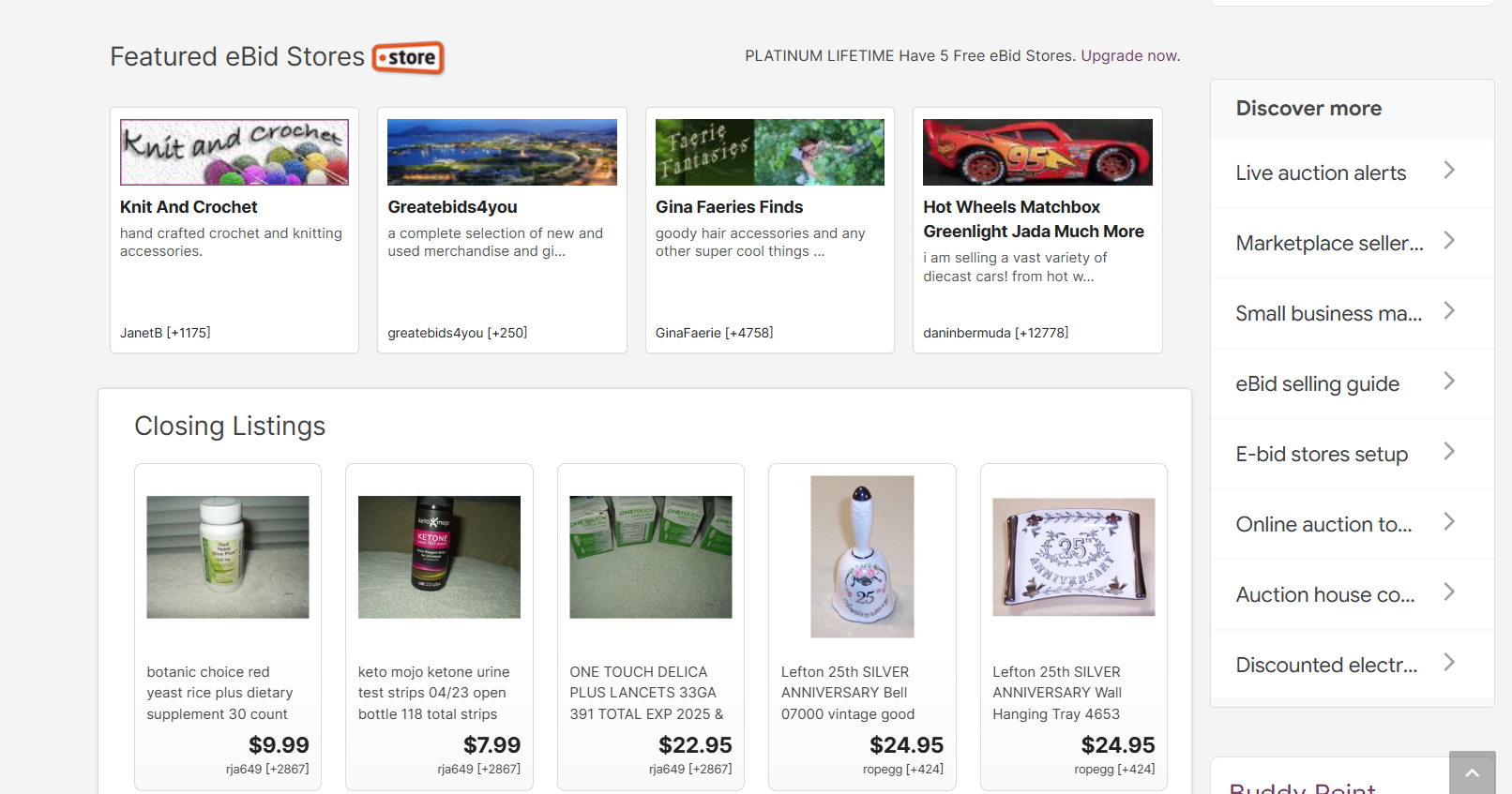
- Basic storefront setup: Similar to Etsy, sellers can build a branded page that appears like a real store.
- Global selling support: eBid is available in over 20 countries, allowing you to reach buyers in different markets.
- Google Shopping + Bing Shopping: Expose your items to more buyers. If you subscribe to the Gold Plan, your listings can appear on Google Shopping. The Platinum Plan adds Bing Shopping.
- eBid bulk tools: Sellers can upload and manage inventory all at once instead of creating listings one at a time. The eBid Ninja Lister lets sellers create listings offline and use bulk edit tools to update shipping settings. Spreadsheet bulk uploads let sellers add inventory quickly through tab-delimited files.
- Advanced tools: Developers have access to the eBid API and Developer Portal to automate listings, inventory management, and order handling.
What users are saying about eBid
I reviewed sources from Reddit, Trustpilot, the Google Play Store, and Apple App Store to see what real users had to say. It was hard to find recent reviews of eBid, which may suggest the platform has lower activity and a smaller active seller community than larger marketplaces.
eBid pros
- One user said that eBid is a great place to buy and sell. (January 16th, 2026)
- A stamp seller said they’ve had success on eBid, mentioning that if you list more items, you have a higher chance of making sales. (February 22nd, 2025)
- An eBid seller noted that the eBid app is great and far more affordable than eBay. (December 5th, 2019)
eBid cons
- One seller stated that eBid doesn’t have the same reach as platforms like eBay. They’ve used eBid for 8 months yet only sold 4 items. (December 28th, 2025)
- An eBid seller noted that they used the platform under the Platinum Plan, listed over 100 items, yet never made one sale. (December 18th, 2025)
- Another seller said they’ve had discount clothing listed for years and have only sold one item. (February 21st, 2025)
My personal take on eBid
I signed up for the eBid Silver Plan and listed 5 zip-up hoodies. Here’s my experience with the platform:
What I liked about eBid …
- Onboarding is simple: Although the old interface screamed “1999 Geocities,” I created my shop, uploaded my product photos, and posted my hoodies in about 30 minutes.
- The fee model is different: Although I didn’t sign up for it, eBid’s lifetime seller plan is one of the platform’s biggest advantages. Sellers pay once and can reduce or avoid many ongoing selling fees.
What I didn’t like about eBid …
- Traffic is a real problem: My experience on eBid matched what reviewers said about listings not selling. No one viewed my hoodies in a 3-month span.
- User trust is weaker than major marketplaces: Platforms like eBay and Poshmark already have strong buyer trust and attract over 100 million monthly users. eBid doesn’t have the same level of user trust or brand recognition.
- The mobile app is outdated: I downloaded the eBid app from the Play Store, which hasn’t received an update since 2019 (the same is true for the Apple App Store). The app crashed three times when I was browsing for competitor products.
The best eBid alternatives: At a glance
| Platform | Best For | Fees | Users | Key trade-off |
|---|---|---|---|---|
| eBay | High-volume, general selling | 10–15% + $0.30–$0.40 per item | 136 million active buyers worldwide | Fees cut margins significantly |
| Mercari | Fast, mobile-first casual sales | 10% final value fee | 20 million+ active users | Limited pricing flexibility |
| Whatnot | Live auctions, collectibles, fast turnover | 4–8% commission + 2.9% + $0.30 processing | 20 million+ new accounts (2025) / 14.26M monthly visits | Requires live streaming and daily engagement |
| Poshmark | Fashion, community-driven sales | 20% on sales $15+; $2.95 flat fee under $15 | 130 million users across North America | Category restricted to fashion |
| Depop | Vintage, streetwear, trend items | 3.3% + $0.45 payment processing fee (U.S. sellers) | Over 56 million worldwide users | Needs active engagement daily |
The eBid alternative you choose depends on whether you prefer live streaming, buy-it-now listings, or silent auctions. Here’s an in-depth look at each eBid alternative:
- eBay: The OG of reselling, eBay started in the late 1990s and is the better option for sellers who care more about sales volume than lower fees. Buyers already trust the platform, which helps products sell faster and convert more consistently.
- Mercari: This platform works best for sellers who list clothing, electronics, home goods, and other everyday items. Buyers come to the platform to find deals, so be prepared to haggle. But sales often come more quickly than on other platforms.
- Whatnot: This marketplace focuses on live-stream selling for collectibles such as trading cards, coins, and niche products. Although you can still list buy-it-now items, sellers who host live streams have the most success.
- Poshmark: Built mainly for clothing, shoes, and accessories, Poshmark features a social-sharing system that helps sellers gain visibility without paying for ads. You can also host live shows to reach more buyers.
- Depop: Young millennials and Gen Z buyers come to Depop for vintage clothing, streetwear, and fashionable items. Like Poshmark, sharing and following help gain visibility.
Final verdict: Is eBid right for you?
eBid is an old marketplace with very little activity compared to other platforms. Here’s how to determine whether eBid works for you:
Try eBid if you …
- Sell rare or niche items: If you sell rare collectibles, like vintage thimbles or antique telegraph insulators, you might be able to find some buyers on eBid. One reviewer who sells stamps has had some success on eBid.
- Want a simple, low-stakes platform to test the waters: eBid asks very little upfront (only $9.99/month for the Gold Tier), so testing the platform carries very little financial risk.
Avoid eBid if you …
- Want a modern, updated platform: Even the desktop version appears dated, and navigation is clunky and ridden with too many clicks. The team also hasn’t updated its mobile app since 2019.
- Actually want to make money: Listing on eBid instead of a larger marketplace may waste your time because the platform attracts very little buyer traffic.
Sell more with Nifty
Now that you know eBid is legit but limited, why not try some of the eBid alternatives like eBay or Poshmark? These platforms reach millions of buyers. As your listings grow, consider adopting Nifty, a crosslisting and automation tool that lets you manage your items on all of your marketplaces from one interface.
Here’s why Nifty’s so helpful:
- Customized AI listing: Snap a pic and let Nifty's AI build a complete listing with SEO-optimized titles, descriptions, and trending hashtags already filled in. You can customize it to match your style and even set shipping presets.
- Crosslist now: Post across Whatnot, Poshmark, eBay, Mercari, Depop, and Etsy in a couple of clicks. No copy-paste, no tab switching.
- Automatic delisting? Handled: When a sale comes in, Nifty auto-delists that item from every marketplace. No double-sells, no awkward apology messages.
- Bulk tools, no busywork: Share, relist, and schedule listings in minutes. Set automatic discounts that deepen over time while you do something else.
- Analytics that actually tell you something: Track sales, fees, top-performing products, and stale listings in one dashboard. Set seller goals and watch them from your home screen.
Nifty pays for itself fast in just a few weeks. Start with a 7-day free trial and find out how you can reach more buyers on eBid alternatives with less manual work.
FAQs
1. Can you actually sell items on eBid?
Yes, you can actually sell items on eBid. The Silver tier (free to join but requiring card validation) allows up to 5 active listings. The Gold tier ($9.99/month) supports up to 100 listings, and the Platinum tier ($139.98 lifetime) supports unlimited listings. However, low buyer traffic means most listings receive minimal views and inconsistent sales, reducing your chances of steady revenue from eBid.
2. Why is eBid so cheap compared to eBay?
eBid is so cheap compared to eBay because sellers pay the platform a monthly fee with low transaction fees. Plus, eBid’s fee structures are less complex than eBay’s. But the trade-off is far lower buyer demand, which limits sales and reduces overall return on investment.
3. Is eBid better than eBay?
No, eBid is not better than eBay. eBay has significantly more traffic, better trust signals, and higher conversion potential. These advantages make eBay the more effective platform for sellers who want to avoid slow-moving inventory and earn consistent revenue.


.png)
.png)
.png)